


Trichocereus serpentinus | Live plant
Trichocereus serpentinus is an unusual Bolivian-Peruvian cactus with exceptionally slender, scrambling to pendent stems, numerous low ribs, short reddish-brown to whitish spines and enormous white flowers. Our original plant came to us through Alex after several years of searching for this uncommon species. We maintain it clonally, separately from our documented Peruvian locality seed lines.
Currently unavailable.
Product Features
Trichocereus serpentinus is one of the more unusual species in our collection: a remarkably slender, scrambling to trailing cactus from Bolivia and Peru whose mature stems can snake through surrounding vegetation, creep across rocky ground or hang from steep slopes. Its extraordinary growth habit and disproportionately large white flowers make it quite unlike the familiar upright columnar Trichocereus.
We spent several years trying to obtain genuine material before our original plant finally reached us through Alex, to whom considerable thanks are due. We have maintained that plant clonally ever since, alongside our separately sourced locality seed lines of the species.
Growth & appearance
T. serpentinus develops long, narrow, light to mid-green stems which can reach approximately two metres in length while remaining only around 1.4–2.5 cm thick. Their slender, comparatively flexible structure means that the stems cannot maintain the rigid, self-supporting architecture associated with most columnar Trichocereus.
Plants generally develop ten to twelve relatively low ribs, with small, closely spaced areoles. These carry numerous slender, needle-like spines, typically including shorter radial spines and somewhat longer central spines. Their colouring varies from whitish and tan to reddish-brown, with the longest central spines sometimes reaching approximately 2 cm.
Its unusual architecture becomes increasingly obvious as the stems lengthen. In habitat they scramble through other vegetation, extend over rocky slopes or hang from near-vertical surfaces. Under cultivation, they can be allowed to trail, provided with suitable support or positioned so that their naturally pendent growth has sufficient room to develop.
Flowers & fruit
Mature T. serpentinus produces remarkably large white flowers, approximately 20–22 cm long and around 10 cm in diameter. The flowers open in the evening and are particularly impressive when viewed against the exceptionally narrow stems which support them.
The floral tube is elongated and carries prominent scales and dark hairs, while the white inner petals are comparatively narrow and pointed. The overall flower structure is substantially different from the shorter, more widely opening blooms of some related species.
Following successful pollination, the plant produces globose to shortly ovoid fruit with a strongly tuberculate surface, prominent scales and hairs. This distinctive fruit morphology was among the characters documented in the original botanical description.
Native range
T. serpentinus is native to Bolivia and neighbouring southern Peru, particularly the deeply dissected Andean valleys of the Apolobamba region around northern La Paz and Sandia in Puno.
The type specimen, Mendoza 3369, was collected by Moisés Mendoza below the village of Camata in Muñecas Province, La Paz, Bolivia, on 10 November 2008. Plants occur on steep, rocky valley slopes, among relatively open vegetation and on near-vertical rock faces, where their narrow stems naturally become pendent.
Peruvian populations are documented from the Sandia area. Our separate T. serpentinus ‘PH 1005.02’ seed line continues Paul Hoxey locality material from around Sandia at approximately 2,100 m, while his earlier PH 718.01 collection was recorded nearby at approximately 2,270 m. These locality accessions are maintained separately from our original cultivated clone.
A recently described species
Despite its distinctive appearance, T. serpentinus entered the formal botanical literature relatively recently. Martin Lowry and Moisés Mendoza described the species as Echinopsis serpentina in CactusWorld in 2011, using Bolivian material including Mendoza 3369 from Camata. The combination Trichocereus serpentinus was published by Alessandro Guiggi in 2012.
The plant had been encountered several years before publication. Lowry and colleagues observed the unusual cactus in Bolivia in 2003, while Paul Hoxey subsequently documented a population near Sandia in Peru in 2009. His discovery of mature fruit and seeds provided important additional material for the formal description.
The specific epithet refers to the snake-like appearance of the long, slender stems as they extend through surrounding vegetation and across the ground. It is an unusually appropriate name for a cactus whose natural growth bears little resemblance to the upright columns usually associated with the genus.
Relationship with other trailing Trichocereus
The slender, sprawling habit makes T. serpentinus unusual within Trichocereus. One of its most important botanical comparisons is Trichocereus vasquezii, a Bolivian species with which it shares several morphological characteristics.
The original description distinguished T. serpentinus from T. vasquezii through its longer, narrower and strongly decumbent stems, more numerous but generally shorter spines, comparatively narrow flowers and strongly tuberculate fruit. T. vasquezii, by contrast, develops shorter, thicker and more upright stems, with less conspicuously tuberculate fruit.
Another useful comparison is Trichocereus hahnianus, a creeping species from Paraguay which shares the general trailing habit but differs in its ribbing, spination, flowers and geographic distribution. Morphological resemblance should not be mistaken for a particularly close evolutionary relationship: molecular comparisons discussed in the original description did not establish either species as an immediate relative of T. serpentinus.
Our guide to creeping, sprawling and pendent Trichocereus explores these unusual growth forms further, including T. arboricola, T. hahnianus, T. serpentinus and T. vasquezii.
T. serpentinus remains readily recognisable through its exceptionally narrow stems, numerous low ribs, dense short spination, enormous white flowers and naturally scrambling to pendent growth habit.
Taxonomic context
Current Plants of the World Online treatment accepts Echinopsis serpentina M.Lowry & M.Mend. as the botanical name for the species. The later combinations Trichocereus serpentinus (M.Lowry & M.Mend.) Guiggi and Soehrensia serpentina (M.Lowry & M.Mend.) Schlumpb. are treated as synonyms.
We retain Trichocereus serpentinus because it preserves continuity with specialist horticultural usage and with the rest of our Trichocereus collection, including locality accessions maintained under the same genus.
Cultivation
Our plants respond well to an open, freely draining substrate, abundant light and good air movement. In habitat, the species occupies subtropical Andean valleys, often growing among relatively open vegetation rather than on the fully exposed, high-altitude slopes associated with some of the hardier columnar Trichocereus. We therefore give it somewhat more protection from prolonged cold and introduce strong direct sunlight gradually where necessary.
During active growth, we water thoroughly and allow the substrate to dry adequately before watering again. Moderate feeding during the growing season supports the development of long, healthy stems without keeping the root zone continuously wet.
Published cultivation observations also suggest that T. serpentinus can be particularly sensitive to excessive drying while developing flower buds. Plants have been reported to abort buds when kept too dry during late spring and summer, so adequate moisture during active flowering growth is worth considering, while still maintaining excellent drainage.
Reduce watering and feeding substantially during cool, low-light periods. Good ventilation is particularly useful where long stems overlap, trail against surrounding surfaces or create sheltered pockets which dry more slowly.
Its eventual growth habit is worth planning for early. A raised container, hanging arrangement or suitable support can accommodate the species considerably better than attempting to force its naturally trailing stems into the upright architecture expected from most Trichocereus.
Our Trichocereus cultivation guide covers the general principles of substrate, watering, feeding, light and seasonal care in greater detail.
Our material
Our original T. serpentinus came to us through Alex after several years of searching for genuine material. We preserve this genetic individual through clonal propagation, independently of our seed-grown locality material, so the different accessions remain identifiable within the collection.
Unless stated otherwise, plants ship bare-root to supported EU destinations. Outside our delivery area? Ask about seed-only orders or join our email list for shipping updates. Photos are representative unless an exact specimen is specified; ask for current specimen photos. Some plants are cut to order where noted. Save 10-35% automatically on qualifying live plants, with bonus seeds and at least one bonus cactus in every live plant order.
Product Details
| Product Type | |
|---|---|
| Amount | 1 unrooted cutting |
| Size | Size is added here when this item is in stock. |
| Family | |
| Genus | |
| Species | |
| Form | |
| Flower | |
| Collection |
Only logged in customers who have purchased this product may leave a review.
You May Also Appreciate
-


Lophophora williamsii ‘RS 378’ | ‘Peyote’ | Live plant
€32.00 Add to basket -
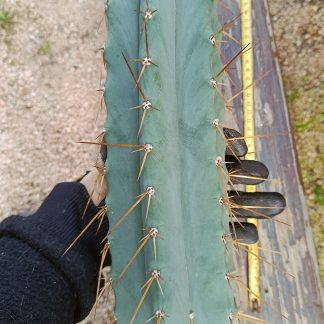
Trichocereus bridgesii cv. ‘Deutsche’ | Unrooted Cutting | Exact Specimen FCES0002
€66.00 Add to basket -

Trichocereus atacamensis ‘TB 1320.2’ | ‘Cardón Grande’ | Live plant
€8.00 Add to basket -
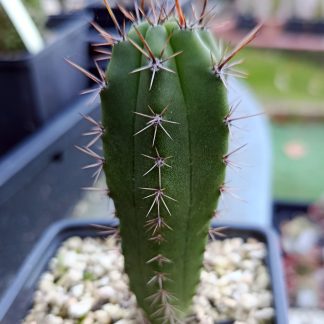
Trichocereus knuthianus | Live plant
€20.00 Add to basket -
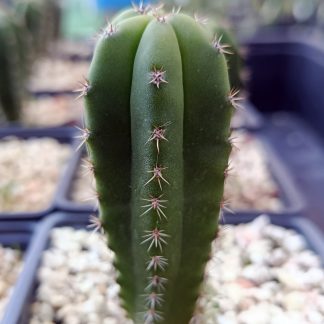
Trichocereus cordobensis | Live plant
€14.00 Add to basket -

Trichocereus rowleyi ‘P134’ (ex. var. pumila) | ‘Red Torch’ | Live plant
€18.00 Add to basket -

Opuntia microdasys cv. ‘Rufida’ | ‘Mexican Bunny Ears Cactus’ | Live plant
€11.25 Add to basket
Reviews
There are no reviews yet