
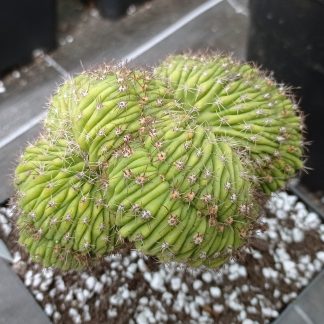
We are particularly fond of the wonderfully distinctive Argentine cactus Trichocereus thelegonus, and its crested form manages to make an already unusual species considerably stranger. This gallery documents the T. thelegonus mutant material represented in our collection, beginning with our crested T. thelegonus, illustrated below.
Compared with species such as T. bridgesii, we have encountered relatively few distinct thelegonus mutants in cultivation. That makes the crested plant all the more interesting to us, particularly as mature specimens develop increasingly complicated folds and knotted ridges rather than simply producing a neat fan.
You may also enjoy our companion galleries devoted to Trichocereus bridgesii mutants, T. purpureopilosus mutants, T. schickendantzii mutants and T. spachianus mutants.
Jump to: Taxonomy | Crested form | How cresting develops | Cultivation
Trichocereus thelegonus – Taxonomy & Horticultural Identity
We use Trichocereus thelegonus throughout this gallery because it is the familiar horticultural name attached to our material and remains useful when discussing cultivated plants, provenance and hybrids. The species has travelled through several generic combinations during its taxonomic history.
Current Plants of the World Online treatment by the Royal Botanic Gardens, Kew accepts Echinopsis thelegona. The species is native to north-western Argentina, where it occurs in dry habitats. We retain the older Trichocereus usage alongside that modern treatment rather than sacrificing useful horticultural continuity every time generic boundaries move.
The normal species already has an unusually distinctive appearance, particularly through the combination of its rib development, areoles, spination and textured epidermis. Cristation alters that architecture profoundly while still retaining enough of the underlying plant to make mature specimens recognisably related to ordinary thelegonus.
Trichocereus thelegonus f. cristata – Crested Mutant Form
The crested form of T. thelegonus replaces the ordinary single-pointed pattern of stem extension with a broadened line of active growth. Young crests may initially appear as fairly simple fans, but older plants can become much more convoluted as the ridge lengthens, folds, twists and branches.
In our plants this produces an especially attractive combination because the naturally characterful surface of T. thelegonus is repeated and distorted along the crest. As growth accumulates, what begins as a relatively orderly fan can become a mass of winding ridges, bends and knotted-looking sections.
Comparable cristate growth occurs in many other cacti, including forms of Trichocereus candicans, T. pachanoi and T. spachianus, but the underlying architecture of each species gives its crest a rather different eventual character.


How Crested Growth Develops
Cresting in cacti is a form of fasciated growth. In an ordinary shoot, active cell division is concentrated around a relatively compact apical meristem. In a crest, that meristematic region becomes abnormally broadened or elongated, so new growth is produced along a line rather than around a single conventional apex.
As the line of active growth becomes longer than the tissue beneath it can accommodate neatly, the crest begins to curve and fold. Continued development can produce increasingly elaborate fans, waves and convolutions, particularly on older specimens.
The underlying cause of fasciation is not necessarily evident from the plant itself. Genetic and developmental abnormalities can produce persistent crested clones, while injury, disease and environmental disruption can also affect meristem behaviour. A mature crest shows us the resulting growth pattern but does not automatically reveal what initiated it.
Cresting can also be unstable within a plant. A cristate specimen may produce an ordinary cylindrical shoot, generally described horticulturally as a reversion, while conventional growth can occasionally become fasciated later. Where a particularly attractive crest is being propagated, growers therefore tend to select material from actively cristate tissue rather than from reverted branches.
Cultivating Crested Trichocereus thelegonus
Crested T. thelegonus can broadly be cultivated according to the needs of the ordinary species, but its architecture deserves some additional attention. The growing ridge and older convolutions create depressions and enclosed areas where water, dead material and pests can become trapped more readily than on a conventional stem.
A free-draining substrate and good air circulation are consequently particularly useful. We also avoid allowing water to remain sitting deep within complicated folds during cool or damp weather, when evaporation is slow and damaged tissue is more vulnerable to rot.
The increasingly broad and top-heavy growth of an established crest can eventually make stability another consideration. A suitably substantial pot and healthy root system help support older plants, while awkward specimens may occasionally benefit from temporary support until newly rooted or recently repotted plants have anchored themselves properly.
Propagation is normally vegetative if the aim is to preserve the cristate clone. A section of healthy crest can be cut, allowed to callus thoroughly and rooted in much the same way as other Trichocereus cuttings. Grafting is also useful for small pieces or where faster development is desired, but a healthy green crest is not inherently dependent upon grafting.
For broader practical information on propagation, watering, substrates and other aspects of cactus care, see the Freaky Cacti Cultivation Advice library.
Explore Mutant Trichocereus thelegonus at Freaky Cacti
The catalogue below draws dynamically from currently published live plants combining our thelegonus species classification with the mutant tag. Availability naturally changes as propagations grow, sell and return to stock.
Browse Trichocereus thelegonus | Explore mutant cacti | Explore the complete catalogue
Related Mutant Galleries
Continue with Trichocereus bridgesii Mutants, Trichocereus purpureopilosus Mutants, Trichocereus schickendantzii Mutants or Trichocereus spachianus Mutants.