

Trichocereus crassicaulis ‘TB 0660.1’ | Live plant
Trichocereus crassicaulis ‘TB 0660.1’, an established Polish-sourced accession retaining the original field identification Lobivia grandiflora var. crassicaulis. The TB 660.1 record identifies Tomasz Blaczkowski’s collection near Narvaez, Catamarca, Argentina, at 1,922 m on 18 January 2013. A compact, stout-ribbed Argentine cactus with conspicuous spination and an identifiable field-number history, maintained separately from our other crassicaulis material.
Currently unavailable.
Product Features
Trichocereus crassicaulis ‘TB 0660.1’ is a field-numbered Argentine cactus with a particularly useful documented locality. Our material came to us as an established plant from a Polish grower, carrying the original identification Lobivia grandiflora var. crassicaulis TB0660.1, together with its collection locality and altitude.
We retain the accession number but use Trichocereus crassicaulis in accordance with our existing catalogue. This keeps the plant identifiable within our collection without discarding the older Lobivia identification under which it circulated.
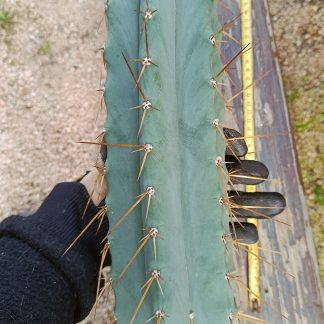
Our plant shows the characteristic stout, ribbed growth and prominent spination associated with compact crassicaulis material. Its green stem has well-defined ribs, with regularly arranged areoles bearing outward-pointing spines in pale yellowish to brownish shades. Unlike the tall columns associated with many familiar Trichocereus, this is a relatively short-bodied plant that can develop into a substantial clump over time.
TB 0660.1: Narvaez, Catamarca, Argentina
The original field-number record identifies TB 660.1 as a collection by Tomasz Blaczkowski, made on 18 January 2013 near Narvaez, north of Sinquil, in Catamarca Province, Argentina, at an altitude of 1,922 metres.
The recorded field identification was Lobivia grandiflora var. crassicaulis. The number appears on our received label with an additional leading zero, as TB 0660.1. Both forms refer to the same numbered field record.
This is valuable provenance information. Catamarca contains several related populations traditionally identified under Lobivia, Soehrensia, Echinopsis and Trichocereus, and plants from different localities have often been grouped together under broad horticultural names. The field number allows this particular material to remain distinguishable from other crassicaulis accessions.
Our plant was acquired from an established Polish collection, rather than collected by us in Argentina. We preserve the field identification and locality supplied with it, while distinguishing the original 2013 collection record from the subsequent history of the cultivated plant.
A compact, heavily armed Argentine cactus
Trichocereus crassicaulis is native to north-western Argentina and belongs to a group of relatively compact cacti whose relationships have been interpreted differently by successive botanists.
Established plants generally form thick, green, globose to shortly cylindrical stems with broad ribs and conspicuous spines. They may produce offsets from their bases, gradually developing into groups of stout, densely armed heads.
The spines are particularly important to the plant’s appearance. Those produced in strong light can be notably robust, sometimes with darker tips contrasting against their paler bases. Spine length and density can vary with cultivation, and a plant grown under relatively sheltered conditions may appear less heavily armed than material exposed to intense sunshine.
The epithet crassicaulis means thick-stemmed, an appropriate description of the substantial body proportions found in this group.
Flowers
One of the attractions of crassicaulis is its flowering. Plants belonging to this group are known for comparatively large, brilliantly coloured flowers, often in orange, scarlet, red or reddish-pink shades.
These flowers contrast sharply with the dark-green stems and strong spination, and are quite different from the predominantly white, night-opening flowers associated with many of the tall columnar Trichocereus.
The precise flower colour of an individual field-numbered accession should not be inferred solely from the wider species. The TB 0660.1 identity is retained for its documented collecting history and living material, independently of any particular flower colour.
Taxonomy: from Lobivia grandiflora to Trichocereus crassicaulis
The nomenclature of this plant reflects the complicated boundaries historically drawn between Lobivia, Echinopsis, Soehrensia and Trichocereus.
Roberto Kiesling validly described Lobivia crassicaulis in 1978. The combination Echinopsis crassicaulis followed in 1983, while Walter Rausch published Lobivia grandiflora var. crassicaulis in 1987. The combination Trichocereus crassicaulis was subsequently published by Joël Lodé.
Plants of the World Online currently accepts Echinopsis crassicaulis, treating these other published combinations as synonyms. We use Trichocereus crassicaulis throughout our catalogue, while preserving the original names attached to identifiable plants and field collections.
The designation TB 0660.1 is a field-number identifier, not a botanical variety or cultivar name. It distinguishes this material from our ordinary crassicaulis plants and from our separately maintained ‘Crass’ selection.
Cultivation
Provide a freely draining cactus substrate with a generous mineral component, bright light and good airflow. Strong light helps encourage compact growth and well-developed spination, although plants should be acclimatised gradually when moved into more intense sunshine.
Water thoroughly during active growth, allowing the compost to dry adequately between waterings. Avoid keeping the roots continuously damp, especially in cool weather. Feeding can be moderate, with no need to force rapid growth.
During winter, a cool, bright and substantially drier rest is preferable. Protect the plant from prolonged wet conditions and hard frost, particularly when the substrate is moist. Resume watering progressively when temperatures rise and growth becomes active.
Over time, crassicaulis can develop into a handsome, strongly spined clump. For collectors interested in geographically documented Argentine material, TB 0660.1 also preserves a specific locality and collection history that ordinary unnumbered plants cannot provide.
Unless stated otherwise, plants ship bare-root to supported EU destinations. Outside our delivery area? Ask about seed-only orders or join our email list for shipping updates. Photos are representative unless an exact specimen is specified; ask for current specimen photos. Some plants are cut to order where noted. Save 10-35% automatically on qualifying live plants, with bonus seeds and at least one bonus cactus in every live plant order.
Product Details
| Product Type | |
|---|---|
| Amount | 1 rooted plant |
| Size | Size is added here when this item is in stock. |
| Family | |
| Genus | |
| Species | |
| Clone/Variety/Cultivar | |
| Form | |
| Flower | |
| Breeder/Source | |
| Collection |
Only logged in customers who have purchased this product may leave a review.
You May Also Appreciate
-


Opuntia microdasys cv. ‘Rufida’ | ‘Mexican Bunny Ears Cactus’ | Live plant
€11.25 Add to basket -

Lophophora williamsii ‘RS 378’ | ‘Peyote’ | Live plant
€32.00 Add to basket -

Trichocereus atacamensis ‘TB 1320.2’ | ‘Cardón Grande’ | Live plant
€8.00 Add to basket -

Trichocereus atacamensis subsp. pasacana ‘TB 1099.3’ | ‘Cardón Grande’ | Live plant
10% OFF until 30 Nov Original price was: €18.00.€16.20Current price is: €16.20. Add to basket -
Trichocereus bridgesii cv. ‘Deutsche’ | Unrooted Cutting | Exact Specimen FCES0002
€66.00 Add to basket -

Trichocereus pachanoi cv. ‘Mujica’ | ‘San Pedro’ | Live plant
10% OFF until 30 Nov Original price was: €22.50.€20.25Current price is: €20.25. Add to basket -

Trichocereus faundezii ‘GM 1849’ | Live plant
From €21.00 Browse options This product has multiple variants. The options may be chosen on the product page -

Trichocereus cordobensis cv. ‘Helon’ | Australian Clone | Live plant
10% OFF until 30 Nov Original price was: €55.00.€49.50Current price is: €49.50. Add to basket -

Trichocereus bridgesii f. semi-monstrosa cv. ‘RAP’ | ‘Monstrose Bolivian Torch’ | Live plant
10% OFF until 30 Nov Original price was: €81.00.€72.90Current price is: €72.90. Add to basket -

Trichocereus rowleyi ‘P134’ (ex. var. pumila) | ‘Red Torch’ | Live plant
€18.00 Add to basket -
Trichocereus cordobensis | Live plant
€14.00 Add to basket -
Trichocereus knuthianus | Live plant
€20.00 Add to basket
Reviews
There are no reviews yet