
Trichocereus skottsbergii ‘JN 379’ | Live plant
Trichocereus skottsbergii ‘JN 379’ is a heavily spined Chilean columnar cactus associated with Jan Novák’s 2007 collection from western Coquimbo, near Fray Jorge. Originally recorded as intermediate between T. chiloensis and T. skottsbergii, our clonal selection develops handsome grey-green ribs, woolly white areoles and exceptionally dense golden-yellow to amber spination. Propagated from our established mother plant, originally obtained from an Italian collector.
Currently unavailable.
Product Features
Trichocereus skottsbergii ‘JN 379’ is a particularly attractive, heavily spined Chilean columnar cactus originating from field-numbered material collected by Jan Novák in the Coquimbo Region in 2007. Our plants are clonally propagated from a mother plant obtained from an Italian collector, preserving the characteristics of this particular cultivated individual.
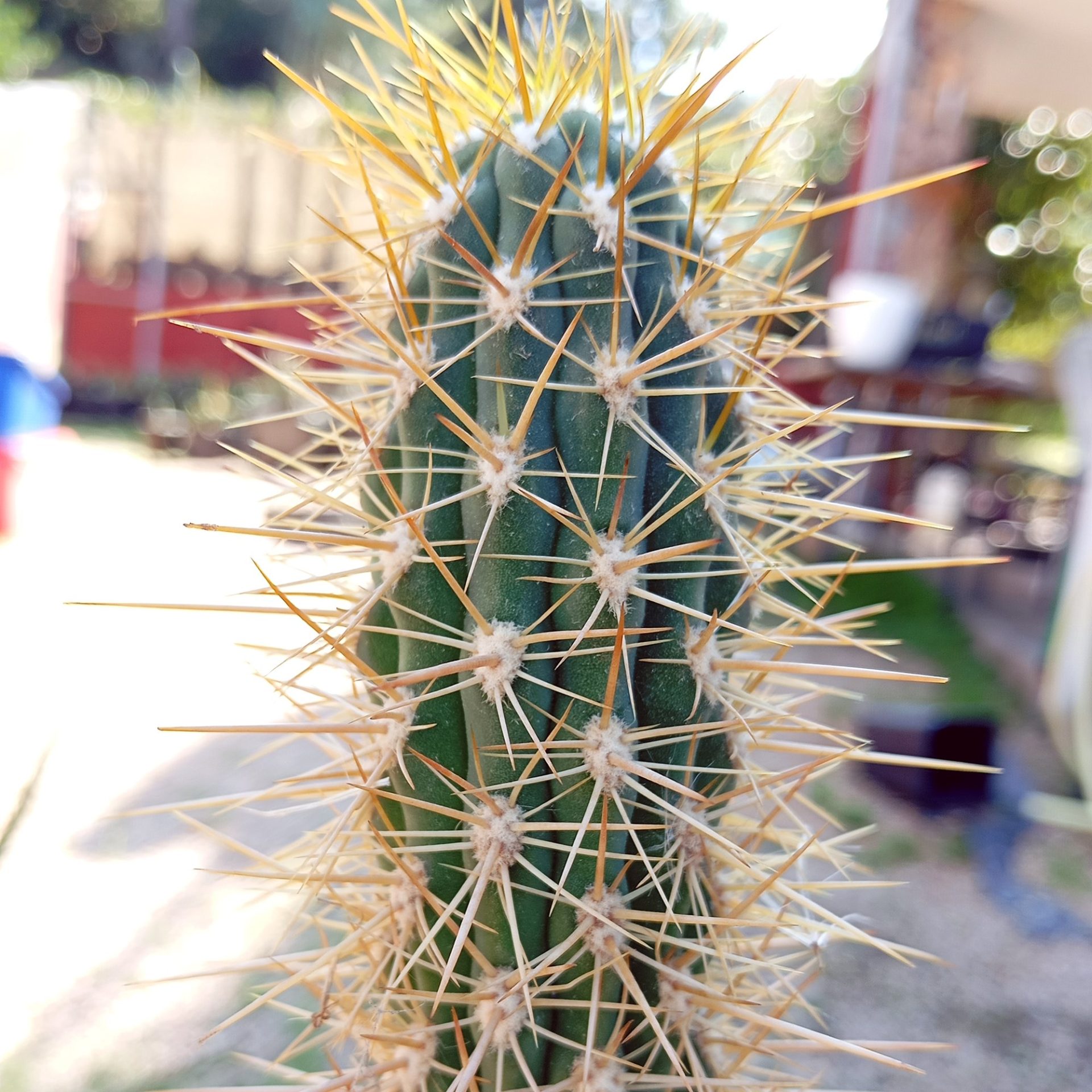
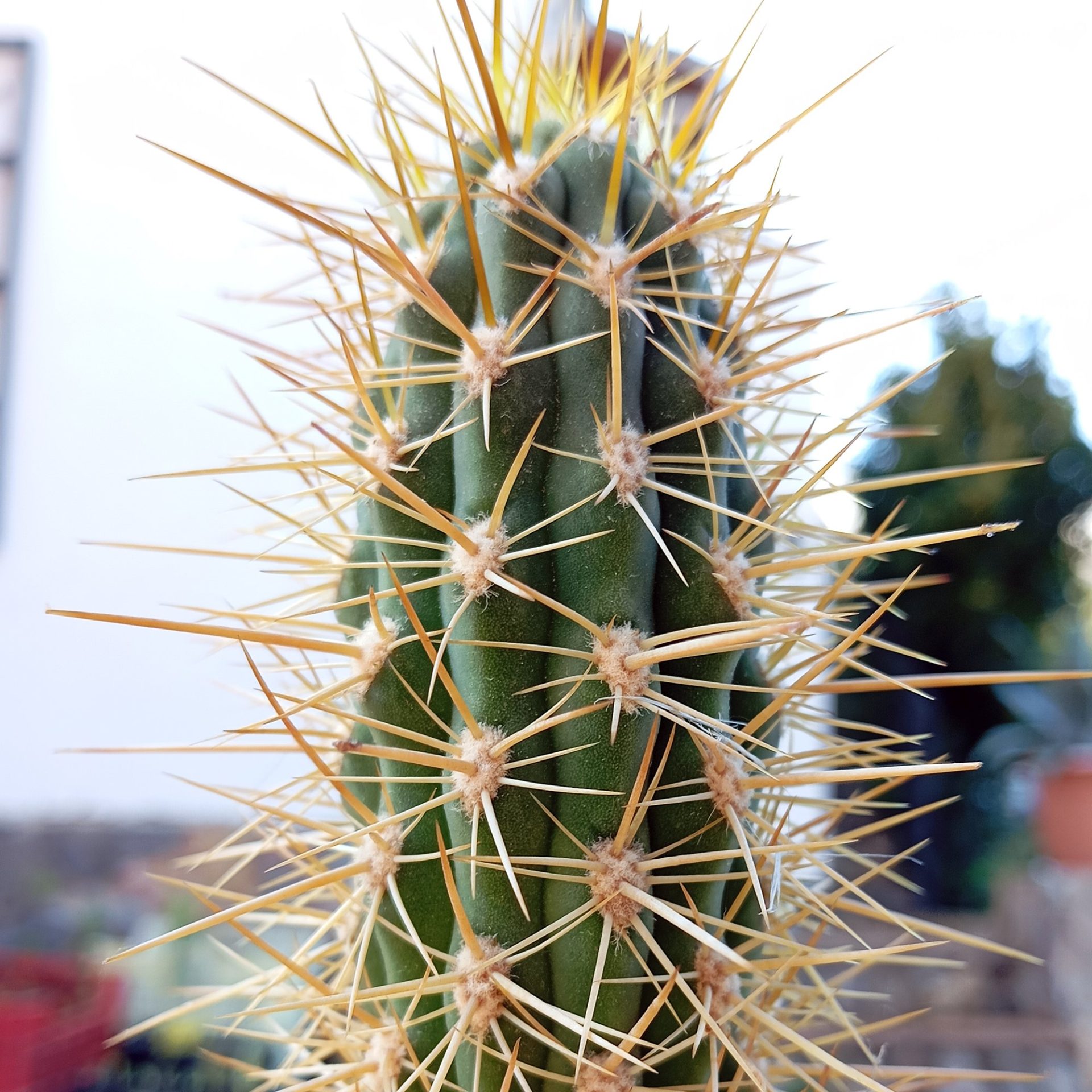
The original JN 379 collection is especially interesting because Novák recorded the plants as intermediate between Trichocereus chiloensis and Trichocereus skottsbergii, noting their particularly hard spination. Our clone certainly lives up to that description, developing a dense arrangement of long, golden-yellow to amber spines over a handsome grey-green, prominently ribbed stem.
Growth, Appearance and Spination
‘JN 379’ develops upright, columnar growth with a grey-green to somewhat glaucous epidermis and numerous well-defined vertical ribs. The ribs are comparatively narrow and rounded, with clearly recessed grooves between them, giving the stem a finely divided appearance beneath its substantial armature.
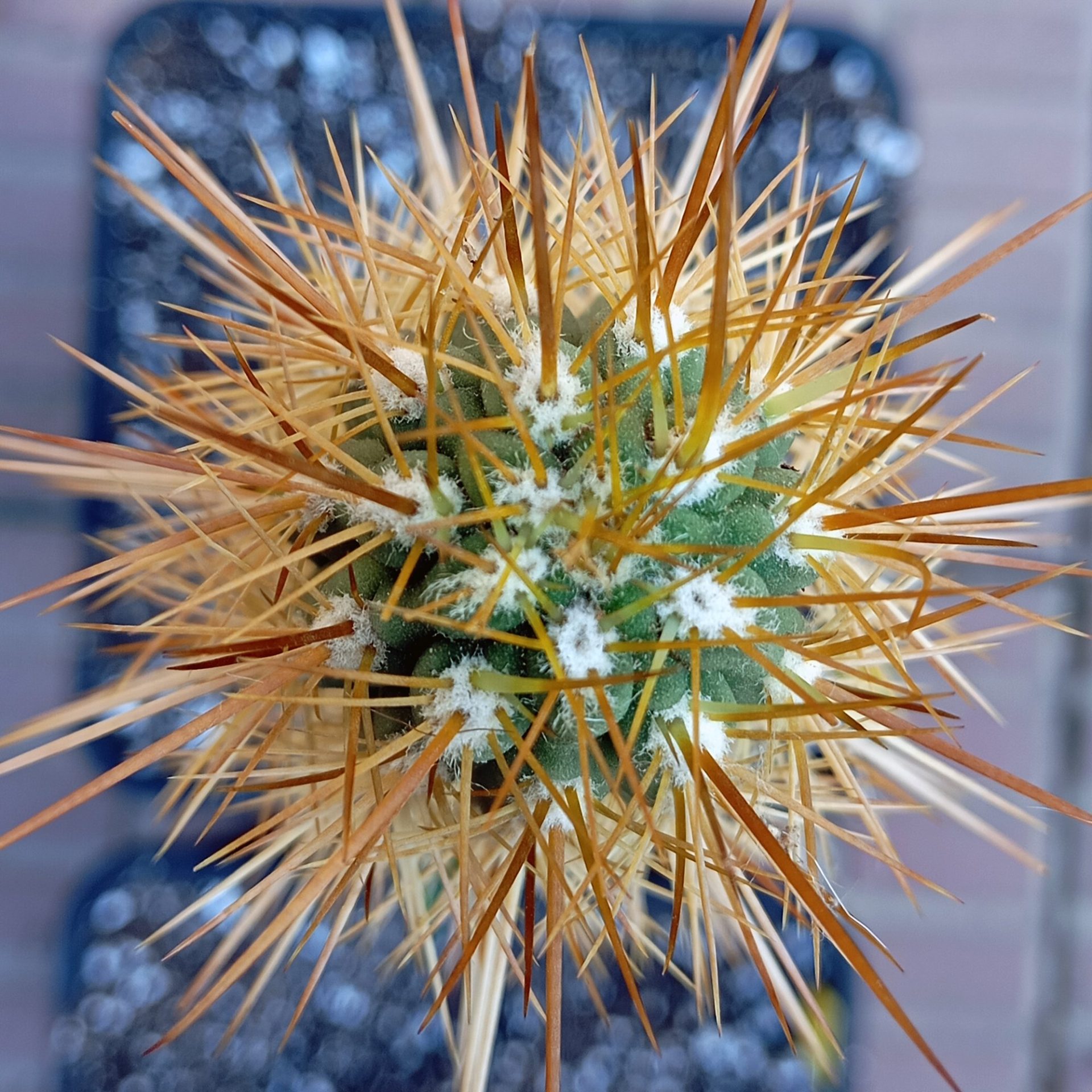
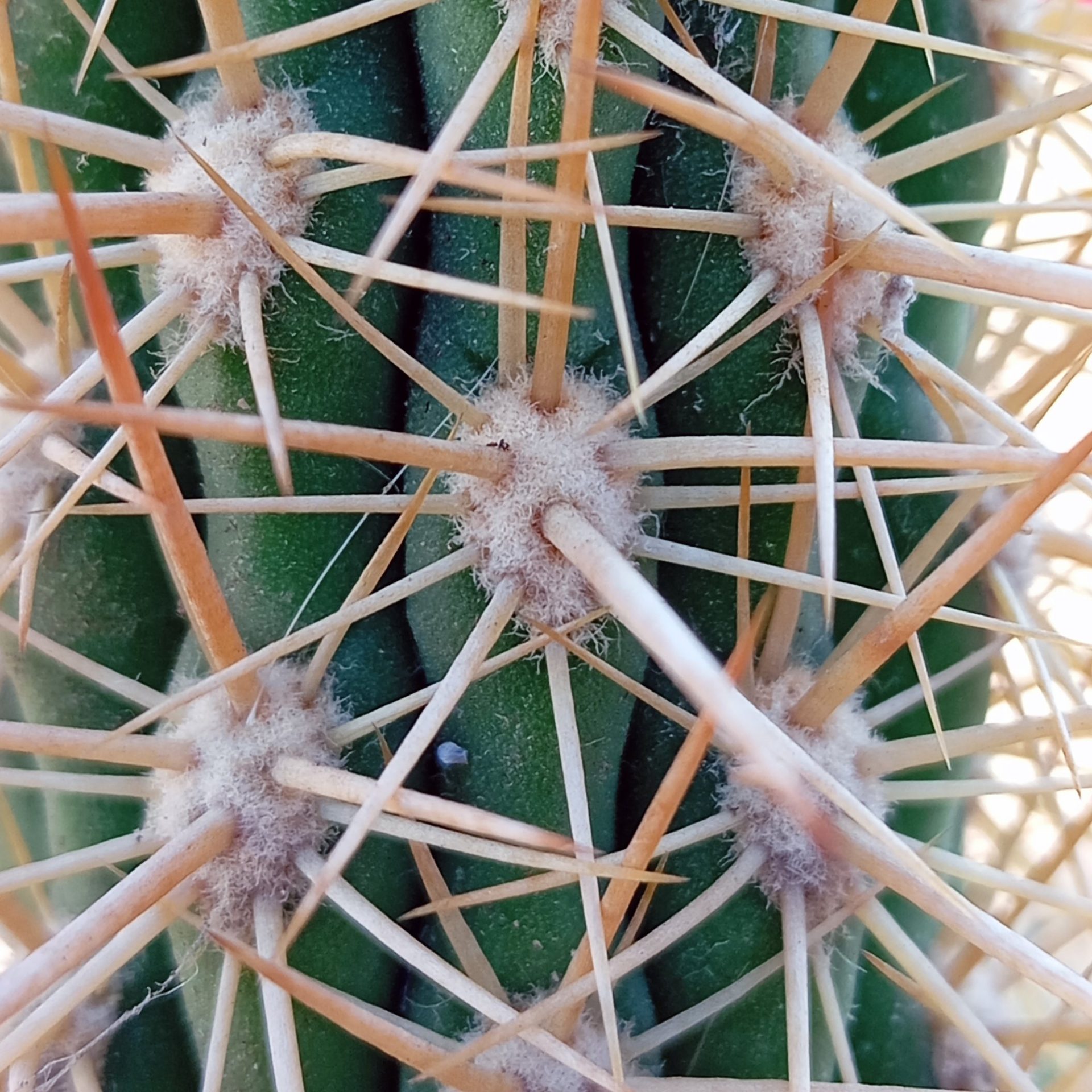
The spination is the most conspicuous characteristic of our clone. Each areole produces a dense cluster of long, slender, sharply pointed spines radiating in several directions, with some projecting prominently away from the stem. Their colouring ranges from pale straw-yellow and warm golden tones to deeper amber and reddish-brown, particularly towards the spine bases and tips.
As the spines develop, neighbouring clusters overlap extensively, creating an almost continuous lattice of golden armature around the stem. This is especially noticeable in the upper growth, where the younger spines form a dense crown of bright yellow and amber points.
The areoles themselves are woolly, with conspicuous white to cream-coloured fibres surrounding the spine bases. Against the darker epidermis, the pale areoles and warm-coloured spines produce an attractive contrast. Our close-up photographs show how even individual areoles can develop substantial, multi-directional armature.
Although spine density and colour can be influenced by growing conditions, these characteristics are well established in our mother plant. We maintain the line clonally rather than selecting unrelated seedlings simply because they display similarly impressive spination.
JN 379: Jan Novák’s 2007 Collection
The designation JN 379 originates from the field records of Czech cactus collector Jan Novák. It identifies material recorded in 2007 from western Coquimbo, Chile, near the road towards Fray Jorge and the turning associated with Laguna Lorenzo Peralta and La Punilla.
The recorded collection locality is a small hill immediately to the left of the road near that turning. The original description places JN 379 among several closely related collections from the same general area, including JN 380 and JN 381, each associated with a slightly different collecting position.
Novák recorded the plants under both Trichocereus chiloensis and Trichocereus skottsbergii, describing them as a multi-intermediate form with hard spines. This is an important part of the accession’s history because it preserves the collector’s observation of intermediate morphology rather than imposing an artificially precise identification.
Such intermediate characters do not, by themselves, demonstrate a hybrid origin. The Chilean chiloensis group contains considerable natural variation, and differences in ribbing, spine arrangement and stem proportions can overlap between closely related species.
Our original mother plant was obtained from an Italian collector under the Trichocereus skottsbergii ‘JN 379’ designation. We retain that name for horticultural continuity while recognising the broader chiloensis–skottsbergii interpretation attached to the original field collection.
Clonal Identity and Provenance
There is an important distinction between a field number and a clonal designation. JN 379 originally identifies a documented collection, not necessarily one genetically identical plant. Material raised independently from seeds belonging to the same collection could therefore contain different individual genotypes.
Our ‘JN 379’ plants, however, are maintained through vegetative propagation from our established mother plant. They represent the same cultivated clonal line rather than a mixture of genetically distinct seedlings carrying the JN 379 designation.
This preserves the particular combination of grey-green epidermis, strongly defined ribs, dense golden spination and other characteristics expressed by our mother plant. As always, growing conditions can influence the appearance of successive growth, especially spine development, without changing the underlying clonal identity.
The distinction is particularly valuable with locality-associated material, where retaining both the original collection number and the identity of the cultivated mother plant helps prevent unrelated specimens from becoming confused over successive generations of propagation.
Relationship to Other Chilean Trichocereus
Trichocereus skottsbergii belongs to a closely related group of Chilean columnar cacti that includes Trichocereus chiloensis ‘Fray Jorge’, another locality-associated selection from the Coquimbo Region. The proximity of these collections makes their morphological differences particularly interesting, although geographic association alone does not establish a shared genetic identity.
Typical T. skottsbergii generally develops numerous ribs and relatively long, slender spines, whereas some forms of T. chiloensis have somewhat stouter armature. These distinctions are not absolute, however, and naturally variable populations can display overlapping characteristics.
Another useful comparison is Trichocereus chiloensis subsp. litoralis, traditionally known as ‘Quisco Costero’. This coastal taxon is now treated by Kew as the distinct species Leucostele litoralis, although its historical relationship with chiloensis remains important in horticultural literature.
We also maintain more recent Jan Novák material under the T. skottsbergii identity, including ‘JN 2567’, originating from Medio de Agua, Coquimbo, at approximately 1,715 metres elevation. Unlike the 2007 JN 379 material from western Coquimbo, JN 2567 represents a separate, considerably higher-elevation collection. The field numbers should therefore remain distinct rather than being grouped as interchangeable skottsbergii genetics.
Taxonomy of Trichocereus skottsbergii
Trichocereus skottsbergii Backeb. was described in 1950 and named in honour of Swedish botanist and explorer Carl Skottsberg. The species is native to Chile’s Coquimbo Region, where it occurs in dry shrubland and desert-associated vegetation.
Its taxonomic treatment has changed repeatedly. The name Echinopsis skottsbergii was published following the transfer of numerous Trichocereus species into Echinopsis, while another treatment recognised the plant as Echinopsis chiloensis subsp. skottsbergii.
Current Kew taxonomy accepts Leucostele skottsbergii (Backeb.) P.C.Guerrero & Helmut Walter as a distinct species, separate from Leucostele chiloensis. We nevertheless retain the traditional Trichocereus name for established horticultural material, particularly where original field numbers and historical collection labels are involved.
The species is generally characterised by grey-green columnar stems with numerous ribs, conspicuous spination and pale flowers. Mature plants can eventually develop substantial branching growth. The original JN 379 identification remains especially informative because it records a plant population showing characters intermediate between two historically associated taxa.
Cultivation
We grow our Chilean Trichocereus in a freely draining cactus substrate with good aeration, strong light and adequate ventilation. ‘JN 379’ benefits from the same general approach, with regular but measured watering during active growth and substantially reduced watering during cooler periods.
Strong light is particularly useful for maintaining compact, well-proportioned stems and encouraging the development of the dense spination which makes this clone so attractive. Plants grown under glass or in comparatively shaded conditions should be acclimatised gradually before exposure to intense summer sunshine.
Allow the substrate to dry appropriately between waterings, and avoid prolonged saturation around the roots. Moderate feeding during the growing season can support steady development without encouraging excessively soft or elongated growth.
The Chilean chiloensis–skottsbergii group can grow more deliberately than some of the particularly vigorous Peruvian and Bolivian columnar cacti, especially under cooler conditions. Patience is worthwhile, as successive seasons of healthy growth allow the characteristic ribs and increasingly substantial spine clusters to develop.
During winter, keep plants considerably drier and protect them from prolonged combinations of low temperatures and wet substrate. Suitable minimum temperatures depend on acclimatisation, plant condition, growing medium and local climate, rather than a single universal frost-tolerance figure.
For collectors interested in documented Chilean locality material, ‘JN 379’ combines a useful historic field identity with the consistently heavy golden spination of our particular clonal selection. It is a rewarding plant to grow for the architecture of its stems and spines alone, while preserving an interesting record of the morphological variation encountered in the Coquimbo populations of Trichocereus.
Unless stated otherwise, plants ship bare-root to supported EU destinations. Outside our delivery area? Ask about seed-only orders or join our email list for shipping updates. Photos are representative unless an exact specimen is specified; ask for current specimen photos. Some plants are cut to order where noted. Save 10-35% automatically on qualifying live plants, with bonus seeds and at least one bonus cactus in every live plant order.
Product Details
| Product Type | |
|---|---|
| Amount | 1 rooted plant |
| Size | Size is added here when this item is in stock. |
| Family | |
| Genus | |
| Species | |
| Clone/Variety/Cultivar | |
| Form | |
| Flower | |
| Breeder/Source | |
| Collection |
Only logged in customers who have purchased this product may leave a review.
You May Also Appreciate
-


Acacia courtii | ‘Northern Brother Wattle’ | Rooted Plant | Exact Specimen FCES0004
€200.00 Add to basket -

Trichocereus atacamensis ‘TB 1320.2’ | Cariquima, Chile | Seeds
From €7.50 Browse options This product has multiple variants. The options may be chosen on the product page -

Opuntia microdasys cv. ‘Rufida’ | ‘Mexican Bunny Ears Cactus’ | Live plant
€11.25 Add to basket -

Trichocereus faundezii ‘GM 1849’ | Live plant
From €21.00 Browse options This product has multiple variants. The options may be chosen on the product page -
Trichocereus cordobensis | Live plant
€14.00 Add to basket -

Lophophora williamsii ‘RS 378’ | ‘Peyote’ | Live plant
€32.00 Add to basket -

Trichocereus cordobensis cv. ‘Helon’ | Australian Clone | Live plant
10% OFF until 30 Nov Original price was: €55.00.€49.50Current price is: €49.50. Add to basket -
Trichocereus bridgesii cv. ‘Deutsche’ | Unrooted Cutting | Exact Specimen FCES0002
€66.00 Add to basket -

Trichocereus rowleyi ‘P134’ (ex. var. pumila) | ‘Red Torch’ | Live plant
€18.00 Add to basket -
Trichocereus knuthianus | Live plant
€20.00 Add to basket -
Trichocereus atacamensis ‘TB 1320.2’ | ‘Cardón Grande’ | Live plant
€8.00 Add to basket -

Trichocereus pachanoi cv. ‘Mujica’ | ‘San Pedro’ | Live plant
10% OFF until 30 Nov Original price was: €22.50.€20.25Current price is: €20.25. Add to basket
Reviews
There are no reviews yet