

Trichocereus hybrid cv. ‘Diego’ × Trichocereus thelegonoides hybrid cv. ‘Köln’ | Seeds
From €5.00
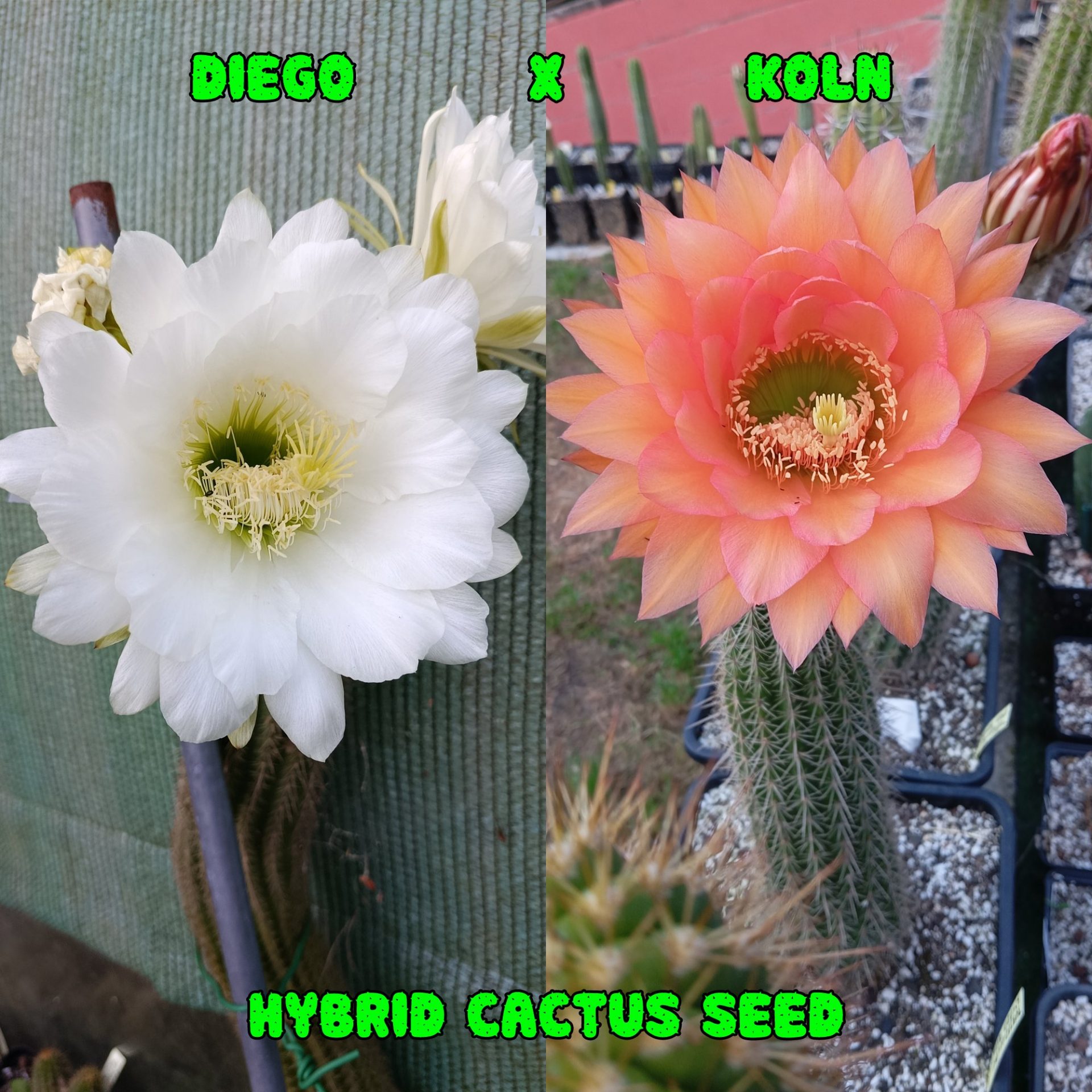
Seeds from our July 2026 hybrid of white-flowered Trichocereus hybrid cv. ‘Diego’ × early-flowering Trichocereus thelegonoides hybrid cv. ‘Köln’, whose flowers range from deep pink through salmon to reddish orange.
Product Features
Cactus seeds from our July 2026 harvest, produced at Freaky Cacti by crossing our Trichocereus hybrid cv. ‘Diego’ as the mother with our Trichocereus thelegonoides hybrid cv. ‘Köln’ as the pollen parent.
‘Diego’ is one of the more mysterious flowering plants in our collection, producing white flowers from substantial deep-green, clustering stems despite its deeper ancestry remaining unknown. ‘Köln’ provides a very different floral background, with early blooms ranging from deep pink through salmon to reddish orange. The combination should be particularly interesting for growers who enjoy flowering out genetically variable Trichocereus seedlings.
Parentage
Mother: Trichocereus hybrid cv. ‘Diego’
Father: Trichocereus thelegonoides hybrid cv. ‘Köln’
This hybrid belongs to the growing archive of material bred by Freaky Cacti. Each seedling will be genetically distinct, so variation in vigour, ribs, spination, branching, stem proportions and eventual flowers should be expected.
About ‘Diego’
‘Diego’ is a clonally maintained Trichocereus hybrid which came to us as a gift from Diego, a grower and shopkeeper in Sabadell, Spain. We named the plant after him and continue to preserve that cultivar name because its precise botanical identity and pedigree remain unresolved.
Mature plants develop substantial deep-green stems which branch and cluster from the base, with broad ribs and moderate ivory to pale-tan spination. Once mature, our plants have proved remarkably floriferous, producing large white flowers and becoming increasingly useful in our breeding work.
Its overall morphology has led us to wonder whether Trichocereus thelegonoides, or related material, may occur somewhere in its ancestry, but we have no evidence sufficient to treat that as confirmed parentage. For that reason the plant remains simply Trichocereus hybrid cv. ‘Diego’ in our records.
You can explore the parent itself and its descendants through our Diego archive, or see the ‘Diego’ live-plant listing for more information about the original clone.
About ‘Köln’
‘Köln’ is an established flowering hybrid associated with Trichocereus thelegonoides, a species which has played a particularly important role in European ornamental cactus breeding.
It flowers relatively early for a columnar cactus and produces attractive blooms ranging from deep pink through salmon to reddish orange. These characteristics have made it one of the thelegonoides-associated cultivars we use repeatedly as a breeding parent.
Its complete historical pedigree is not documented in our records, so we retain the established designation T. thelegonoides hybrid cv. ‘Köln’ rather than assigning additional ancestry without evidence.
Our Köln archive brings together the cultivar and the numerous further hybrids in which its genetics appear.
What might the seedlings produce?
The maternal parent contributes a large white-flowered background together with substantial clustering growth, while ‘Köln’ contributes much stronger pink, salmon and reddish-orange pigmentation.
There is no reason to expect every seedling to produce a simple intermediate flower. Some may favour the white-flowered maternal side, others may inherit stronger colour from ‘Köln’, and still others may produce less obvious combinations of pigmentation, petal form, throat colour and flower size.
The plants themselves may also diverge considerably. Differences in branching, stem thickness, rib development and spination should become apparent well before the first flowers open.
An especially interesting pedigree
This pairing has an additional point of interest because ‘Diego’ itself has unresolved ancestry. Its morphology has suggested possible thelegonoides involvement to us, but that remains only a horticultural observation rather than documented pedigree information.
Crossing it with the established thelegonoides-associated ‘Köln’ therefore creates an interesting population without requiring us to pretend we know more about ‘Diego’ than we actually do. As the offspring mature, their growth and flowering characteristics may provide useful comparisons, even though they cannot retrospectively prove the ancestry of the mother plant.
European Trichocereus breeding genetics
Both parents belong to the European horticultural material represented in our Trichocereus Genetics from Europe collection. ‘Diego’ entered our collection through a Spanish grower, while ‘Köln’ belongs to the established European ornamental thelegonoides breeding tradition.
Linking the parent archives to their offspring allows these genetics to remain traceable through later generations rather than becoming detached product names as further crosses are made.
About Trichocereus
Trichocereus is central to our collection and breeding work, from botanical species and locality material through to old European cultivars, unidentified horticultural clones and our own later-generation hybrids.
That mixture is one reason careful record-keeping matters. Where a parent is securely identified we preserve that identity, and where the ancestry is uncertain, as with ‘Diego’, we preserve the uncertainty rather than inventing a cleaner pedigree.
Growing the seeds
Surface-sow on a fine, evenly moist and freely draining cactus substrate, covering the seeds only very lightly if at all. Warm conditions, useful light and sustained humidity are generally suitable during germination and early seedling development.
Our current nursery method is described in our guide to growing cacti from seed, including substrate preparation, humidity management and gradual acclimatisation.
Harvest details
These seeds were harvested at Freaky Cacti in July 2026. Our own 2026 seed is cleaned before packing to remove visibly immature or otherwise malformed seed.
Save 10-55% automatically on qualifying standard 25-seed packs and receive bonus seeds with every seed order. Seed-only orders over €125 after discounts ship free. Outside our delivery area? Contact us about a seed-only order. Please check your destination's import and local restrictions before ordering.
Product Details
| Product Type | |
|---|---|
| Amount | 25 seeds, 50 seeds, 100 seeds, 250 seeds, 500 seeds, 1000 seeds |
| Family | |
| Genus | |
| Species | |
| Clone/Variety/Cultivar | |
| Form | |
| Breeder/Source | |
| Year Harvested | |
| Collection |
Only logged in customers who have purchased this product may leave a review.
You May Also Appreciate
-


Echinopsis eyriesii f. variegata marmorata × (Trichocereus hybrid cv. ‘Pisac’ × Trichocereus vatteri) | Seeds
€5.00 Add to basket -

(Hildewintera hybrid ‘Noller 2’ × Trichocereus vasquezii) × Echinopsis hybrid cv. ‘Orange California’ | Seeds
€5.00 Add to basket -

(Hildewintera hybrid ‘Noller 2’ × Trichocereus vasquezii) × Echinopsis eyriesii f. variegata marmorata | Seeds
€5.00 Add to basket -

Trichocereus huascha v. rubriflora × Echinopsis eyriesii f. variegata marmorata | Seeds
€5.00 Add to basket -

Echinopsis hybrid cv. ‘Oberon’ × Echinopsis subdenudata f. variegata | Seeds
€5.00 Add to basket -

Echinopsis hybrid cv. ‘Windigo’ × Echinopsis subdenudata f. variegata | Seeds
€5.00 Add to basket -

Echinopsis oxygona f. variegata × Echinopsis eyriesii f. variegata marmorata | Seeds
€5.00 Add to basket -

(Hildewintera hybrid ‘Noller 2’ × Trichocereus vasquezii) × Echinopsis subdenudata f. variegata | Seeds
€5.00 Add to basket -

Echinopsis eyriesii f. variegata marmorata × Echinopsis hybrid cv. ‘Windigo’ | Seeds
€5.00 Add to basket -

(Hildewintera hybrid ‘Noller 2’ × Trichocereus vasquezii) cv. ‘Butterfley’ × (Hildewintera hybrid ‘Noller 2’ × Trichocereus vasquezii) | Seeds
€5.00 Add to basket -

Echinopsis eyriesii f. variegata marmorata × Echinopsis subdenudata f. variegata | Seeds
€5.00 Add to basket -

Echinopsis hybrid cv. ‘Charlemagne’ × Echinopsis hybrid cv. ‘Gossamer’ | Seeds
€5.00 Add to basket
Reviews
There are no reviews yet