

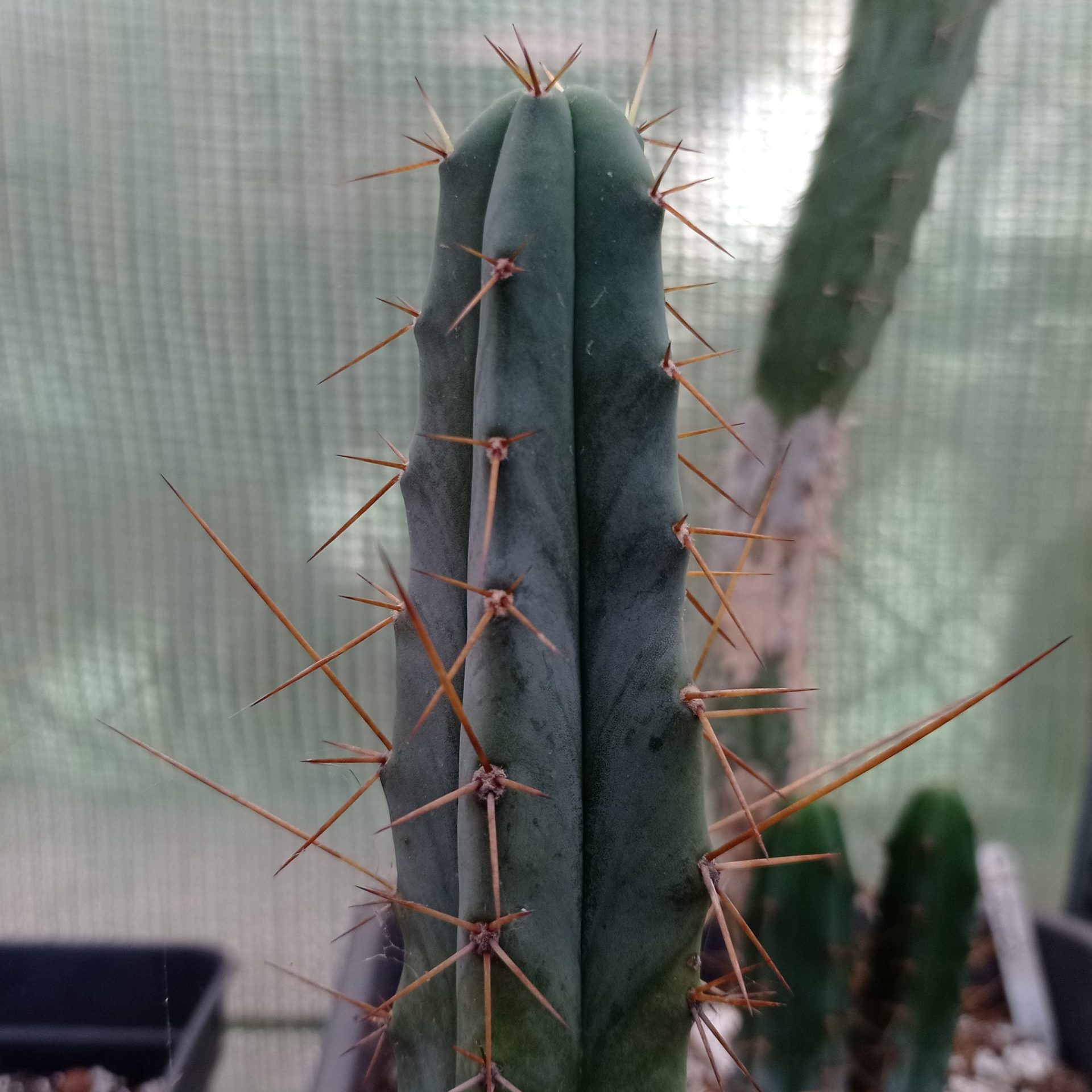


Trichocereus bridgesii cv. ‘Malta’ | ‘Bolivian Torch’ | Live plant
Trichocereus bridgesii cv. ‘Malta’ is a clonal Bolivian Torch line originating from our mother plant grown in Malta. A vigorous, comparatively slender columnar cactus with green to blue-green stems and the strong spination characteristic of the species. Live plant.
Currently unavailable.
Product Features
Trichocereus bridgesii cv. ‘Malta’ is a clonal line originating from our original mother plant grown in Malta. The name records that horticultural provenance rather than a wild Bolivian locality. We have maintained the plant vegetatively since acquiring it, preserving the same individual genetics in our collection.
It has long been one of our favourite examples of Trichocereus bridgesii. The species combines relatively slender columnar growth with green to blue-green stems and often formidable spination, giving mature plants a very different appearance from the broader stems of many familiar Trichocereus.
Growth & appearance
‘Malta’ develops the characteristic upright growth of T. bridgesii, with comparatively narrow columns divided into a small number of prominent ribs. Areoles are well spaced and can produce long, strong spines which begin lighter in colour and darken before eventually ageing greyish.
Stem colour varies with age and conditions. Well-lit growth can develop a distinctly blue-green or glaucous appearance, while shade, nutrition, temperature and the vigour of individual growth periods all influence the exact colour, girth and spine development.
Older plants can branch from the base and eventually form substantial multi-stemmed specimens. Although T. bridgesii is usually narrower than species such as T. pachanoi or T. terscheckii, established plants can still become very large with time.
Flowers
Mature T. bridgesii produces large white to whitish flowers from the sides of established stems. They are typically long-tubed and open predominantly at night, with the conspicuous hairy floral tube characteristic of many Trichocereus.
Flowering generally requires a mature plant with sufficiently established growth, so it should not be expected from young material simply because the species is capable of producing very large flowers.
Provenance of ‘Malta’
The ‘Malta’ designation refers to the origin of our horticultural material: our mother plant came from cultivation in Malta. Trichocereus bridgesii is native to Bolivia, not Malta, and the name should therefore not be read as a botanical locality collection.
We retain ‘Malta’ because it distinguishes this particular clonal line from the many other T. bridgesii plants, accessions and named clones in cultivation. Its European horticultural history also places it naturally within our European Trichocereus genetics collection.
Taxonomy
The plant remains widely known horticulturally as Trichocereus bridgesii, although current Kew treatment regards that name as a synonym of Echinopsis lageniformis. The accepted species is native to Bolivia and occurs naturally in dry habitats.
Confusingly, Echinopsis bridgesii is also an accepted name in current taxonomy, but it refers to a different taxon. For collector material such as this, retaining the established name Trichocereus bridgesii alongside the modern treatment Echinopsis lageniformis is considerably clearer than simply replacing one label with the other.
Cultivation
Trichocereus bridgesii grows vigorously when given abundant light, adequate root room and a freely draining, well-aerated substrate. Acclimatise plants gradually to strong direct sun rather than moving shaded growth straight into intense exposure.
During active growth we water thoroughly and then allow the substrate to dry sufficiently before watering again. The species can use a surprising amount of water while warm and actively growing, but persistently wet roots, particularly in cool conditions, are best avoided. In our experience T. bridgesii is somewhat less forgiving of prolonged excess moisture than some of the chunkier columnar species.
Moderate feeding during active growth supports firm new growth, while watering should be reduced substantially when temperatures and light fall and the plant becomes dormant or nearly so. Our Trichocereus cultivation guide covers light, watering, substrates, feeding and winter care in greater detail.
About Trichocereus
Trichocereus is the traditional horticultural name for a diverse group of South American columnar cacti now treated in several different genera by modern classifications. The name remains particularly useful in cultivation, where species such as T. bridgesii, T. pachanoi and T. peruvianus have accumulated extensive histories of named clones, locality material, mutations and hybrid breeding.
Unless stated otherwise, plants ship bare-root to supported EU destinations. Outside our delivery area? Ask about seed-only orders or join our email list for shipping updates. Photos are representative unless an exact specimen is specified; ask for current specimen photos. Some plants are cut to order where noted. Save 10-35% automatically on qualifying live plants, with bonus seeds and at least one bonus cactus in every live plant order.
Product Details
| Product Type | |
|---|---|
| Amount | 1 rooted plant |
| Size | ~3 cm diameter, ~14 cm tall |
| Common Name | |
| Family | |
| Genus | |
| Species | |
| Clone/Variety/Cultivar | |
| Form | |
| Flower | |
| Collection |
Only logged in customers who have purchased this product may leave a review.
You May Also Appreciate
-


Trichocereus pachanoi cv. ‘Mujica’ | ‘San Pedro’ | Live plant
10% OFF until 30 Nov Original price was: €22.50.€20.25Current price is: €20.25. Add to basket -
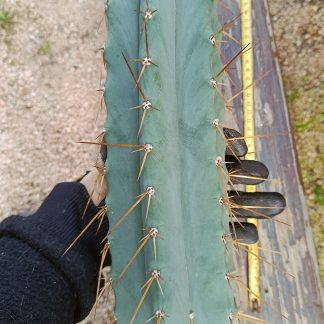
Trichocereus bridgesii cv. ‘Deutsche’ | Unrooted Cutting | Exact Specimen FCES0002
€66.00 Add to basket -

Opuntia microdasys cv. ‘Rufida’ | ‘Mexican Bunny Ears Cactus’ | Live plant
€11.25 Add to basket -

Trichocereus atacamensis subsp. pasacana ‘TB 1099.3’ | ‘Cardón Grande’ | Live plant
10% OFF until 30 Nov Original price was: €18.00.€16.20Current price is: €16.20. Add to basket -

Trichocereus bridgesii f. semi-monstrosa cv. ‘RAP’ | ‘Monstrose Bolivian Torch’ | Live plant
10% OFF until 30 Nov Original price was: €81.00.€72.90Current price is: €72.90. Add to basket -

Trichocereus rowleyi ‘P134’ (ex. var. pumila) | ‘Red Torch’ | Live plant
€18.00 Add to basket -
Trichocereus cordobensis | Live plant
€14.00 Add to basket -
Trichocereus knuthianus | Live plant
€20.00 Add to basket -

Lophophora williamsii ‘RS 378’ | ‘Peyote’ | Live plant
€32.00 Add to basket -

Trichocereus atacamensis ‘TB 1320.2’ | ‘Cardón Grande’ | Live plant
€8.00 Add to basket -

Trichocereus cordobensis cv. ‘Helon’ | Australian Clone | Live plant
10% OFF until 30 Nov Original price was: €55.00.€49.50Current price is: €49.50. Add to basket -

Trichocereus faundezii ‘GM 1849’ | Live plant
From €21.00 Browse options This product has multiple variants. The options may be chosen on the product page
Reviews
There are no reviews yet