


Echinopsis eyriesii f. cristata | ‘Crested Sea Urchin Cactus’ | Live plant
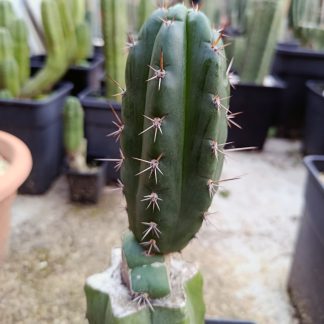
Echinopsis eyriesii f. cristata, the ‘Crested Sea Urchin Cactus’, transforms the familiar deep-green ribbed species into spectacular fans, folds and brain-like mounds. A robust and increasingly sculptural crested cactus descended from a species famous for its enormous fragrant white nocturnal flowers. Live plant.
Currently unavailable.
Product Features
Echinopsis eyriesii f. cristata is the spectacular crested form of the classic ‘Sea Urchin Cactus’. Instead of developing the familiar globular to short-columnar stems of ordinary E. eyriesii, its growing point expands laterally into broad fans which fold, divide and crowd together as they mature, eventually producing dense, brain-like sculptural growth.
This is a particularly attractive mutation in a species already worth growing in its ordinary form. The deep-green crests retain the pronounced ribs, woolly areoles and short spination associated with E. eyriesii, but cristation distorts those structures into irregular waves and folds. No two established specimens develop in precisely the same way.
Young crests may initially form relatively simple fans. With age, continued growth along the elongated apical meristem causes those fans to curve and fold repeatedly, producing increasingly complex mounds. Well-established crested plants can become surprisingly substantial specimens, with cultivated examples reported eventually forming masses approaching a metre tall and considerably broader under favourable conditions.
The underlying species is naturally caespitose, and the cristate form can likewise branch and produce multiple growing fronts. Individual sections may expand at different rates, divide into new crests or occasionally produce conventional growth through partial reversion. That changing architecture is a major part of the appeal of growing cristate cacti.
Our standard Echinopsis eyriesii ‘Sea Urchin Cactus’ provides a useful comparison with the ordinary morphology of the species. Conventional plants develop deep-green globular to elongated stems, usually with approximately 9–18 pronounced ribs and very short spination.
The species is especially famous for its flowers. Mature conventional growth produces enormous, fragrant, long-tubed white flowers which open principally at night. The blooms can dwarf the stems that produce them and are one of the reasons E. eyriesii has remained popular in cultivation for nearly two centuries. Crested plants retain the underlying flowering potential of the species, although cristate growth can take longer to reach flowering maturity and flowering should never be assumed from every individual crest.
We also grow and work with E. eyriesii within our wider breeding collection. Its large white flowers and long history of compatibility within the Echinopsis/Trichocereus complex have made the species an important horticultural parent. It is also represented in our collection as a parent of Echinopsis eyriesii × Trichocereus candicans.
This crested form belongs naturally within our Mutants & Unusual Forms collection, which brings together the cristate, monstrose, variegated, dichotomous, polytomous and otherwise unusual cacti represented in the nursery.
Taxonomic note
Echinopsis eyriesii has one of the longer histories in cultivated Echinopsis. The plant was originally described by Pierre Jean François Turpin as Echinocactus eyriesii in 1830 and was transferred to Echinopsis by Pfeiffer and Otto in 1838.
The species name commemorates the French cactus enthusiast and collector Alexandre Eyries. It subsequently circulated under several additional combinations and horticultural names, including Cereus eyriesii and Echinonyctanthus eyriesii.
Current Kew taxonomy places Echinopsis eyriesii in the synonymy of Echinopsis oxygona. The two names have long been associated with a wider and highly variable complex of South American plants, and historical literature has treated their boundaries differently.
We nevertheless retain E. eyriesii in our catalogue. It remains a deeply established horticultural identity, is useful for keeping our plants and breeding records traceable, and describes the material under which this particular crest has circulated.
The crested plant has historically also been published or circulated as Echinopsis eyriesii var. cristata. We use f. cristata horticulturally because the defining characteristic is its crested growth rather than a geographically or taxonomically distinct natural variety.
Cristation is a growth mutation, not a separate species. The normal compact apical growing point becomes elongated into a line, so new tissue develops along a broad front rather than around a single apex. As that line expands faster than the plant can remain flat, it folds back on itself to create the characteristic fans, waves and brain-like masses.
The original trigger for an established crest usually cannot be determined. Fasciated growth can arise through developmental mutation or disruption and has also been associated more generally with damage and environmental or biological factors. We therefore do not assign a specific cause to this clone without evidence.
Likewise, the existence of a crested E. eyriesii does not mean that all crested plants of the species are one clone. Cristation can arise independently in genetically different plants. The designation f. cristata describes the growth form rather than functioning as a universal cultivar name.
Flowers and unusual growth
A mature conventional E. eyriesii produces some of the most impressive flowers relative to plant size in the cactus family: large, white, funnel-shaped and fragrant blooms carried on very long floral tubes. They open principally during the evening and night, with individual flowers relatively short-lived.
Whether and where a crest flowers depends heavily on the individual plant and its maturity. Cristate tissue devotes its growth across an extended meristem and can behave differently from ordinary stems. Some established crests eventually flower directly, while conventional shoots arising through reversion may also provide flowering growth.
Reversion is not evidence that the plant has somehow ceased to be the same genotype. A conventional shoot emerging from a crest remains part of the same plant; only its growth pattern has returned to a normal apical structure. Whether reverted growth is retained or removed is therefore largely a horticultural decision.
If the aim is to maintain a strongly crested specimen, conventional shoots can be removed before they dominate the slower-growing crest. They can also be rooted independently, providing an interesting opportunity to compare normal and cristate growth originating from the same plant.
Cultivation
E. eyriesii f. cristata is generally a robust and comparatively vigorous crested cactus. Grow it in a freely draining cactus substrate with strong light and excellent air movement. Water thoroughly during active growth, then allow the substrate to dry substantially before watering again.
Good light encourages compact, strongly folded growth. Insufficient light can produce stretched, weak sections that compromise the dense architecture of the crest. Plants moved from protected cultivation should nevertheless be acclimatised gradually before exposure to intense direct sunlight.
The convoluted structure deserves slightly more attention than an ordinary globular Echinopsis. Deep folds can retain water, dead flowers and organic debris, creating humid pockets with poor airflow. Keep the crest clean and well ventilated and avoid allowing water to remain trapped between folds for extended periods.
As the crest enlarges, its shape can also make the plant physically awkward. Repot carefully and support large specimens from beneath rather than lifting them by delicate growing edges. A broad, stable container becomes increasingly useful as the plant develops a heavier and more irregular crown.
Reduce watering substantially during cool winter conditions. A drier seasonal rest helps avoid root problems and supports the normal annual growth cycle. Cold, wet substrate is considerably more dangerous than cool conditions around a healthy dormant plant.
Vegetative propagation is required to preserve a particular crest. Sections can be removed with a clean blade, allowed to callus thoroughly and then rooted during suitably warm conditions. Seed produced after flowering represents a new genetic generation and should not be expected automatically to reproduce the cristate mutation.
About Echinopsis
Echinopsis eyriesii has been cultivated in Europe since the nineteenth century and remains popular for good reason. Even the ordinary species combines manageable growth with extraordinary nocturnal white flowers; cristation adds an entirely different sculptural quality without losing the underlying character of the plant.
The result is one of the more rewarding classic Echinopsis mutants: deep-green ribbed tissue transformed into continually changing fans, folds and brain-like mounds. Browse our complete Echinopsis collection for the wider range of species, unusual forms and flowering hybrids represented in the nursery.
Unless stated otherwise, plants ship bare-root to supported EU destinations. Outside our delivery area? Ask about seed-only orders or join our email list for shipping updates. Photos are representative unless an exact specimen is specified; ask for current specimen photos. Some plants are cut to order where noted. Save 10-35% automatically on qualifying live plants, with bonus seeds and at least one bonus cactus in every live plant order.
Product Details
| Product Type | |
|---|---|
| Amount | 1 rooted plant |
| Size | ~9 cm tall, ~12 cm diameter |
| Common Name | |
| Family | |
| Genus | |
| Species | |
| Form |
1 review for Echinopsis eyriesii f. cristata | ‘Crested Sea Urchin Cactus’ | Live plant
Only logged in customers who have purchased this product may leave a review.
You May Also Appreciate
-


Trichocereus sp. f. variegata cv. ‘Judith’ | Australian Mutant Clone | Live plant
€97.50 Add to basket -

Trichocereus bridgesii f. monstrosa cv. ‘Sina’ | ‘Monstrose Bolivian Torch’ | Live plant
€81.00 Add to basket -

Echinopsis hybrid f. monstrosa cristata cv. ‘Circle’ | Live plant
10% OFF until 30 Nov Original price was: €15.75.€14.17Current price is: €14.17. Add to basket -

Trichocereus bridgesii f. semi-monstrosa cv. ‘RAP’ | ‘Monstrose Bolivian Torch’ | Live plant
10% OFF until 30 Nov Original price was: €81.00.€72.90Current price is: €72.90. Add to basket -

Trichocereus peruvianus ‘Matucana’ f. variegata | ‘Variegated Peruvian Torch’ | Live plant
10% OFF until 30 Nov Original price was: €72.00.€64.80Current price is: €64.80. Add to basket -
Trichocereus chalaensis × Trichocereus pachanoi f. monstrosa (on ‘Emilio’) | Grafted Plant | Exact Specimen FCES0003
€75.00 Add to basket -

Trichocereus cuzcoensis f. cristata regressus cv. ‘Hamilton’s Peru Crest Revert’ | Live plant
€30.00 Add to basket -

Trichocereus bridgesii f. semi-monstrosa cv. ‘Freddy’ | ‘Semi-Monstrose Bolivian Torch’ | Live plant
20% OFF until 30 Nov Original price was: €81.00.€64.80Current price is: €64.80. Add to basket -

(Trichocereus chalaensis x Trichocereus pachanoi cv. ‘Oscar’) f. monstrosa cristata cv. ‘Chosca’ | Live plant
From €49.00 Browse options This product has multiple variants. The options may be chosen on the product page -

Trichocereus bridgesii f. monstrosa cv. ‘Rusty’ | ‘Monstrose Bolivian Torch’ | Live plant
10% OFF until 30 Nov Original price was: €77.00.€69.30Current price is: €69.30. Add to basket -

Trichocereus bridgesii f. monstrosa cv. ‘Jenna’ | ‘Monstrose Bolivian Torch’ | Live plant
10% OFF until 30 Nov Original price was: €59.50.€53.55Current price is: €53.55. Add to basket -

Trichocereus pachanoi f. variegata cv. ‘T102 / Ogrod’ | Live plant
10% OFF until 30 Nov Original price was: €76.00.€68.39Current price is: €68.39. Browse options This product has multiple variants. The options may be chosen on the product page
Paco B. (verified owner) –
Maravilloso, gracias por esta web repleta de tesoros