

Trichocereus thelegonus f. cristata | Live plant
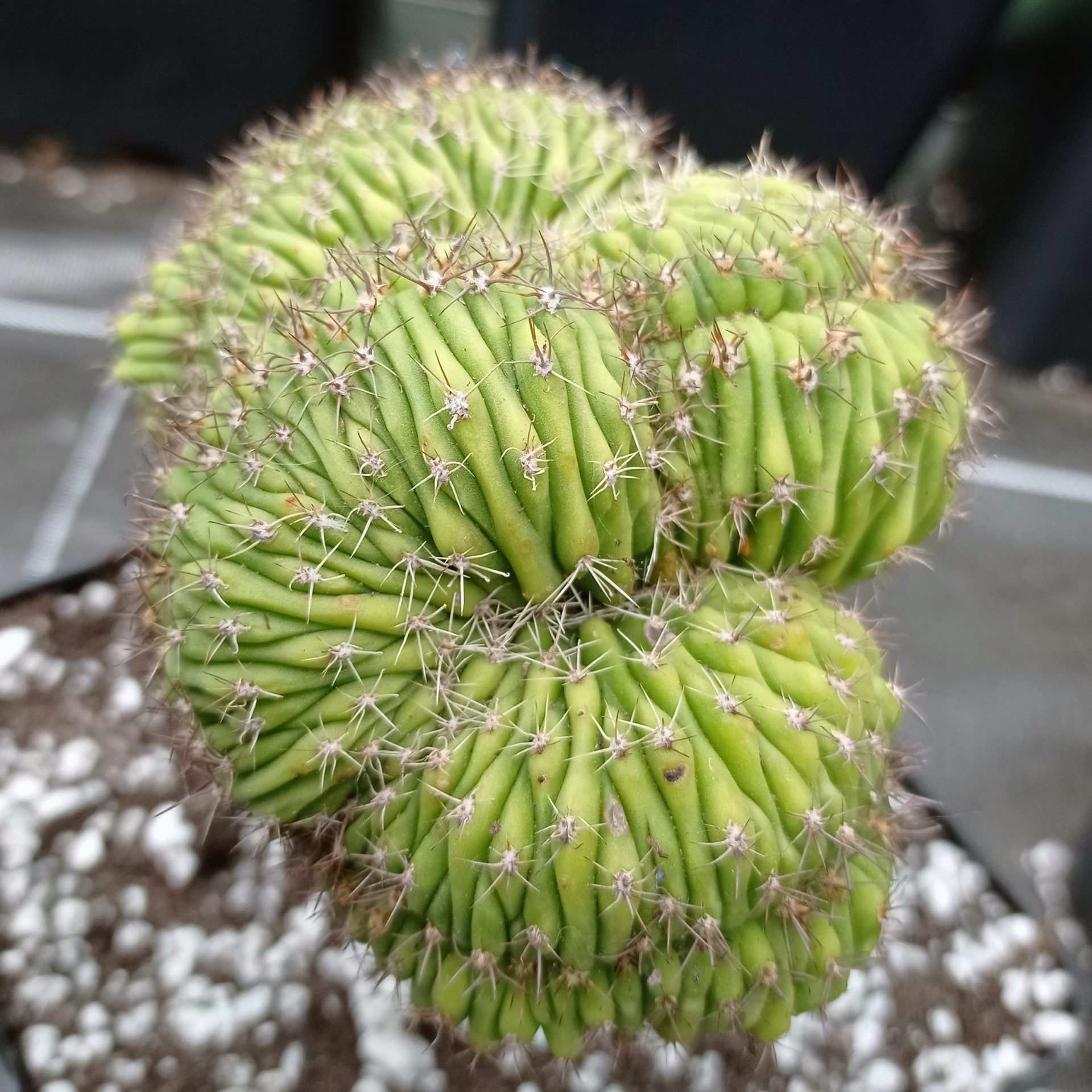
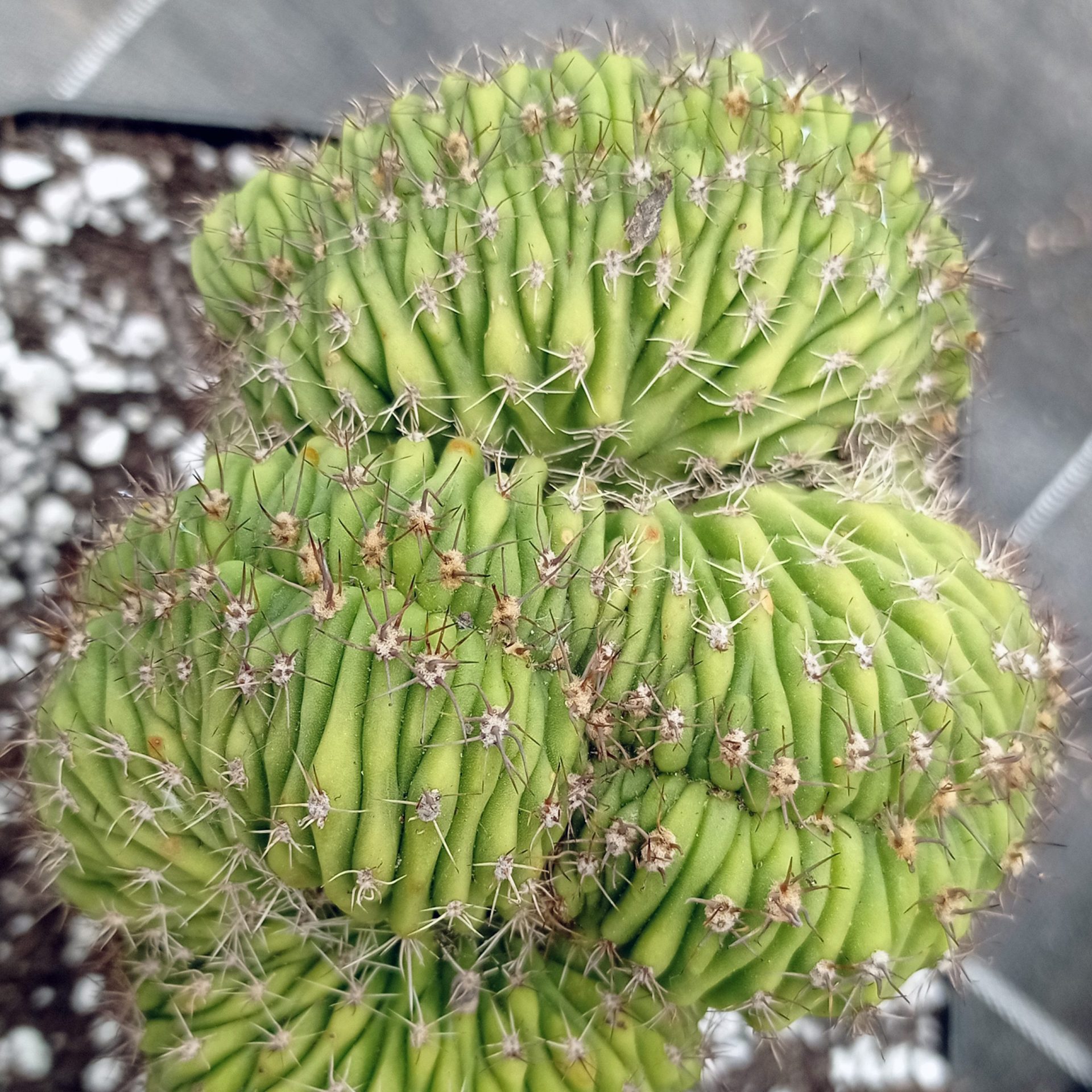
Trichocereus thelegonus f. cristata is the exceptionally unusual crested form of this distinctive Argentine species. Its already strongly sculpted thelegonus growth is transformed into slow-growing, twisted and increasingly convoluted fans, making it one of the most striking mutants in our Trichocereus collection. Live plant.
Currently unavailable.
Product Features
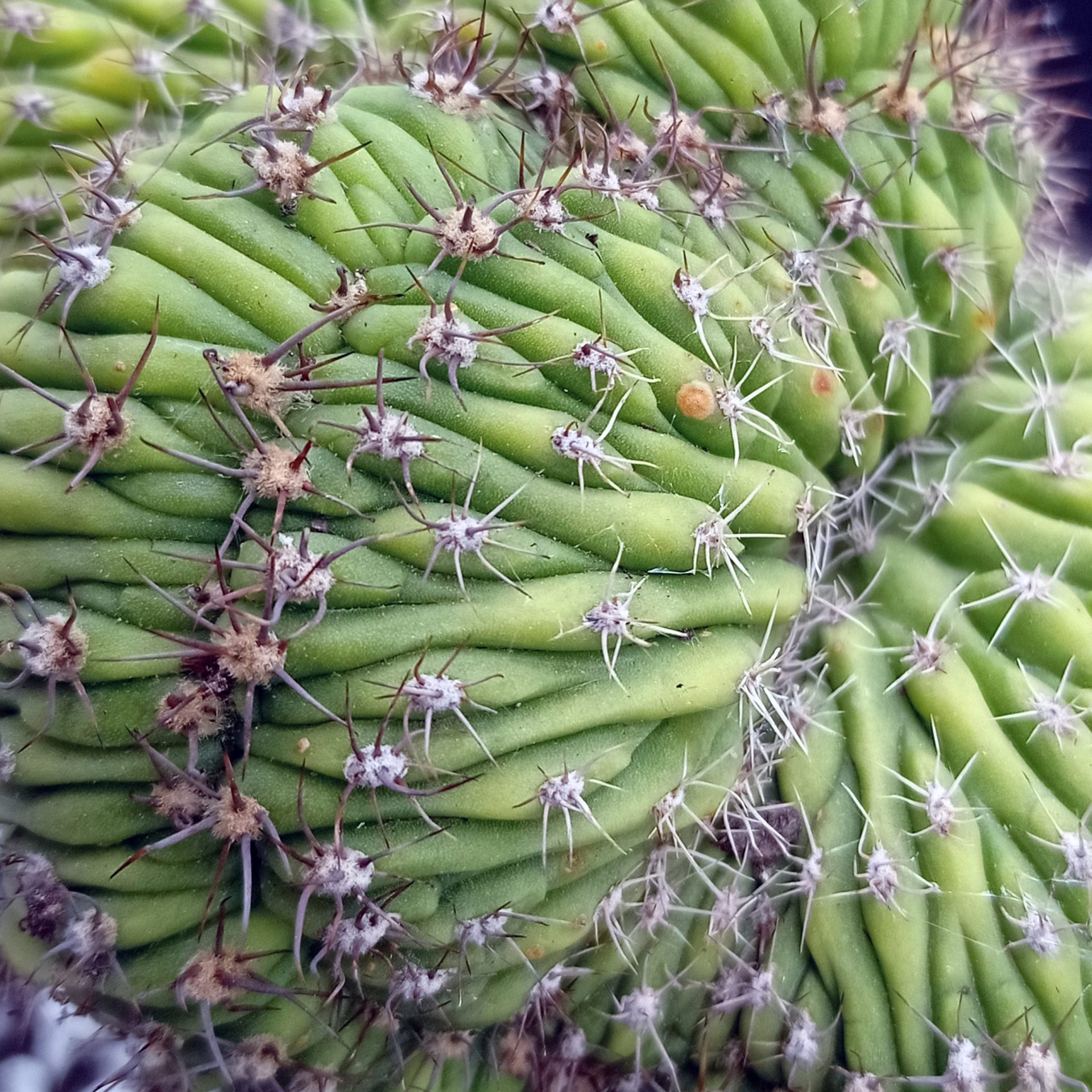
Trichocereus thelegonus f. cristata is the exceptionally unusual crested form of one of our favourite Argentine Trichocereus species. Standard T. thelegonus is already distinctive for its strongly sculpted, almost cellular-looking stem surface; cristation transforms that architecture into slowly expanding, twisted and knotted fans which become increasingly extraordinary with age.
Rather than maintaining the conventional cylindrical growing point of normal T. thelegonus, the apical meristem has elongated laterally. New growth consequently develops along a line rather than around a single point, producing the characteristic fan-shaped crest. As that growing edge expands, it curves, folds and crowds against itself, eventually creating convoluted structures quite unlike the ordinary branching columns of the species.
This is not simply an unidentified crest to which we have attached a convenient name. We maintain T. thelegonus itself extensively, including documented accessions, and the species has an unusually recognisable epidermal architecture. Our dedicated Trichocereus thelegonus mutant gallery documents this exact type of crested material alongside the wider mutant forms of the species in our collection.
The crested plants remain recognisably thelegonus beneath the mutation. Growth is green to light green and divided into strongly defined, geometric sections around the areoles, with yellowish to brown and reddish-brown spination. Cristation compresses, stretches and redirects those structures as the growing line develops, producing a remarkably textured surface across the folds of the crest.
Growth is generally considerably slower and more compact than conventional T. thelegonus. Energy that would ordinarily extend a column is distributed along the expanding crest, so mature specimens gradually build mass through repeated folding rather than simply gaining height. The resulting plant can become an extraordinary sculptural specimen given sufficient time.
Cristation is a form of fasciated growth rather than a separate species. A conventional cactus shoot develops from a relatively compact apical meristem; in a crest, that meristem becomes elongated and produces growth across a wider line. The precise trigger cannot usually be established retrospectively. Genetic or developmental abnormalities, environmental factors, physical damage and infection have all been associated with fasciation in plants, and we do not assign an unsupported cause to this particular mutant.
The mutation can also be dynamic. Sections of a crest may develop at different rates, divide into additional growing fronts or occasionally produce more conventional shoots through partial reversion. Such reverted growth remains genetically part of the same plant and can be useful for seeing how dramatically cristation has altered the ordinary architecture of the species.
Our Trichocereus thelegonus species archive provides the main catalogue route through the different genetics we maintain for this species. Among our documented material is T. thelegonus ‘TB 1126.4’, originating from a February 2022 Tomasz Błaczkowski collection at Cabra Corral–Juramento, east of Coronel Moldes, Salta, Argentina, at approximately 948 metres. That standard-growing accession provides a useful comparison with the profoundly altered architecture of the crested plants.
The species is still only sporadically encountered in European cultivation, and its crested form is considerably less commonplace again. This combination of an already unusual species and a dramatic growth mutation makes T. thelegonus f. cristata particularly worthwhile within a specialist Trichocereus collection.
It belongs naturally within our Mutants & Unusual Forms collection, alongside the crested, monstrose, variegated, dichotomous, polytomous and otherwise abnormal cacti we maintain.
The underlying species is native to north-western Argentina, including Salta, Jujuy and Tucumán. It is a branching columnar cactus of dry environments, and our botanical material consequently belongs within our Trichocereus Genetics from South America collection irrespective of the later horticultural history of an individual crested clone.
Taxonomic note
Trichocereus thelegonus has a comparatively straightforward core synonymy despite the repeated rearrangement of the surrounding genera. The species was originally published as Cereus thelegonus F.A.C.Weber and was transferred to Trichocereus by Britton & Rose in 1920.
Current Kew taxonomy accepts the species as Echinopsis thelegona (F.A.C.Weber) H.Friedrich & G.D.Rowley. Kew records Cereus thelegonus, Trichocereus thelegonus and Soehrensia thelegona as homotypic synonyms and gives north-western Argentina as its native range.
We retain Trichocereus thelegonus because it remains the most useful name within our collection and keeps this material together with the extensive Trichocereus genetics, hybrids and historical records in which the species occurs.
The suffix f. cristata describes the abnormal crested morphology. It should not be interpreted as evidence that this plant represents a separately accepted botanical taxon. Likewise, cristation alone does not create a cultivar: a particular vegetatively maintained crest may be a clone, but the phenomenon itself can arise independently in different seedlings or genetic lines of the same species.
This distinction is particularly relevant because we cultivate multiple unusual T. thelegonus plants. Two independently arising crested individuals can both correctly be called T. thelegonus f. cristata while remaining genetically distinct plants. The name describes their species and growth form, not a single universal clone.
Flowers and mature growth
Normal T. thelegonus develops into a branching cactus reaching roughly two metres under favourable conditions, with stems around 10 cm in diameter and yellow-brown to reddish spines reaching approximately 2.5 cm. Mature plants produce large, elongated white flowers which open principally at night, followed after successful pollination by rounded reddish fruits.
The species is self-sterile, so seed production requires compatible pollen from another genetically distinct plant. This becomes especially important with clonally propagated mutants: two cuttings from the same crested mother remain the same genotype and do not become genetically distinct pollination partners simply because they are grown as separate plants.
Flowering from a crest can take considerably longer than from vigorous conventional columns because mutant growth is generally slower. Reverted conventional branches, if produced and retained, may eventually provide another route to flowering while remaining genetically part of the same mutant individual.
Cultivation
We cultivate crested T. thelegonus in a freely draining cactus substrate with strong light and excellent air movement. During active growth, water thoroughly and then allow the substrate to dry substantially before watering again. Periodic feeding through the warmer growing season supports healthy development of the expanding crest.
Strong light encourages compact, well-armed growth and helps prevent the crest becoming weak or excessively stretched. As with any cactus moved from protected conditions, acclimatise plants gradually before exposing them to intense direct sunlight.
The convoluted architecture requires slightly more attention than an ordinary column. Deep folds can trap moisture, dead flowers, substrate or organic debris, while tightly packed areas may dry more slowly after overhead watering. Good airflow around and through the crest is therefore especially useful, and persistent moisture lodged within folds should be avoided.
Crested growth can also be physically more vulnerable than a conventional stem. As the growing edge broadens and folds, relatively narrow points can eventually support substantial masses of tissue. Handle established plants carefully during repotting and transport rather than lifting them by the crest.
Our cactus cold-hardiness reference places standard T. thelegonus at approximately -10°C / 14°F. That figure should be treated as an approximate reference for healthy, acclimatised plants rather than a target for valuable crested material. Cristate specimens are slower to replace damaged tissue and are generally worth protecting more conservatively.
Reduce watering sharply as temperatures fall and maintain excellent drainage during winter. Cold combined with persistent root or crest moisture presents a substantially greater risk than a dry winter rest.
Vegetative propagation is required to preserve a particular crested genotype. Sections should be removed cleanly, allowed to callus thoroughly and rooted during suitably warm conditions. Seed produced by a flowering crest represents a new genetic generation: seedlings cannot automatically be called the same clone and should not be expected to reproduce the cristation.
About Trichocereus
T. thelegonus is already one of the stranger botanical species in the genus, with an epidermal structure quite unlike the smooth-ribbed architecture of familiar plants such as T. pachanoi or T. bridgesii. Cristation exaggerates that character dramatically, turning its geometric stem pattern into a slowly changing mass of fans, folds and knotted growing edges. It is one of the most interesting mutants we cultivate.
Explore our complete Trichocereus collection for the wider range of botanical species, locality collections, field-numbered material, cultivars, hybrids and unusual forms.
Unless stated otherwise, plants ship bare-root to supported EU destinations. Outside our delivery area? Ask about seed-only orders or join our email list for shipping updates. Photos are representative unless an exact specimen is specified; ask for current specimen photos. Some plants are cut to order where noted. Save 10-35% automatically on qualifying live plants, with bonus seeds and at least one bonus cactus in every live plant order.
Product Details
| Product Type | |
|---|---|
| Amount | 1 rooted plant |
| Size | Size is added here when this item is in stock. |
| Family | |
| Genus | |
| Species | |
| Form |
Only logged in customers who have purchased this product may leave a review.
You May Also Appreciate
-


(Trichocereus chalaensis x Trichocereus pachanoi cv. ‘Oscar’) f. monstrosa cristata cv. ‘Chosca’ | Live plant
From €49.00 Browse options This product has multiple variants. The options may be chosen on the product page -

Trichocereus bridgesii f. semi-monstrosa cv. ‘Freddy’ | ‘Semi-Monstrose Bolivian Torch’ | Live plant
20% OFF until 30 Nov Original price was: €81.00.€64.80Current price is: €64.80. Add to basket -

Trichocereus peruvianus ‘Matucana’ f. variegata | ‘Variegated Peruvian Torch’ | Live plant
10% OFF until 30 Nov Original price was: €72.00.€64.80Current price is: €64.80. Add to basket -

Trichocereus bridgesii f. monstrosa cv. ‘Rusty’ | ‘Monstrose Bolivian Torch’ | Live plant
10% OFF until 30 Nov Original price was: €77.00.€69.30Current price is: €69.30. Add to basket -

Trichocereus pachanoi f. variegata cv. ‘T102 / Ogrod’ | Live plant
10% OFF until 30 Nov Original price was: €76.00.€68.39Current price is: €68.39. Browse options This product has multiple variants. The options may be chosen on the product page -

Trichocereus bridgesii f. monstrosa cv. ‘Jenna’ | ‘Monstrose Bolivian Torch’ | Live plant
10% OFF until 30 Nov Original price was: €59.50.€53.55Current price is: €53.55. Add to basket -

Echinopsis hybrid f. monstrosa cristata cv. ‘Circle’ | Live plant
10% OFF until 30 Nov Original price was: €15.75.€14.17Current price is: €14.17. Add to basket -

Trichocereus cuzcoensis f. cristata regressus cv. ‘Hamilton’s Peru Crest Revert’ | Live plant
€30.00 Add to basket -

Trichocereus bridgesii f. semi-monstrosa cv. ‘RAP’ | ‘Monstrose Bolivian Torch’ | Live plant
10% OFF until 30 Nov Original price was: €81.00.€72.90Current price is: €72.90. Add to basket -

Trichocereus sp. f. variegata cv. ‘Judith’ | Australian Mutant Clone | Live plant
€97.50 Add to basket -
Trichocereus chalaensis × Trichocereus pachanoi f. monstrosa (on ‘Emilio’) | Grafted Plant | Exact Specimen FCES0003
€75.00 Add to basket -

Trichocereus bridgesii f. monstrosa cv. ‘Sina’ | ‘Monstrose Bolivian Torch’ | Live plant
€81.00 Add to basket
Reviews
There are no reviews yet