
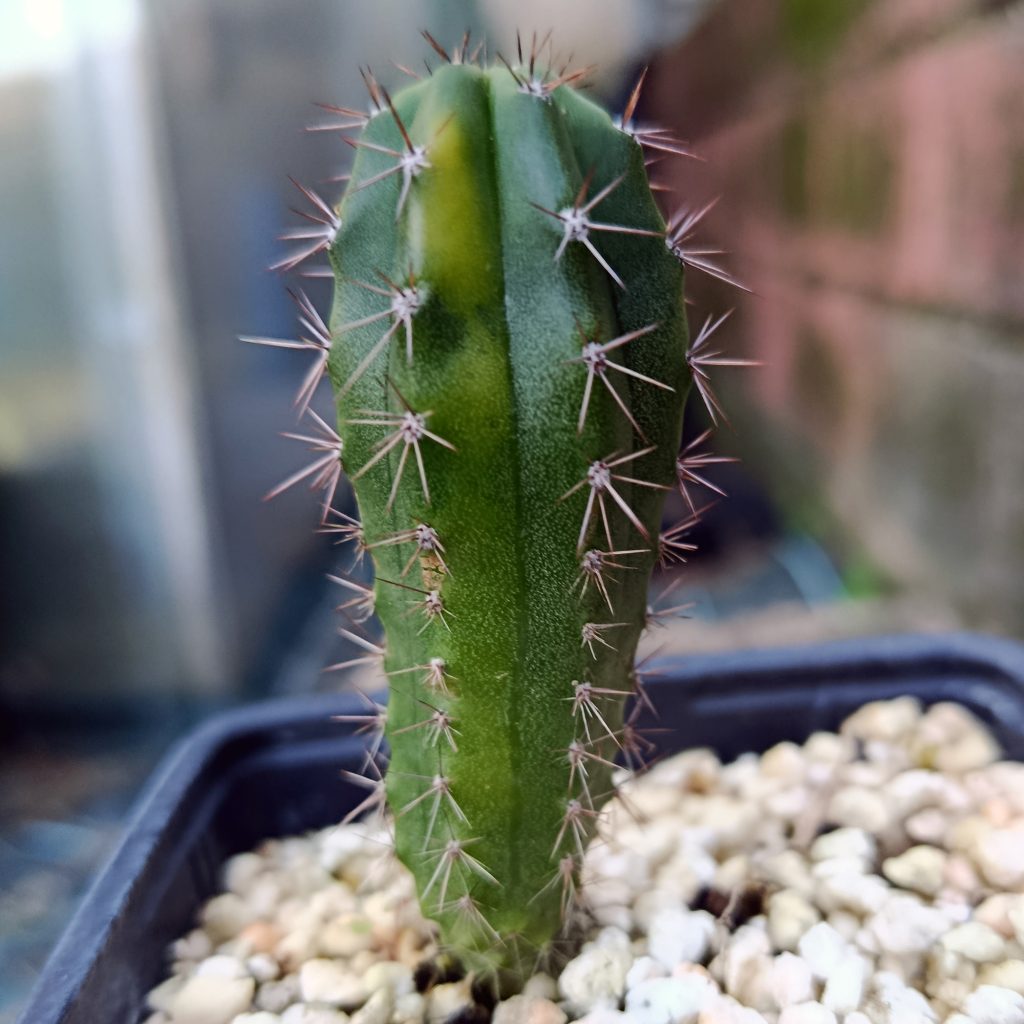
Our Trichocereus knuthianus mutant gallery begins with a promising variegated seedling from our own sowings. At around one year old and approximately 10 cm tall, this young plant has developed a yellow-green band running towards its growing tip, noticeably paler than the surrounding green stem. We have seen similar patterns develop into lasting variegation in other seed-grown cacti, and we think this one is very likely to do the same.
Unusual knuthianus have been elusive in our experience. The only mutants of this species we have personally encountered so far are a couple of variegated seedlings from our own sowings. Whether T. knuthianus is genuinely less inclined to produce mutations, or whether this simply reflects its more limited representation in horticultural cultivation and breeding than familiar plants such as T. bridgesii, T. pachanoi and T. peruvianus, we cannot say. Our observations are too few to establish a species-wide tendency.
Seed-Grown Trichocereus knuthianus Showing Early Variegation
The paler area is particularly noticeable on the upper part of the stem, where a yellow-green stripe follows a rib towards the apex. Its neighbouring tissue remains considerably greener. The seedling otherwise shows fairly ordinary young knuthianus growth, with an upright ribbed stem and developing spines. It is the uneven pigmentation, rather than an unusual stem shape, that caught our attention.
Will the Variegation Persist?
Based on our experience with similar seed-grown plants, we would put our confidence at about 90% that this seedling will develop into a permanently variegated cactus. That figure is our horticultural judgement, not a statistically measured probability. We have grown enough seedlings with early pale sectors to recognise patterns which, in our experience, often mark the beginning of genuine and persistent variegation rather than temporary discolouration.
There is still room for the plant to surprise us. New growth could carry the same stripe, develop larger yellow areas, become greener or arrange its pale tissue differently. What matters now is how pigmentation continues through the growing point. We will document that development as the seedling matures.
Variegation involves differences in pigmentation between areas of tissue, commonly including regions with reduced chlorophyll. Its visible appearance alone does not identify the underlying genetic or developmental cause. Nor does it mean that seed eventually produced by a variegated plant would necessarily give variegated offspring. Our gallery of variegated Trichocereus shows how differently these patterns can appear among cultivated plants.
Typical Trichocereus knuthianus for Comparison: ‘Fields’ and ‘SPI’
For comparison, here are two normally pigmented Trichocereus knuthianus plants in our collection. The first is the historic Australian ‘Fields’ clone; the second is our separately maintained ‘SPI’ plant. Both show the more usual green to blue-green stem colouring associated with cultivated knuthianus, without the conspicuous yellow-green sector visible on our seedling.

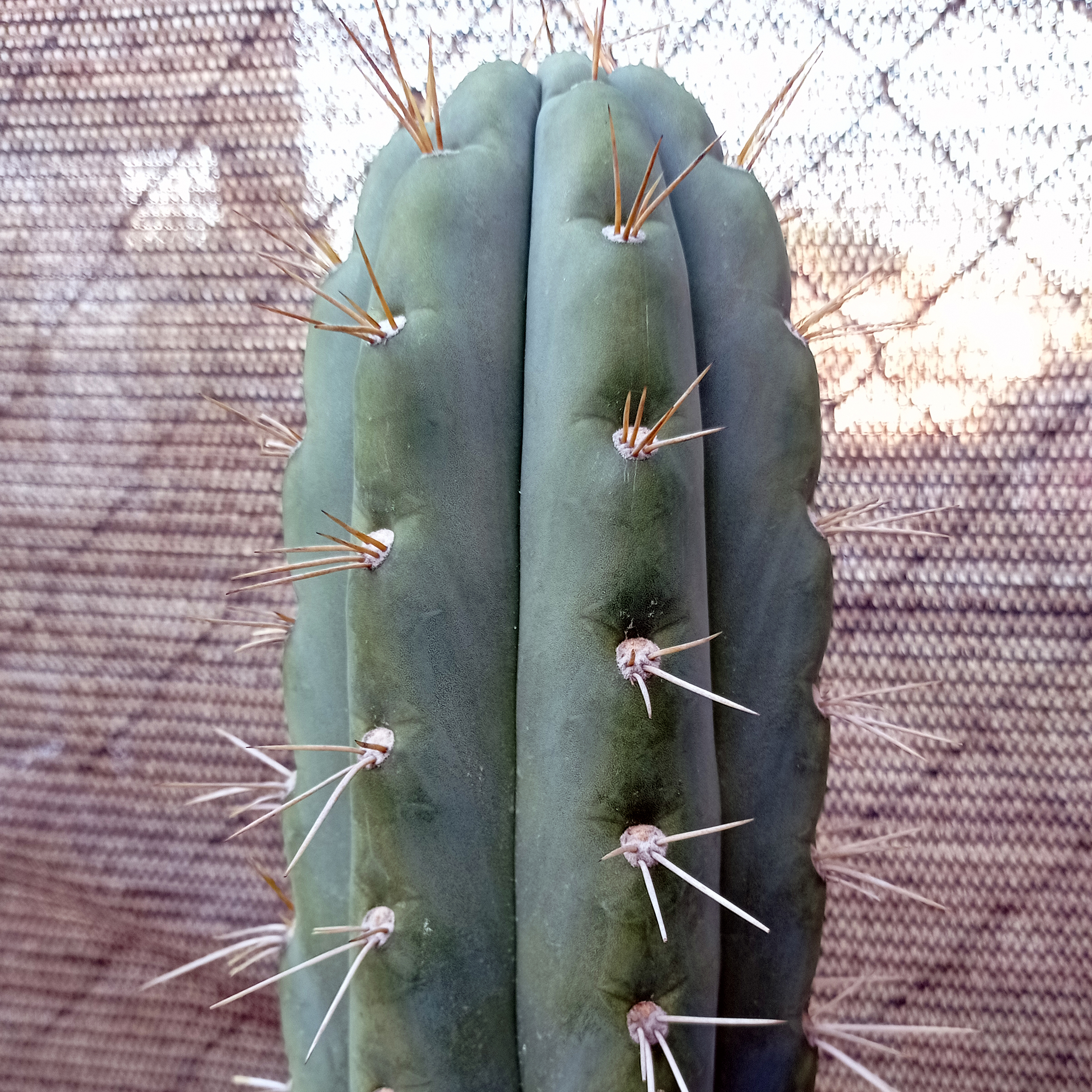
These are comparisons of appearance, not statements about parentage. Neither ‘Fields’ nor ‘SPI’ is being identified as a parent or other documented relative of our variegated seedling, whose seed origin should not be inferred from the plants pictured alongside it.
A Note on the Name Trichocereus knuthianus
We retain Trichocereus knuthianus because it is the horticultural name under which this material is grown and distinguished in our collection. Plants of the World Online currently treats T. knuthianus as a synonym of Echinopsis cuzcoensis. That broader botanical treatment is worth knowing, but it does not make every cultivated plant circulated under these different names the same clone or accession. The history of this group is discussed further in our Peruvian Torch complex overview.
Explore Trichocereus knuthianus at Freaky Cacti
Our Trichocereus knuthianus catalogue archive brings together plants, seed and related material recorded under this horticultural name. We also have individual listings for the ‘SPI’ live plant, the ‘Fields’ clone and other knuthianus live plants.
For those interested in raising their own plants, our T. knuthianus seed listing and the separate T. knuthianus × open-pollinated seed offer two distinct recorded seed sources. Neither listing should be taken as the provenance of the variegated seedling illustrated here, nor as a promise of mutant offspring.


Browse T. knuthianus | Explore Mutant Cacti | Explore Variegated Forms | Explore Trichocereus
Related Mutant Galleries
For more seed-grown abnormalities and variegated cacti from our collection, see Trichocereus hahnianus Mutants, Trichocereus purpureopilosus Mutants and our wider Variegated Trichocereus Gallery.