
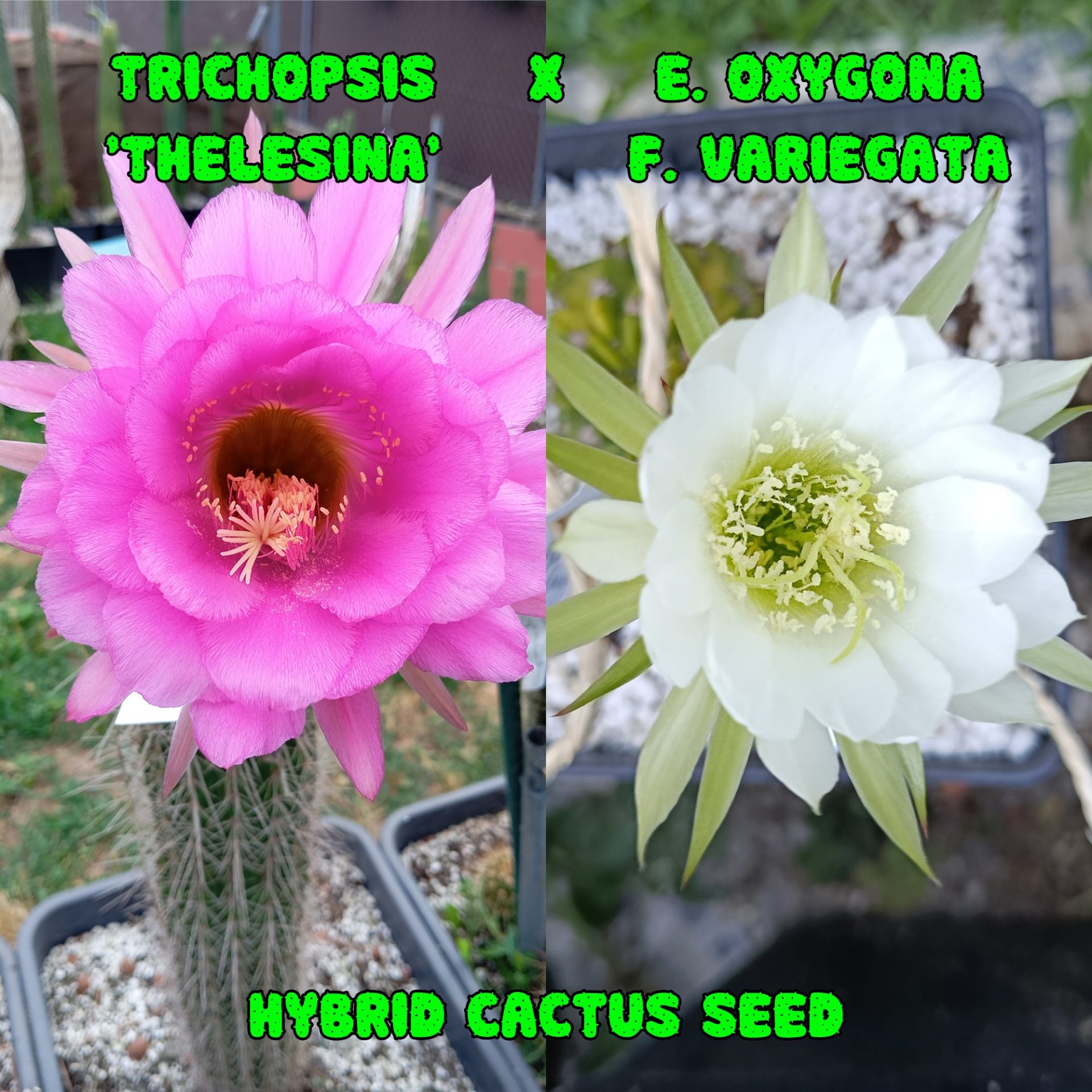

(Trichocereus thelegonus × Echinopsis kermesina) cv. ‘Thelesina’ × Echinopsis oxygona f. variegata | Seeds
From €5.00
Seeds from our August 2026 hybrid of pink-magenta-purple-lilac-flowered (Trichocereus thelegonus × Echinopsis kermesina) cv. ‘Thelesina’ × variegated, large pale-flowered Echinopsis oxygona.
Product Features
Cactus seeds from our August 2026 harvest, produced at Freaky Cacti by crossing our (Trichocereus thelegonus × Echinopsis kermesina) cv. ‘Thelesina’ as the mother with a variegated Echinopsis oxygona as the pollen parent.
‘Thelesina’ is an established ornamental hybrid with striking flowers spanning pink, magenta, purple and lilac tones. The father provides a very different background through the characteristically large, pale flowers of E. oxygona, together with conspicuous variegation in the parent plant.
Parentage
Mother: (Trichocereus thelegonus × Echinopsis kermesina) cv. ‘Thelesina’
Father: Echinopsis oxygona f. variegata
This hybrid forms part of our growing archive of material bred by Freaky Cacti. Each seedling will be genetically distinct, with considerable scope for differences in flower colour, body form, spination and general habit.
About ‘Thelesina’
‘Thelesina’ combines Trichocereus thelegonus with Echinopsis kermesina, bringing together two rather different South American cactus backgrounds in one established ornamental cultivar.
The T. thelegonus side contributes an unusual elongated growth habit and distinctive rib and areole structure. It is an Argentine species which has been used repeatedly in ornamental hybridisation and appears in several established European breeding lines.
E. kermesina contributes a much more compact Echinopsis background and strongly coloured flowers. The resulting ‘Thelesina’ is particularly valued for its pink through magenta, purple and lilac floral tones.
Our Thelesina archive brings together the cultivar and the growing number of seed lines in which its genetics occur.
About Echinopsis oxygona f. variegata
The father is a variegated form of Echinopsis oxygona, a South American species particularly well known for producing very large white to pale flowers from comparatively compact plants.
Its variegated growth adds another ornamental characteristic to the paternal side of the cross, with reduced chlorophyll producing contrasting areas of stem colour. Variegation in the pollen parent does not mean every seedling will inherit or visibly express the same characteristic.
The father therefore contributes both a contrasting pale-flowered background and the possibility of unusual chlorophyll expression among at least some descendants.
What might the seedlings produce?
The flower genetics are particularly interesting. ‘Thelesina’ contributes pink, magenta, purple and lilac tones, while E. oxygona introduces a large white-flowered background.
Individual seedlings may favour either side of the pedigree or produce less obvious combinations of colour, petal form, throat colour and flower size. Pale pinks, stronger purples and intermediate patterned flowers are all possibilities worth exploring, but individual outcomes cannot be predicted from seed.
The body forms may also vary substantially. ‘Thelesina’ already combines the elongated influence of T. thelegonus with a shorter-bodied Echinopsis, while the pollen parent reinforces the compact Echinopsis side of the pedigree.
Variegation adds another variable. Any seedlings developing unusual yellow, cream or paler chlorophyll patterns should be assessed individually rather than assumed to represent the whole population.
Taxonomic context
The historical parentage remains the most useful way to record ‘Thelesina’, although modern taxonomy treats both sides somewhat differently.
Trichocereus thelegonus is currently accepted as Echinopsis thelegona, while Echinopsis kermesina is currently included within Echinopsis mamillosa. We retain the established formula T. thelegonus × E. kermesina because it records the horticultural identities under which ‘Thelesina’ was bred and has circulated.
European ornamental cactus genetics
‘Thelesina’ has a long-established place within European ornamental cactus cultivation and now appears repeatedly in further crosses. This seed line consequently forms part of our Trichocereus Genetics from Europe collection.
Maintaining dedicated archives for ‘Thelesina’, T. thelegonus, E. kermesina and E. oxygona allows these relationships to remain visible as further generations are produced and flowered.
About Trichocereus and Echinopsis hybridisation
Trichocereus and Echinopsis have been combined extensively in ornamental breeding, allowing columnar and shorter-bodied growth forms to be mixed with an enormous range of flower colours and forms.
‘Thelesina’ is itself a good example of that history, and this further cross with E. oxygona takes those genetics another generation forward.
Our mutants and unusual forms archive brings together variegated and other atypical material in the collection.
Growing the seeds
Surface-sow on a fine, evenly moist and freely draining cactus substrate, covering the seeds only very lightly if at all. Warm conditions, useful light and sustained humidity are generally suitable during germination and early seedling development.
Our current nursery method is described in our guide to growing cacti from seed, including substrate preparation, humidity management and gradual acclimatisation.
Harvest details
These seeds were harvested at Freaky Cacti in August 2026. Our own 2026 seed is cleaned before packing to remove visibly immature or otherwise malformed seed.
Save 10-55% automatically on qualifying standard 25-seed packs and receive bonus seeds with every seed order. Seed-only orders over €125 after discounts ship free. Outside our delivery area? Contact us about a seed-only order. Please check your destination's import and local restrictions before ordering.
Product Details
| Product Type | |
|---|---|
| Amount | 25 seeds, 50 seeds, 100 seeds, 250 seeds, 500 seeds |
| Family | |
| Genus | |
| Species | |
| Clone/Variety/Cultivar | |
| Form | |
| Breeder/Source | |
| Year Harvested | |
| Collection |
Only logged in customers who have purchased this product may leave a review.
You May Also Appreciate
-


Echinopsis hybrid cv. ‘Oriole’ × Trichocereus aff. coquimbanus | Seeds
€5.00 Add to basket -

Trichocereus crassicaulis × Echinopsis subdenudata f. variegata | Seeds
€5.00 Add to basket -

(Hildewintera hybrid ‘Noller 2’ × Trichocereus vasquezii) cv. ‘Butterfley’ × (Hildewintera hybrid ‘Noller 2’ × Trichocereus vasquezii) | Seeds
€5.00 Add to basket -

(Hildewintera hybrid ‘Noller 2’ × Trichocereus vasquezii) × Echinopsis subdenudata f. variegata | Seeds
€5.00 Add to basket -

Echinopsis eyriesii × Trichocereus scopulicola cv. ‘Poland’ | Seeds
€5.00 Add to basket -

Trichocereus huascha v. rubriflora × Echinopsis eyriesii f. variegata marmorata | Seeds
€5.00 Add to basket -

Echinopsis hybrid cv. ‘Infinity’ × Trichocereus crassicaulis | Seeds
€5.00 Add to basket -

(Hildewintera hybrid ‘Noller 2’ × Trichocereus vasquezii) × Echinopsis eyriesii f. variegata marmorata | Seeds
€5.00 Add to basket -

Echinopsis eyriesii f. variegata marmorata × (Trichocereus hybrid cv. ‘Pisac’ × Trichocereus vatteri) | Seeds
€5.00 Add to basket -

Echinopsis hybrid cv. ‘Temptress’ × Lobivia jajoiana | Seeds
€5.00 Add to basket -

Echinopsis hybrid cv. ‘Oriole’ × Lobivia winteriana | Seeds
€5.00 Add to basket -

(Hildewintera hybrid ‘Noller 2’ × Trichocereus vasquezii) × Echinopsis hybrid cv. ‘Orange California’ | Seeds
€5.00 Add to basket

Reviews
There are no reviews yet