
Trichocereus species ‘Vicuña’ (Long Spines) | Live plant
€13.75
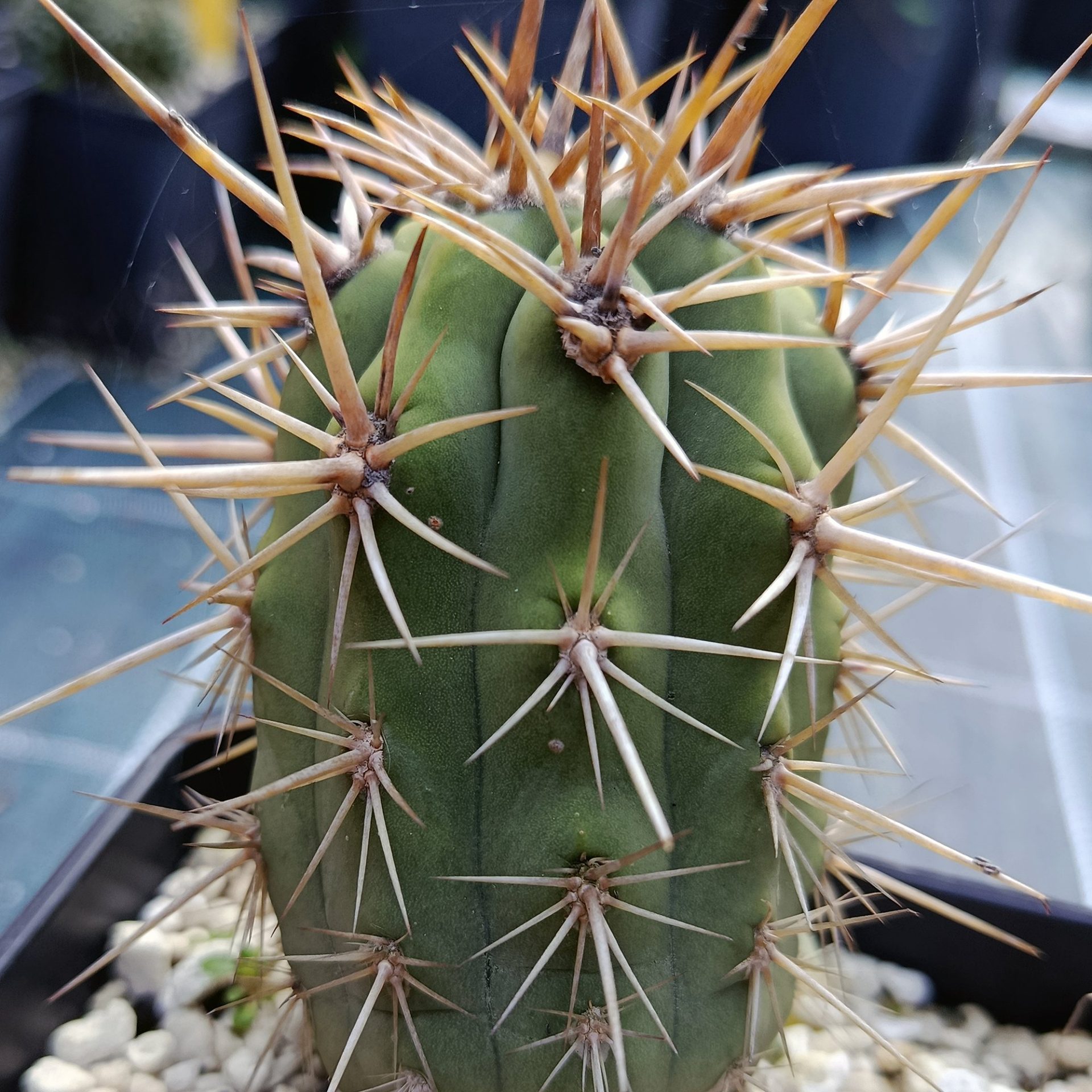
Trichocereus species ‘Vicuña’ (Long Spines) is an unusual Chilean-type cactus distinguished by exceptionally long, widely projecting spines in straw-yellow, amber and brown tones. Strongly ribbed green to grey-green stems carry pale woolly areoles and an especially impressive crown of emerging spines. Maintained under its original ‘Vicuña’ collection designation, this selection has possible historical associations with Chile’s Coquimbo Region, although its precise species identity and original field provenance remain unconfirmed. An appealing plant for collectors of distinctive, heavily spined Trichocereus.
Plant photos are representative unless an exact specimen is specified. Want to see a particular available plant? Ask for current specimen photos.
Product Features
Trichocereus species ‘Vicuña’ (Long Spines) is a striking, heavily armed Chilean-type cactus maintained at Freaky Cacti under its original ‘Vicuña’ collection designation. Its most conspicuous feature is an impressive arrangement of exceptionally long, slender spines, radiating from pale, woolly areoles over strongly ribbed green to grey-green stems.
Unlike the relatively short-spined Trichocereus familiar to many growers, this selection has a distinctly formidable appearance. The spines extend well beyond the body, forming an open, almost architectural framework around the plant. Their pale straw, honey and amber tones contrast with darker brown tips and the fresh green epidermis beneath.
The precise botanical identity remains unresolved. Although the name suggests a connection with Vicuña in Chile’s Coquimbo Region, we retain it as a horticultural collection designation rather than presenting an unverified locality or species identification as established fact.
Growth and appearance
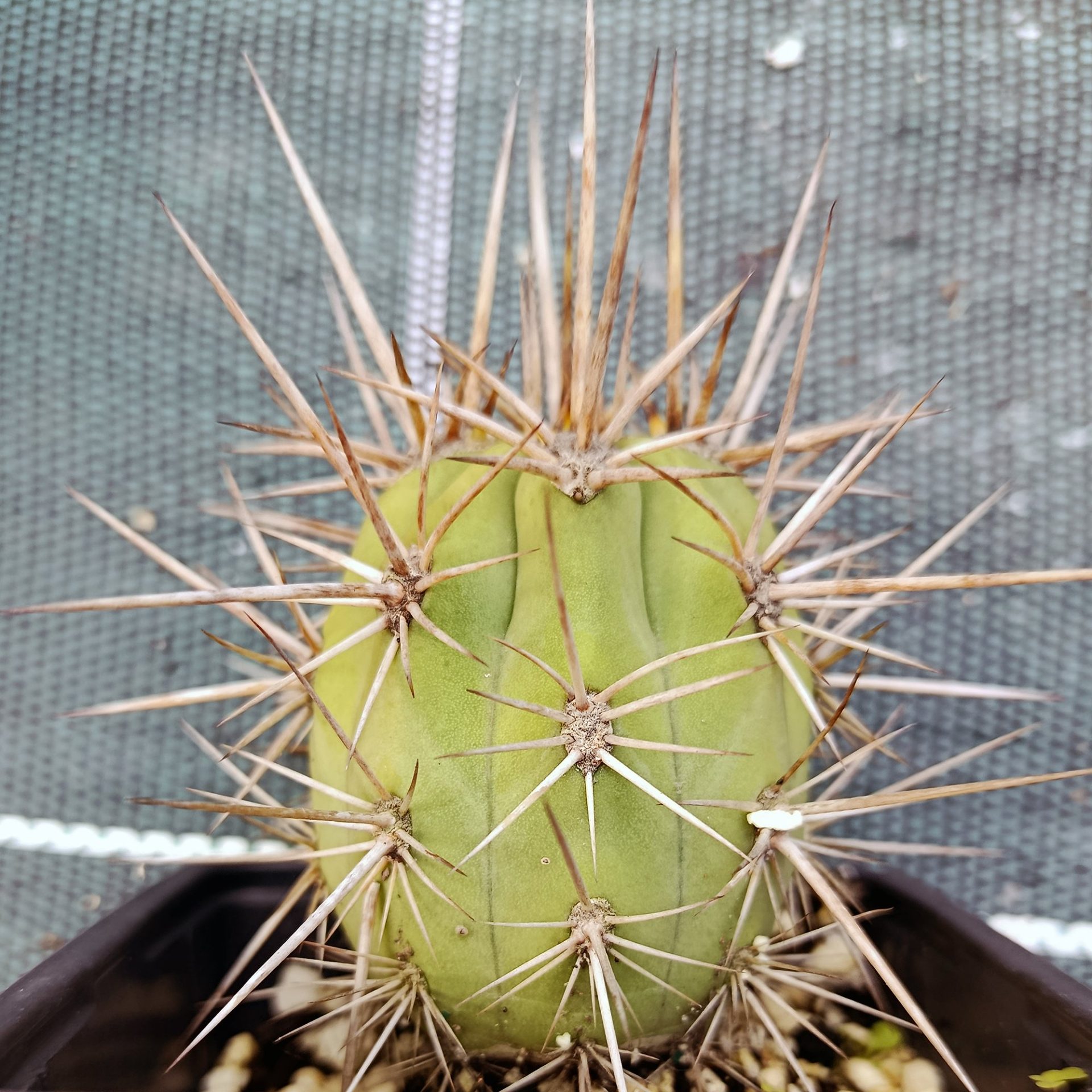
Young growth is initially rounded to short-columnar, becoming more elongated as the stems develop. The body is divided into well-defined longitudinal ribs, with moderately deep grooves and a green to subtly grey-green epidermis. Its comparatively restrained stem colour provides an effective background for the conspicuous spination.
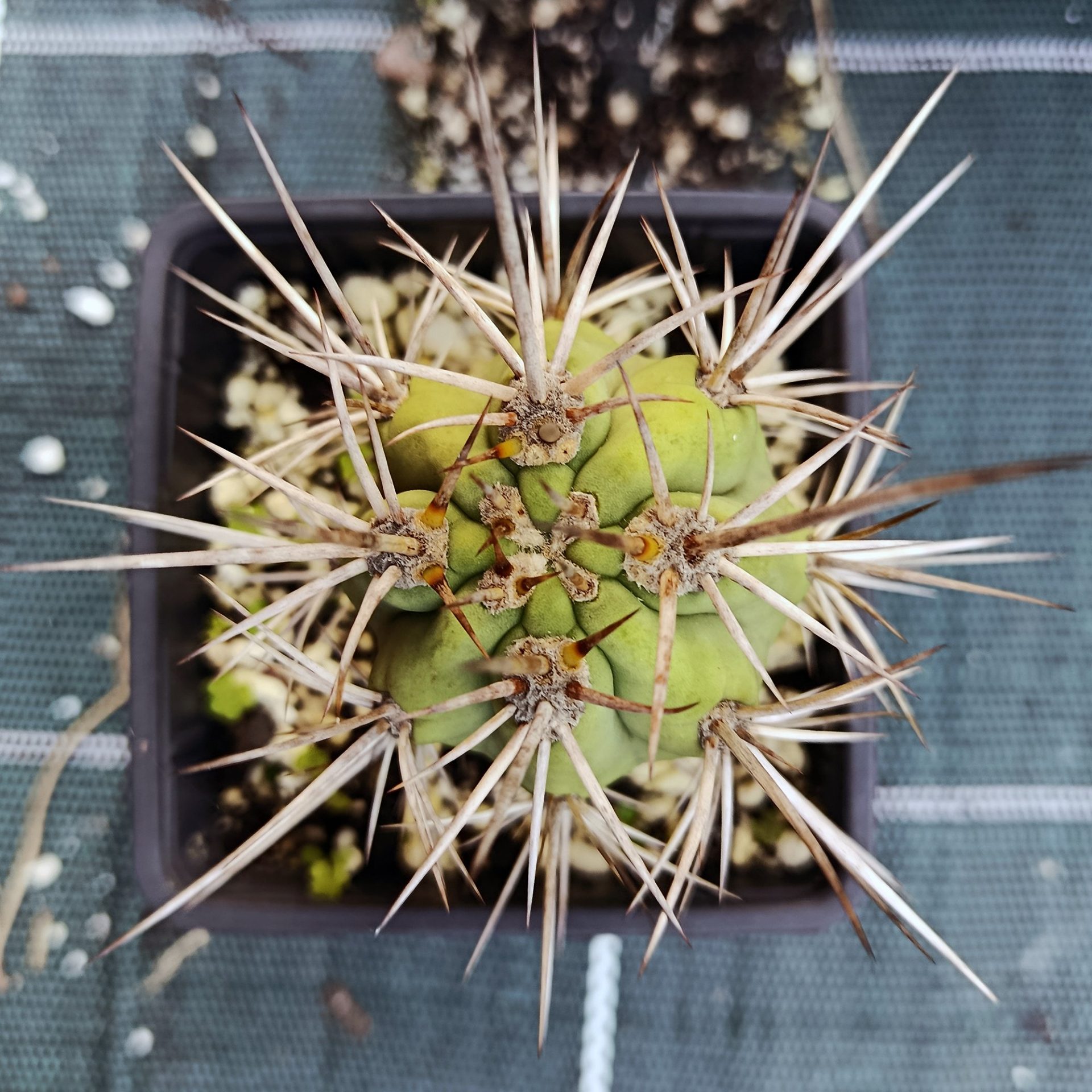
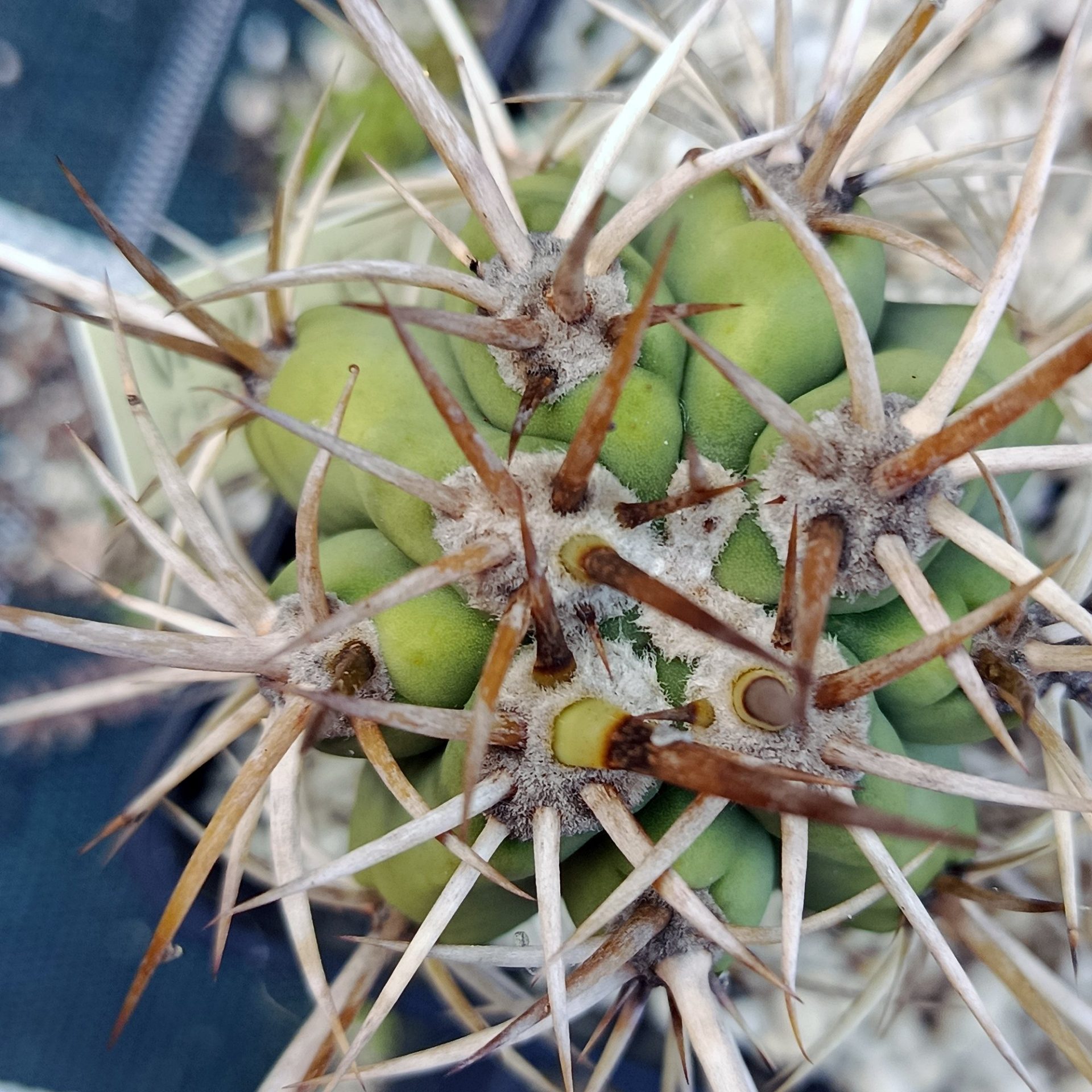
The areoles are particularly attractive. Each sits on the outer edge of a rib and bears a small cushion of pale wool, from which the spines project in several directions. The radial spines create a loose starburst, while stronger central spines extend further outwards or upwards, sometimes at pronounced angles to the stem.
Newer spines can appear pale yellow or golden, gradually developing warmer amber and brown tones. Some are markedly darker towards their tips. Around the growing apex, the closely arranged young areoles and their emerging spines form a dense, intricate crown.
What distinguishes this selection is not simply the length of an individual spine, but the combined effect of the whole armature: long, widely spreading spines, conspicuous central projections and numerous pale areoles arranged along the ribs. Even comparatively young plants have a much more heavily defended appearance than many conventional columnar cacti.
The eventual proportions and branching habit of mature specimens are still worth observing. The ‘Long Spines’ designation identifies the particularly noticeable character of our material without implying that every spine will retain precisely the same length or colour throughout the plant’s development.
The ‘Vicuña’ collection name
Vicuña is a town and commune in the Elqui Valley of Chile’s Coquimbo Region, east of La Serena. Its surrounding hills and valleys form part of a botanically interesting landscape in which several strongly spined Chilean columnar cacti occur.
We originally received this material under the name ‘Vicuña’ and have retained that designation to preserve its identity within our collection. The additional description ‘Long Spines’ helps distinguish it from other Trichocereus material.
We also recall seed of unusual, long-spined Chilean Trichocereus circulating among European cactus growers some years ago, possibly during the 2010s. Indeed, locality-associated, long-spined forms from the wider Vicuña area have appeared in European seed catalogues. However, we have not established a documentary connection between those earlier offerings and the particular material maintained at Freaky Cacti.
Consequently, ‘Vicuña’ should be understood as the name under which this selection has been preserved, rather than proof of a particular wild collection site, seed supplier or original collector.
Botanical identity and related Chilean species
There are several plausible points of comparison within the Chilean Trichocereus group, although the available evidence is insufficient to identify this selection confidently with any one of them.
One is Trichocereus chiloensis, the Chilean quisco, a widespread and variable complex that includes plants with exceptionally substantial spination. Names historically associated with this group include var. borealis, var. zizkaanus and subsp. panhoplites. Such forms are relevant comparisons because of their prominent central spines, strongly ribbed stems and occurrence in northern and central Chile.
We also see some superficial similarities with Trichocereus deserticolus, which can produce relatively compact, strongly spined growth. However, T. deserticolus is associated primarily with more northerly, often coastal habitats, so its resemblance in cultivation should not be mistaken for evidence of shared provenance.
Another name encountered in the wider regional flora is Trichocereus coquimbanus. This belongs to a historically complicated group of Chilean taxa whose names and boundaries have been interpreted differently by successive authors.
The difficulty is not merely one of choosing among similar-looking plants. Chilean Trichocereus taxonomy has undergone repeated revision, with several familiar horticultural names transferred to or interpreted within Echinopsis, Leucostele and related genera. Species concepts can also differ substantially between treatments.
For this reason, the name Trichocereus species ‘Vicuña’ is deliberately conservative. It preserves a useful collection identity without implying that its precise relationship to chiloensis, deserticolus or another Chilean taxon has been established.
What the Vicuña district’s collecting records tell us
The wider Vicuña area has attracted botanical collectors for decades. As one documented example, Alan William Craig recorded an unidentified Trichocereus under field number AWC 528 on 12 November 1996, approximately eight kilometres south of Vicuña.
That record is interesting because it confirms that unidentified Trichocereus material has been documented close to the locality suggested by our plant’s name. It is, however, a separate field collection. We do not claim that ‘Vicuña’ (Long Spines) derives from AWC 528 or from any other numbered accession without supporting provenance.
For a specialist collector, maintaining this distinction matters. A descriptive collection name can remain useful over many years, even when the original gathering details are incomplete. Assigning an unsupported field number or a more precise botanical identity would make the history appear stronger than it is.
Flowers and further identification
The flowering characteristics of this particular selection have not yet been established in our records. Related Chilean Trichocereus species frequently produce substantial pale or white flowers, but it would be premature to assign a definite flower colour, size or flowering period to ‘Vicuña’ on that basis alone.
Observations of mature flowering stems may eventually help narrow its botanical affinities. Floral structure, mature rib arrangement, branching habit and the relative development of central and radial spines are all valuable identification characters.
Until more complete evidence is available, the distinctive spination and preserved collection designation provide the soundest basis for recognising this material.
Cultivation
‘Vicuña’ (Long Spines) can be grown using the general principles appropriate to strongly spined Chilean Trichocereus, with particular attention to light, drainage and seasonal watering.
Provide a bright position with generous direct light once properly acclimatised. Good illumination supports compact, sturdy growth and encourages the development of strong spines. Plants moved from sheltered conditions should be introduced to intense sunshine gradually to avoid scorching tender epidermal tissue.
A freely draining, mineral-rich growing medium is preferable to one that remains persistently wet. Established plants can be watered thoroughly during active growth, allowing the substrate to dry appropriately between waterings. Avoid combining prolonged dampness with low temperatures.
During winter, substantially reduce watering according to temperature and growing conditions. A cool, largely dry rest is generally suitable, while protection from prolonged wet cold and hard frost is advisable, particularly for container-grown plants.
The widely projecting spines deserve consideration when positioning and handling these cacti. Allow sufficient space between neighbouring plants to prevent the longer spines from catching on adjacent stems or obstructing routine maintenance.
Our guide to caring for Trichocereus covers substrate choice, light, feeding, watering and seasonal care in greater detail.
Collection identity at Freaky Cacti
We maintain this selection as Trichocereus species ‘Vicuña’ (Long Spines), preserving the received name while drawing attention to its exceptionally prominent spination.
Its appeal lies in a combination of unusual appearance and an intriguing, incompletely documented horticultural history. Until additional evidence clarifies its origin, we prefer to retain an honest identification rather than attach an unsupported species name.
For further comparison with other Chilean species and their distinguishing characters, explore our Trichocereus identification keys.
Unless stated otherwise, plants ship bare-root to supported EU destinations. Outside our delivery area? Ask about seed-only orders or join our email list for shipping updates. Photos are representative unless an exact specimen is specified; ask for current specimen photos. Some plants are cut to order where noted. Save 10-35% automatically on qualifying live plants, with bonus seeds and at least one bonus cactus in every live plant order.
Product Details
| Product Type | |
|---|---|
| Amount | 1 rooted plant |
| Size | ~4 cm diameter, ~5 cm tall |
| Family | |
| Genus | |
| Species | |
| Clone/Variety/Cultivar | |
| Form | |
| Collection |
Only logged in customers who have purchased this product may leave a review.
You May Also Appreciate
-


Trichocereus vatteri ‘R 122’ / ‘WR 122’ | Live plant
10% OFF until 30 Nov Original price was: €16.00.€14.39Current price is: €14.39. Add to basket -

Lophophora williamsii ‘RS 378’ | ‘Peyote’ | Live plant
€32.00 Add to basket -

Trichocereus atacamensis ‘TB 1320.2’ | ‘Cardón Grande’ | Live plant
€8.00 Add to basket -

Trichocereus terscheckii ‘TB 0003.3’ | ‘Cardón Grande’ | Live plant
10% OFF until 30 Nov Original price was: €15.00.€13.50Current price is: €13.50. Add to basket -

Trichocereus smrzianus ‘Campo Quijano, El Puyil’ | Live plant
€20.00 Add to basket -

Trichocereus pachanoi cv. ‘Mujica’ | ‘San Pedro’ | Live plant
10% OFF until 30 Nov Original price was: €22.50.€20.25Current price is: €20.25. Add to basket -

Trichocereus atacamensis subsp. pasacana ‘TB 1099.3’ | ‘Cardón Grande’ | Live plant
€18.00 Add to basket -
Trichocereus rowleyi ‘P134’ (ex. var. pumila) | ‘Red Torch’ | Live plant
€18.00 Add to basket -

Trichocereus peruvianus ‘Matucana’ f. variegata | ‘Variegated Peruvian Torch’ | Live plant
€72.00 Add to basket -

Trichocereus atacamensis subsp. pasacana ‘JN 1128’ | ‘Cardón Grande’ | Live plant
€21.00 Add to basket -

Trichocereus pachanoi ‘Pumacayán’ (MT07) × Trichocereus ‘Lemmy’ (MT19) | Live plant
From €17.50 Browse options This product has multiple variants. The options may be chosen on the product page -

Trichocereus faundezii ‘GM 1849’ | Live plant
From €21.00 Browse options This product has multiple variants. The options may be chosen on the product page

Reviews
There are no reviews yet