
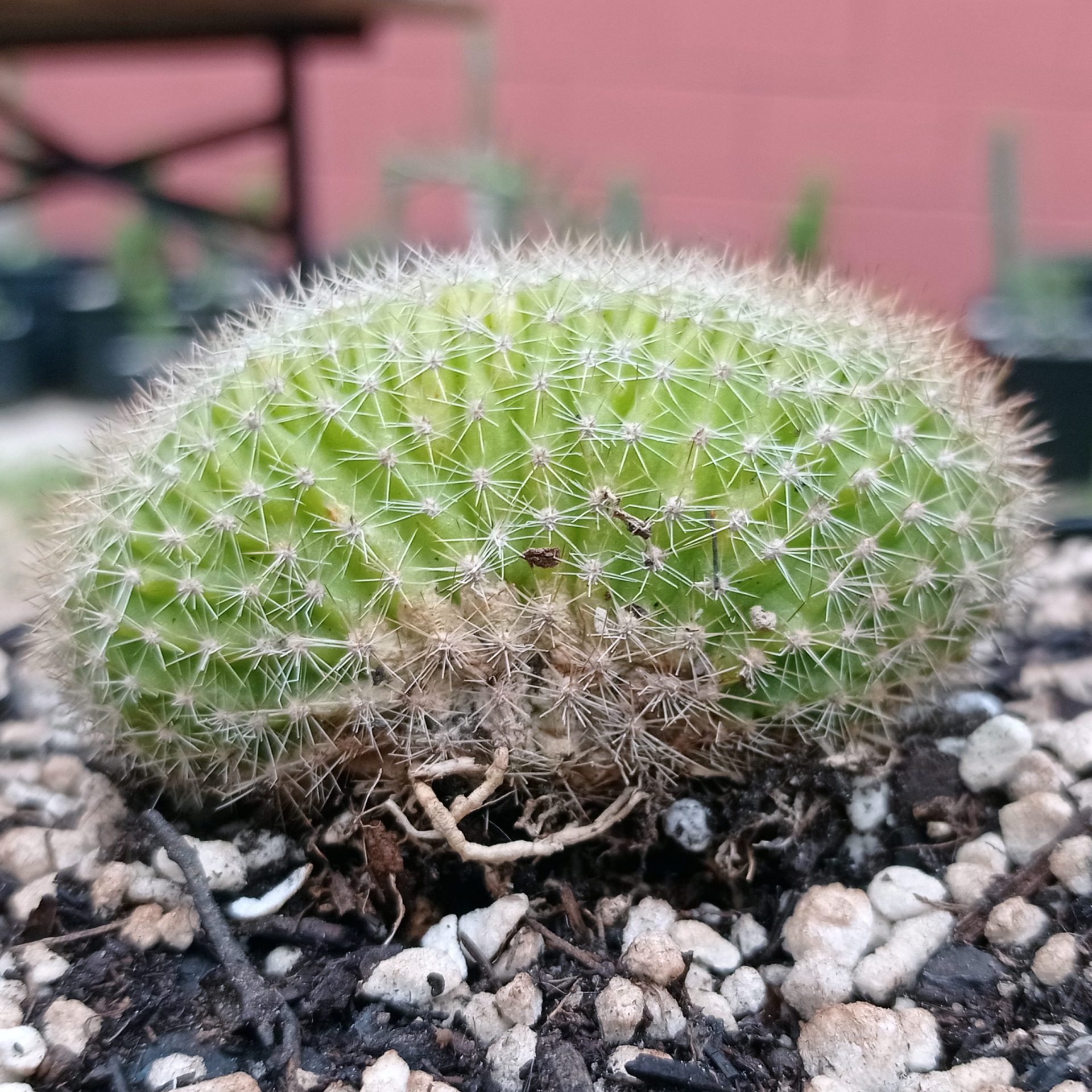
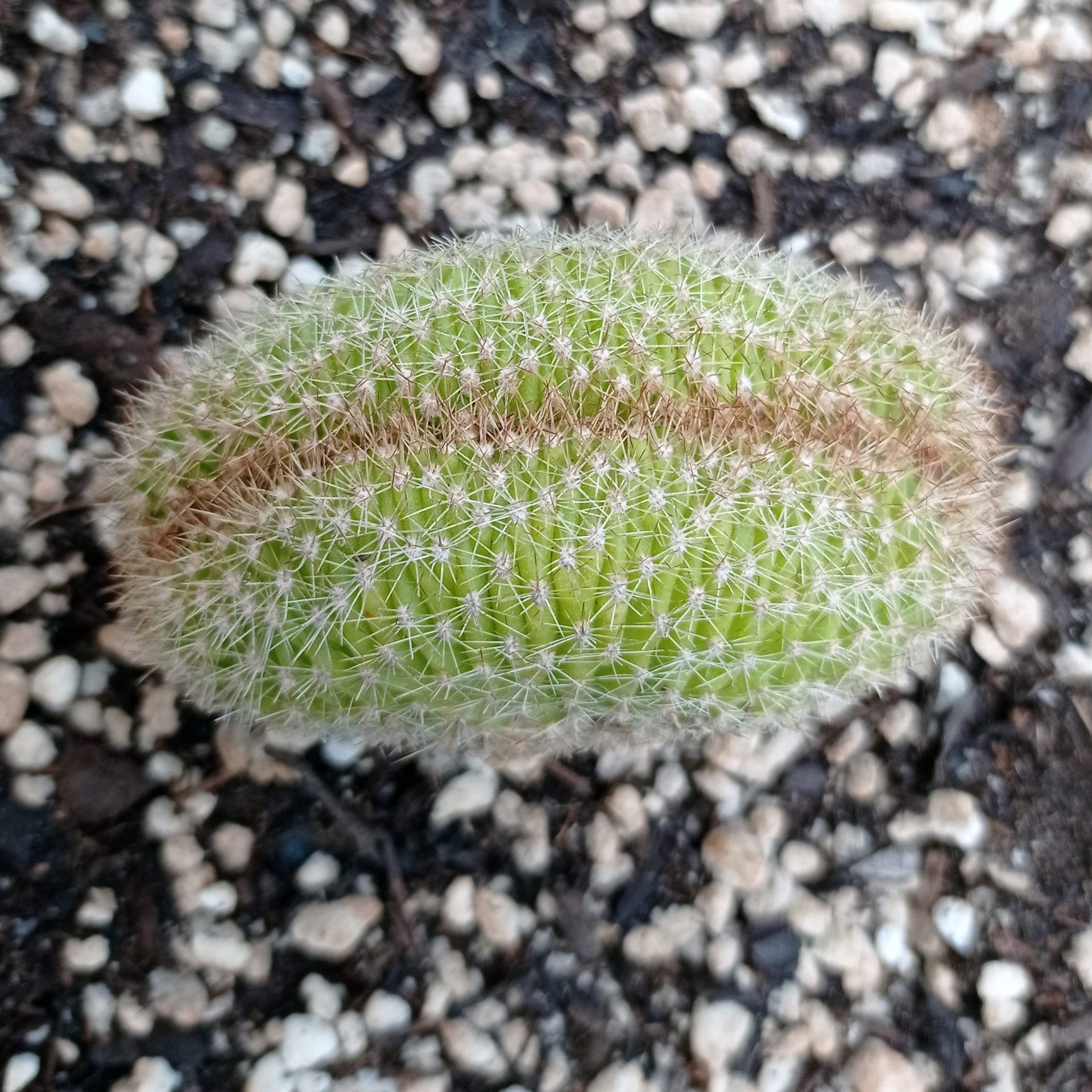
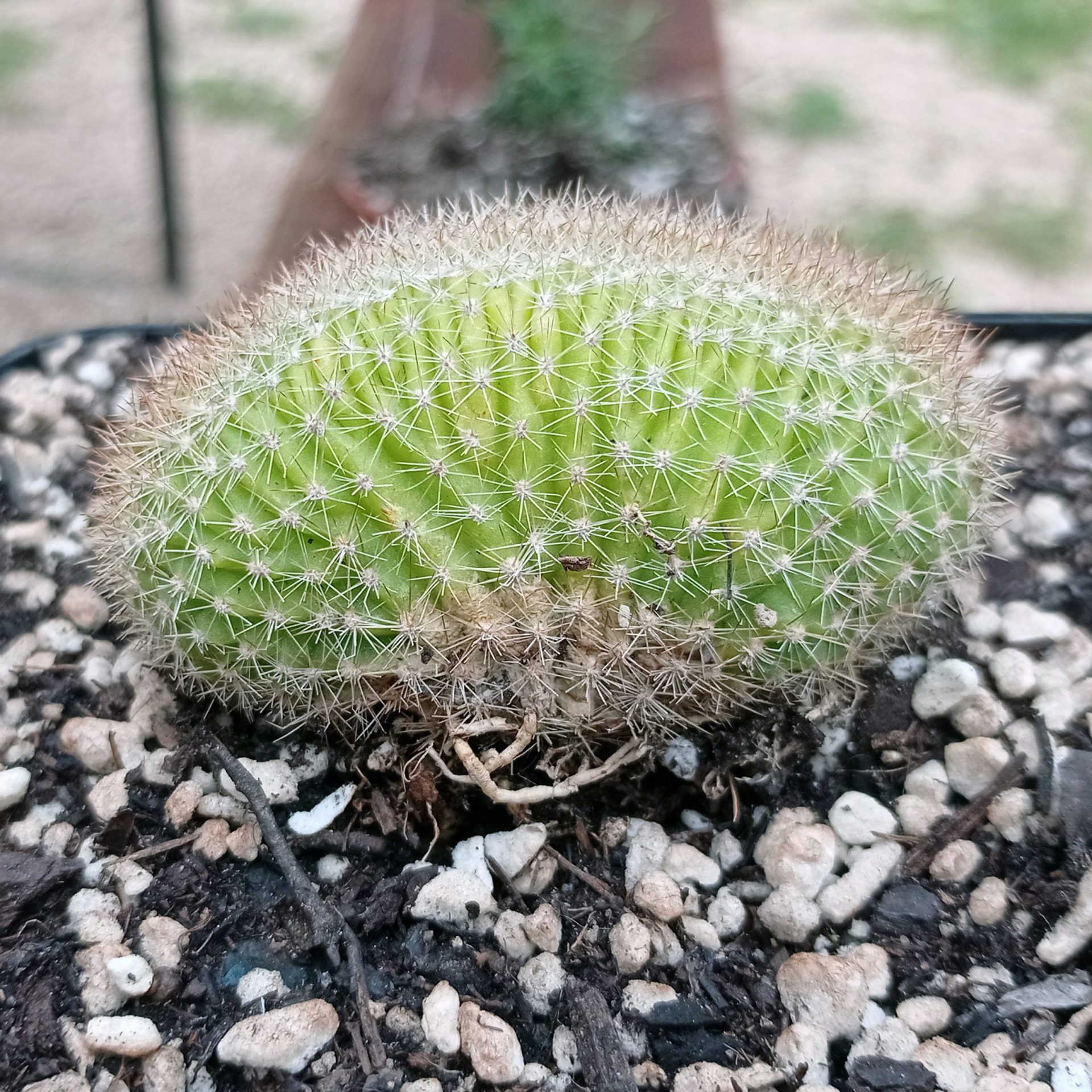
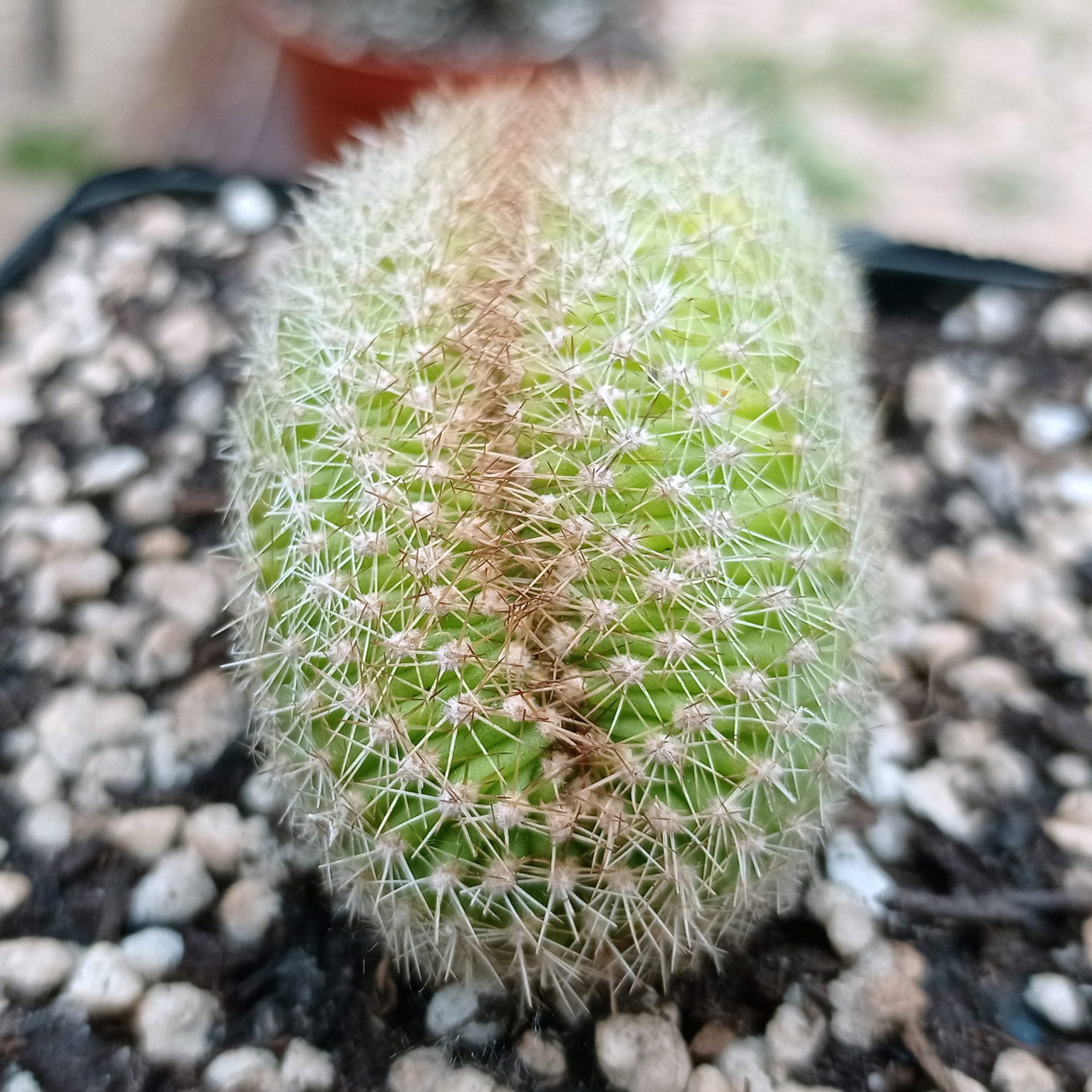
Trichocereus species f. cristata | Live plant
A beautiful unidentified Trichocereus species f. cristata, originally received from another European grower as a small seed-grown plant without a species identification. Now propagated clonally from our established crested mother, with predominantly white to whitish spination contrasting with orange-red-brown new armature. Live plant.
Currently unavailable.
Product Features
This Trichocereus species f. cristata is a particularly attractive unidentified crested Trichocereus which originally came to us from another European grower as a small, seed-grown plant. No species identification or further provenance accompanied the original plant, so we deliberately maintain it simply as Trichocereus species rather than attempting to attach a speculative name to it.
What we can document considerably more confidently is the plant itself. Our original specimen developed into a handsome crest with predominantly medium-length white to whitish spination, contrasting particularly well with the orange, reddish and brown tones of the newest spines around the active growing crest. As the new armature ages it becomes progressively paler, producing an attractive graduation of colour across actively developing growth.
The original plant was seed-grown, making its cristation especially interesting. It was not produced by deliberately cresting a conventional plant, nor did it arrive as a cutting of a named mutant clone. At some stage during its development its apical meristem adopted cristate growth, replacing the conventional single growing point with an elongated line of active growth.
Our sale plants are now clonal propagations of that established crested mother plant. This distinction matters: the original specimen arose as a seedling, whereas vegetative propagation allows us to preserve the particular unidentified mutant represented by our mother plant rather than producing genetically different seedlings which may or may not crest.
Cristation, also described as fasciation, occurs when the normally compact apical meristem becomes laterally elongated. Instead of producing a conventional cylindrical stem around a single growing point, the plant develops a flattened or fan-shaped growth front. Continued growth causes that expanding line to curve, fold and eventually form the convoluted sculptural structures for which mature crested cacti are collected.
The resulting architecture can change continuously as the plant grows. Young sections may form relatively simple fans before broadening and folding over themselves, while different sections of an established crest can grow at different rates. That unpredictability is an important part of the appeal: no two mature specimens develop exactly the same overall shape, even when propagated from the same clone.
Cristation is known across numerous cactus genera and occurs in many different Trichocereus species. The underlying trigger is not necessarily recoverable from an individual plant. Genetic factors, developmental abnormalities, environmental influences, infection and physical damage have all been discussed in connection with fasciation, but the mere presence of a crest does not establish which mechanism originally produced it. We therefore make no unsupported claim about why this particular seedling became cristate.
It is equally important not to infer the underlying species from the mutation. Cristation can substantially alter normal stem proportions, rib structure and the relationship between areoles, making identification from vegetative morphology considerably more difficult. Our plant’s spination may invite comparisons with several familiar Trichocereus, but without reliable provenance, normal reverted growth, flowers or other compelling diagnostic evidence, assigning a species would create certainty that we simply do not have.
This plant belongs within our Mutants & Unusual Forms collection, where it can be compared with the many crested, monstrose, variegated and otherwise abnormal cacti we maintain.
Our own collection demonstrates how widely cristation can occur within the genus. For example, we cultivate multiple apparently distinct crested forms of T. spachianus, documented in our Trichocereus spachianus mutant gallery. Those plants are useful comparisons for understanding the growth phenomenon, but there is no basis for identifying this unknown crest as T. spachianus merely because both display fasciation.
We also maintain much more extensively documented mutants such as T. bridgesii f. monstrosa cv. ‘Melted Wax’ and T. spachianus f. monstrosa. These illustrate another useful distinction: monstrose and cristate growth are not interchangeable terms. A crest develops through an elongated growing meristem, whereas monstrose plants show irregular proliferation and disruption of normal growth points. Some individual cacti can display both phenomena.
Taxonomic note
The most accurate identity currently available for this plant is simply Trichocereus species f. cristata. The original plant arrived without a species name, and nothing subsequently observed provides sufficient evidence to replace that deliberately conservative identification.
The abbreviation f. cristata is the traditional horticultural and botanical-style notation used to indicate crested growth. Here it describes the plant’s morphology; it does not imply that a formally published botanical form has been established for this unidentified species.
Likewise, we do not assign a cultivar name merely because the mother plant is now maintained clonally. It is a distinct clone in the practical horticultural sense, but no cultivar name accompanied it and we have not invented one simply for marketing purposes.
If future flowering, stable reverted growth or reliable historical information provides sufficient evidence for a species identification, the record can be updated while retaining the history of the plant. Until then, Trichocereus species is considerably more informative than an attractive but unsupported guess.
Cultivation
We have successfully cultivated the mother plant much like the majority of our other Trichocereus: in a roomy container with a freely draining mixture of soil and perlite, receiving regular water during active growth and periodic fertilisation from late spring into early autumn. Under our conditions we generally water every week or two during the growing season, although watering frequency should always be adjusted to temperature, container size, substrate, airflow and local climate rather than copied as a fixed schedule.
Provide strong light to maintain compact growth and good spine development. Plants moving from sheltered conditions should be acclimatised gradually before exposure to intense direct sunlight, particularly because the numerous folds of a crest can create sections which have previously received very different levels of light.
Crested plants require a little more attention to moisture and airflow than conventional columns. Their folds can create sheltered pockets where water and debris remain longer, while damage or rot can be harder to notice within a complicated mature crest. Good ventilation and a substrate which drains rapidly are therefore particularly useful.
During active growth, water thoroughly and then allow the substrate to dry substantially before watering again. Feed periodically while the plant is actively growing. Reduce watering sharply during cool weather and avoid leaving the roots wet when temperatures are low.
Vegetative propagation is the appropriate method when the objective is to preserve this particular crest. Sections removed for propagation should be cut cleanly, allowed to callus thoroughly and then rooted in a suitably airy medium during warm growing conditions. Because the original plant arose from seed, seedlings produced from any future flowering would represent new genetic individuals and could not automatically be regarded as the same clone or expected to reproduce its cristation.
Crested growth can occasionally produce more conventional shoots through partial or complete reversion. Such growth is not evidence that the plant has changed species; it represents a return towards the ordinary growth architecture of the same genetic individual. If sufficiently stable normal growth develops on our mother plant in future, it may actually provide useful additional morphological evidence towards its currently unknown species identity.
About Trichocereus
This plant is particularly valuable to us precisely because its identity has not been artificially made more impressive than the evidence allows. It began as an unidentified seed-grown European collection plant, developed a beautiful and persistent crest, and is now maintained clonally as that individual mutant. Its white mature spination, colourful new armature and increasingly convoluted growth make it a superb collection plant regardless of whether its species name is ever recovered.
Explore our complete Trichocereus collection for the wider range of botanical species, locality material, cultivars, accessions, hybrids and unusual forms we maintain.
Unless stated otherwise, plants ship bare-root to supported EU destinations. Outside our delivery area? Ask about seed-only orders or join our email list for shipping updates. Photos are representative unless an exact specimen is specified; ask for current specimen photos. Some plants are cut to order where noted. Save 10-35% automatically on qualifying live plants, with bonus seeds and at least one bonus cactus in every live plant order.
Product Details
| Product Type | |
|---|---|
| Amount | 1 rooted plant |
| Size | Size is added here when this item is in stock. |
| Family | |
| Genus | |
| Species | |
| Form |
Only logged in customers who have purchased this product may leave a review.
You May Also Appreciate
-


Trichocereus peruvianus ‘Matucana’ f. variegata | ‘Variegated Peruvian Torch’ | Live plant
€72.00 Add to basket -

Echinopsis hybrid f. monstrosa cristata cv. ‘Circle’ | Live plant
€15.75 Add to basket -

Trichocereus pachanoi cv. ‘Inmortales’ | ‘San Pedro’ | Live plant
€42.00 Add to basket -

Trichocereus bridgesii f. monstrosa cv. ‘Jenna’ | ‘Monstrose Bolivian Torch’ | Live plant
10% OFF until 30 Nov Original price was: €59.50.€53.55Current price is: €53.55. Add to basket -

Echinopsis subdenudata f. variegata | ‘Variegated Domino Cactus’ | Live plant
From €8.00 Browse options This product has multiple variants. The options may be chosen on the product page -

Trichocereus bridgesii f. monstrosa cv. ‘Sina’ × Trichocereus peruvianus cv. ‘Sharxx Blue’ | Live plant
10% OFF until 30 Nov Original price was: €56.00.€50.40Current price is: €50.40. Add to basket -

Trichocereus bridgesii f. monstrosa cv. ‘Rusty’ | ‘Monstrose Bolivian Torch’ | Live plant
10% OFF until 30 Nov Original price was: €77.00.€69.30Current price is: €69.30. Add to basket -

Trichocereus bridgesii f. semi-monstrosa cv. ‘Freddy’ | ‘Semi-Monstrose Bolivian Torch’ | Live plant
20% OFF until 30 Nov Original price was: €81.00.€64.80Current price is: €64.80. Add to basket -

(Trichocereus chalaensis x Trichocereus pachanoi cv. ‘Oscar’) f. monstrosa cristata cv. ‘Chosca’ | Live plant
From €49.00 Browse options This product has multiple variants. The options may be chosen on the product page -

Trichocereus bridgesii f. semi-monstrosa cv. ‘RAP’ | ‘Monstrose Bolivian Torch’ | Live plant
10% OFF until 30 Nov Original price was: €81.00.€72.90Current price is: €72.90. Add to basket -

Trichocereus sp. f. variegata cv. ‘Judith’ | Australian Mutant Clone | Live plant
€97.50 Add to basket -

Trichocereus pachanoi f. variegata cv. ‘T102 / Ogrod’ | Live plant
10% OFF until 30 Nov Original price was: €76.00.€68.39Current price is: €68.39. Browse options This product has multiple variants. The options may be chosen on the product page
Reviews
There are no reviews yet