


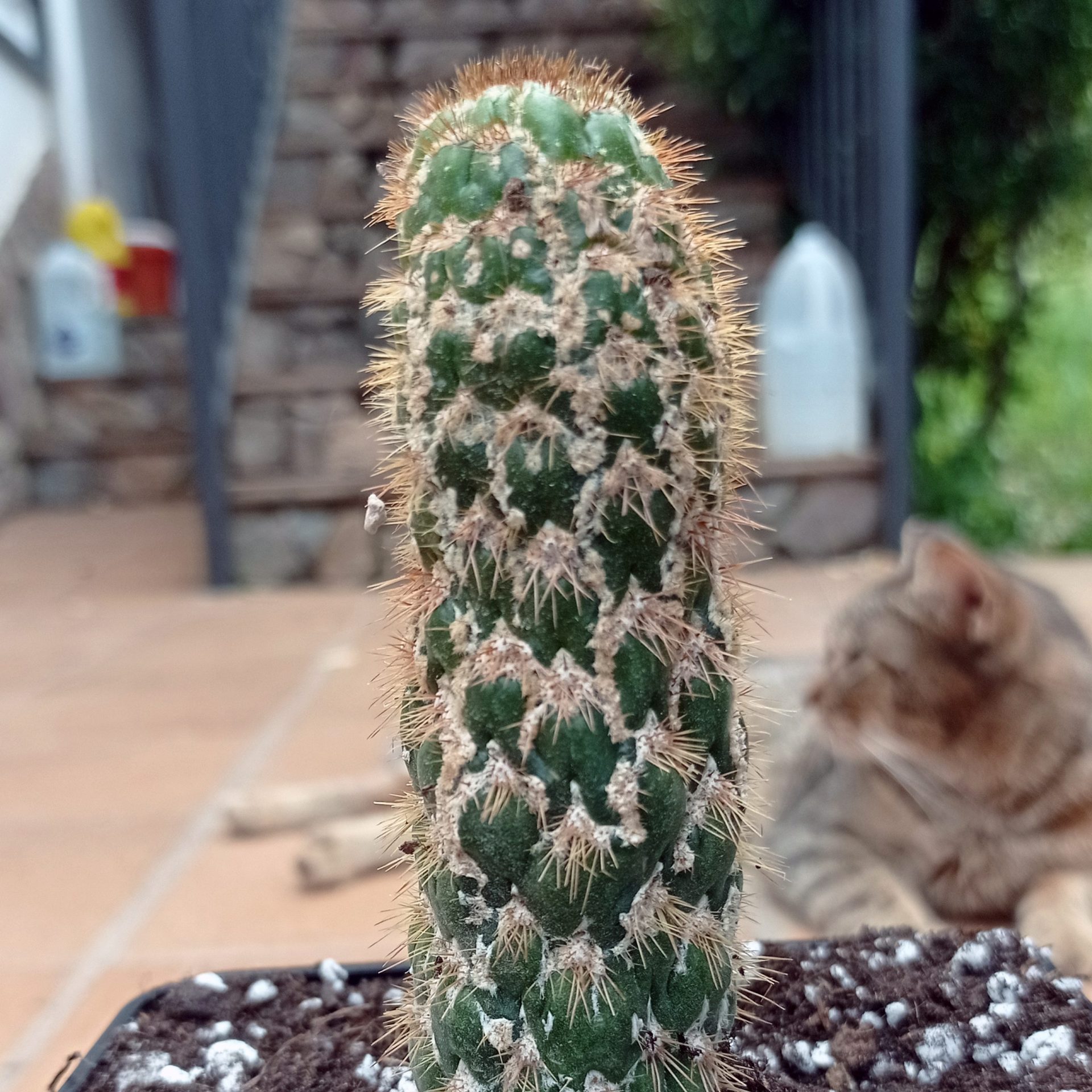

Trichocereus spachianus f. monstrosa | ‘Monstrose Golden Torch’ | Live plant
From €40.00
Trichocereus spachianus f. monstrosa, the ‘Monstrose Golden Torch’, is a distinctive clonal mutant with slow-growing green columns covered in extraordinary diamond- and lattice-like rib patterns and short reddish-brown spines. Maintained separately from our crested forms and the very different ‘Green Pepperoni’ mutant. Live plant.
Plant photos are representative unless an exact specimen is specified. Want to see a particular available plant? Ask for current specimen photos.
Product Features
Trichocereus spachianus f. monstrosa is a highly distinctive clonal Golden Torch mutant with an extraordinary diamond- or lattice-like epidermis. Instead of forming the regular continuous ribs of ordinary T. spachianus, its growing points divide irregularly and produce chunky columns covered with geometric bulges, intersecting grooves and short reddish-brown spines.
Our plants are clonal propagations from our established mother plants. This is therefore one particular monstrose lineage rather than a collection of unrelated seedlings which happen to show abnormal growth. Vegetative propagation preserves the same genotype and its characteristic epidermal architecture.
The mutant is remarkably consistent compared with many monstrose cacti. Established stems develop repeated diamond-, lattice- and net-like patterns, with areoles positioned along the raised intersections. As new growth matures, the pattern becomes increasingly pronounced and gives the stems a heavily sculpted appearance even though the overall plant remains recognisably columnar.
Short spines emerge reddish-brown to brown before ageing paler. Their relatively modest size leaves the unusual stem surface clearly visible, making the epidermal pattern rather than formidable armature the principal ornamental feature.
This is also a relatively slow-growing mutant, particularly compared with ordinary Golden Torch. Normal T. spachianus is vigorous enough to be widely used as grafting stock; this monstrose clone diverts its growth through numerous abnormal meristems and generally takes considerably longer to develop substantial columns.
Grafting can accelerate growth dramatically and is useful when rapid multiplication or development of specimen-sized plants is desired. Own-root plants are entirely practical, however, and have the advantage of developing the natural proportions of the clone without dependence upon a stock plant.
Browse our Trichocereus spachianus species archive for the broader range of Golden Torch genetics, mutants and related material represented in our collection.
Our gallery of Trichocereus spachianus mutants provides a particularly useful comparison between this monstrose clone and the different crested forms we maintain. The contrast is striking: cristate plants broaden their apical meristem into expanding fans, whereas this clone repeatedly divides its growing points to produce irregular patterned columns.
For comparison with the ordinary species architecture, our standard Trichocereus spachianus ‘Golden Torch’ develops regular cylindrical stems, orderly ribs and the vigorous growth for which the species is well known.
We also maintain Trichocereus spachianus f. cristata [form 1], one of our separately maintained Crested Golden Torch lines. Keeping the mutants separate preserves genuinely different growth forms rather than treating all abnormal spachianus as one horticultural clone.
Another particularly useful comparison is Trichocereus santiaguensis f. monstrosa cv. ‘Green Pepperoni’. Modern taxonomy places santiaguensis within the same spachianus species, yet ‘Green Pepperoni’ is a completely different cultivated mutant with much more bulbous, irregular and unpredictable growth. The two should not be confused simply because their underlying botanical identity is now regarded as the same species.
All of these unusual lines belong naturally within our Mutants & Unusual Forms collection.
Because this particular monstrose clone is maintained as an old horticultural line of undocumented wild provenance rather than South American locality material, it belongs within our Trichocereus Genetics from Europe collection. The underlying species itself is South American; the collection classification records the immediate horticultural provenance of this mutant line.
Monstrose growth
A normal cactus stem grows from a relatively orderly apical meristem. In monstrose plants, that organisation becomes disrupted and the growing point divides irregularly, producing multiple abnormal meristems rather than one conventional apex.
The result varies enormously between cactus clones. Some monstrose plants produce amorphous lumps, repeated branching or almost spineless knobbly masses. This T. spachianus clone expresses the mutation in a particularly recognisable way: the stem remains broadly columnar while its ribs fragment into an unusually regular network of geometric swellings.
The repeated diamond pattern is consequently not a decorative marking on the epidermis. It is the visible result of altered stem development, with the normal rib structure repeatedly interrupted and reorganised as the plant grows.
The term f. monstrosa describes this unusual growth habit rather than a separate botanical species. The exact original cause of the mutation in this cultivated lineage is not documented, and we do not assign one retrospectively.
The clone is sometimes marketed elsewhere as f. supermonstrosa. We do not use that name because it has no useful botanical or cultivar status and appears simply to be a horticultural embellishment of the established f. monstrosa identity.
Relationship with ordinary Golden Torch
Ordinary T. spachianus is a vigorous branching columnar cactus. Mature plants develop light- to dark-green cylindrical stems commonly reaching around two metres tall and approximately six or seven centimetres thick.
The regular species typically carries numerous ribs with grey, brown, reddish to yellowish spines. New armature can be particularly warm and golden, giving rise to the familiar common name ‘Golden Torch’.
Mature plants produce large white to whitish nocturnal flowers, sometimes approaching approximately 20 cm in diameter. Flowers open principally at night and can remain open through part of the following day.
This monstrose clone retains the underlying genetics of the species, but its disrupted meristem profoundly changes how the stems develop. Growth is slower, the ribs become fragmented and the plant concentrates its ornamental interest in the peculiar architecture of the stem itself.
Flowering remains biologically possible, but it should not be expected as readily as from vigorous conventional spachianus. Slow-growing monstrose plants can require considerably longer to attain the mass and maturity associated with flowering.
Taxonomic note
Trichocereus spachianus was originally described by Charles Lemaire as Cereus spachianus in 1839 and transferred to Trichocereus by Vincenzo Riccobono in 1909.
Current Kew taxonomy accepts Echinopsis spachiana (Lem.) H.Friedrich & G.D.Rowley as the species, with a native range extending from Bolivia into north-western Argentina. Cereus spachianus, Trichocereus spachianus and Soehrensia spachiana are homotypic synonyms.
Kew also places the historically separate Cereus santiaguensis and its later Echinopsis combinations within the synonymy of E. spachiana. This is why cultivated mutants historically labelled santiaguensis can now fall within the same accepted species as Golden Torch.
The change from spachianus to spachiana reflects grammatical agreement with the feminine genus Echinopsis; it does not indicate a different cactus.
We retain Trichocereus spachianus prominently because it remains the established horticultural identity for Golden Torch and keeps its numerous normal, cristate, monstrose and variegated forms intelligible within our wider collection.
Clonal propagation
This monstrose Golden Torch is preserved vegetatively. Every genuine propagation from our mother plants retains the same genotype and therefore its capacity to produce the characteristic lattice-patterned mutant growth.
Individual cuttings can initially look somewhat different depending upon which part of the mother plant they came from. A section containing several active abnormal meristems may produce complex growth quickly, while another can spend some time elongating before its characteristic pattern becomes increasingly obvious.
This does not make them different cultivars. Variation in the immediate expression of monstrose growth can occur across one genetically identical plant.
Likewise, a seed produced by this plant would represent a new genetic individual. Seedlings would not automatically be this monstrose clone and should not inherit its clonal identity merely because it was one of their parents.
Continuous vegetative provenance is therefore more reliable than trying to identify an old mutant clone solely from photographs.
Cultivation
T. spachianus f. monstrosa grows well in a freely draining cactus substrate with strong light and excellent air movement. Its requirements broadly follow ordinary Golden Torch, although its slower mutant growth deserves slightly more conservative watering.
Water thoroughly during active warm-weather growth and then allow the substrate to dry substantially before watering again. Avoid continually wet conditions, particularly around dense older sections where irregular stem architecture can retain moisture.
Strong light encourages compact, well-defined mutant growth and good spine development. Plants transferred from sheltered cultivation should nevertheless be acclimatised gradually before prolonged exposure to intense direct sunlight.
This clone is substantially slower than ordinary spachianus. Periodic moderate feeding can support development, but excessive fertiliser or constant watering will not convert it into the rapid-growing plant represented by its non-mutant species.
Grafting is particularly effective if faster development is desired. A vigorous stock can dramatically increase the rate at which the characteristic patterned stems develop, and grafting is also useful for multiplying small pieces which would otherwise require considerable time to root and establish.
Own-root plants should be allowed to form a proper root system before being pushed into strong growth. Cuttings need to callus thoroughly before planting, and freshly rooting pieces should not be kept saturated.
The geometric depressions and proliferating growing points can provide hiding places for mealybugs and scale insects. Inspect established plants carefully rather than checking only the exposed outer surface.
Our cactus cold-hardiness reference currently places ordinary T. spachianus at approximately -7°C / 19.4°F. Treat this as an approximate species-level comparison rather than a guaranteed minimum for a slow-growing monstrose clone.
Reduce watering substantially during cold weather and avoid prolonged low temperatures combined with saturated substrate. We favour somewhat more cautious winter treatment for unusual mutants than for large, vigorous conventional Golden Torch plants.
About Trichocereus
This clone is one of the most distinctive Golden Torch mutations we have encountered. Unlike the broad fans of cristate plants or the chaotic bulbous growth of some other monstrose lines, it develops a surprisingly ordered diamond and lattice pattern from fundamentally disordered meristematic growth.
Its slow development is part of the appeal: older specimens gradually become increasingly sculptural as the patterned columns expand and branch, making mature plants far more impressive than their relatively modest juvenile size suggests.
Explore our complete Trichocereus collection for the wider range of botanical species, documented accessions, named clones, cultivars, hybrids and unusual forms maintained in the nursery.
Unless stated otherwise, plants ship bare-root to supported EU destinations. Outside our delivery area? Ask about seed-only orders or join our email list for shipping updates. Photos are representative unless an exact specimen is specified; ask for current specimen photos. Some plants are cut to order where noted. Save 10-35% automatically on qualifying live plants, with bonus seeds and at least one bonus cactus in every live plant order.
Product Details
| Product Type | |
|---|---|
| Amount | 1 rooted plant |
| Size | ~3 cm diameter, ~4 cm diameter, ~10 cm tall, ~11 cm tall, ~12 cm tall, ~13 cm tall, ~14 cm tall, ~15 cm tall |
| Common Name | |
| Family | |
| Genus | |
| Species | |
| Form | |
| Collection |
Only logged in customers who have purchased this product may leave a review.
You May Also Appreciate
-


Trichocereus bridgesii f. monstrosa cv. ‘Sina’ | ‘Monstrose Bolivian Torch’ | Live plant
€81.00 Add to basket -

Trichocereus cuzcoensis f. cristata regressus cv. ‘Hamilton’s Peru Crest Revert’ | Live plant
€30.00 Add to basket -

Echinopsis hybrid f. monstrosa cristata cv. ‘Circle’ | Live plant
€15.75 Add to basket -

Trichocereus sp. f. variegata cv. ‘Judith’ | Australian Mutant Clone | Live plant
€97.50 Add to basket -

Trichocereus bridgesii f. monstrosa cv. ‘Sina’ × Trichocereus peruvianus cv. ‘Sharxx Blue’ | Live plant
10% OFF until 30 Nov Original price was: €56.00.€50.40Current price is: €50.40. Add to basket -

(Trichocereus chalaensis x Trichocereus pachanoi cv. ‘Oscar’) f. monstrosa cristata cv. ‘Chosca’ | Live plant
From €49.00 Browse options This product has multiple variants. The options may be chosen on the product page -

Trichocereus pachanoi f. variegata cv. ‘T102 / Ogrod’ | Live plant
10% OFF until 30 Nov Original price was: €76.00.€68.39Current price is: €68.39. Browse options This product has multiple variants. The options may be chosen on the product page -

Trichocereus bridgesii f. semi-monstrosa cv. ‘Freddy’ | ‘Semi-Monstrose Bolivian Torch’ | Live plant
20% OFF until 30 Nov Original price was: €81.00.€64.80Current price is: €64.80. Add to basket -

Trichocereus bridgesii f. monstrosa cv. ‘Rusty’ | ‘Monstrose Bolivian Torch’ | Live plant
10% OFF until 30 Nov Original price was: €77.00.€69.30Current price is: €69.30. Add to basket -

Trichocereus peruvianus ‘Matucana’ f. variegata | ‘Variegated Peruvian Torch’ | Live plant
€72.00 Add to basket -

Trichocereus bridgesii f. semi-monstrosa cv. ‘RAP’ | ‘Monstrose Bolivian Torch’ | Live plant
10% OFF until 30 Nov Original price was: €81.00.€72.90Current price is: €72.90. Add to basket -

Trichocereus bridgesii f. monstrosa cv. ‘Jenna’ | ‘Monstrose Bolivian Torch’ | Live plant
10% OFF until 30 Nov Original price was: €59.50.€53.55Current price is: €53.55. Add to basket

Reviews
There are no reviews yet