


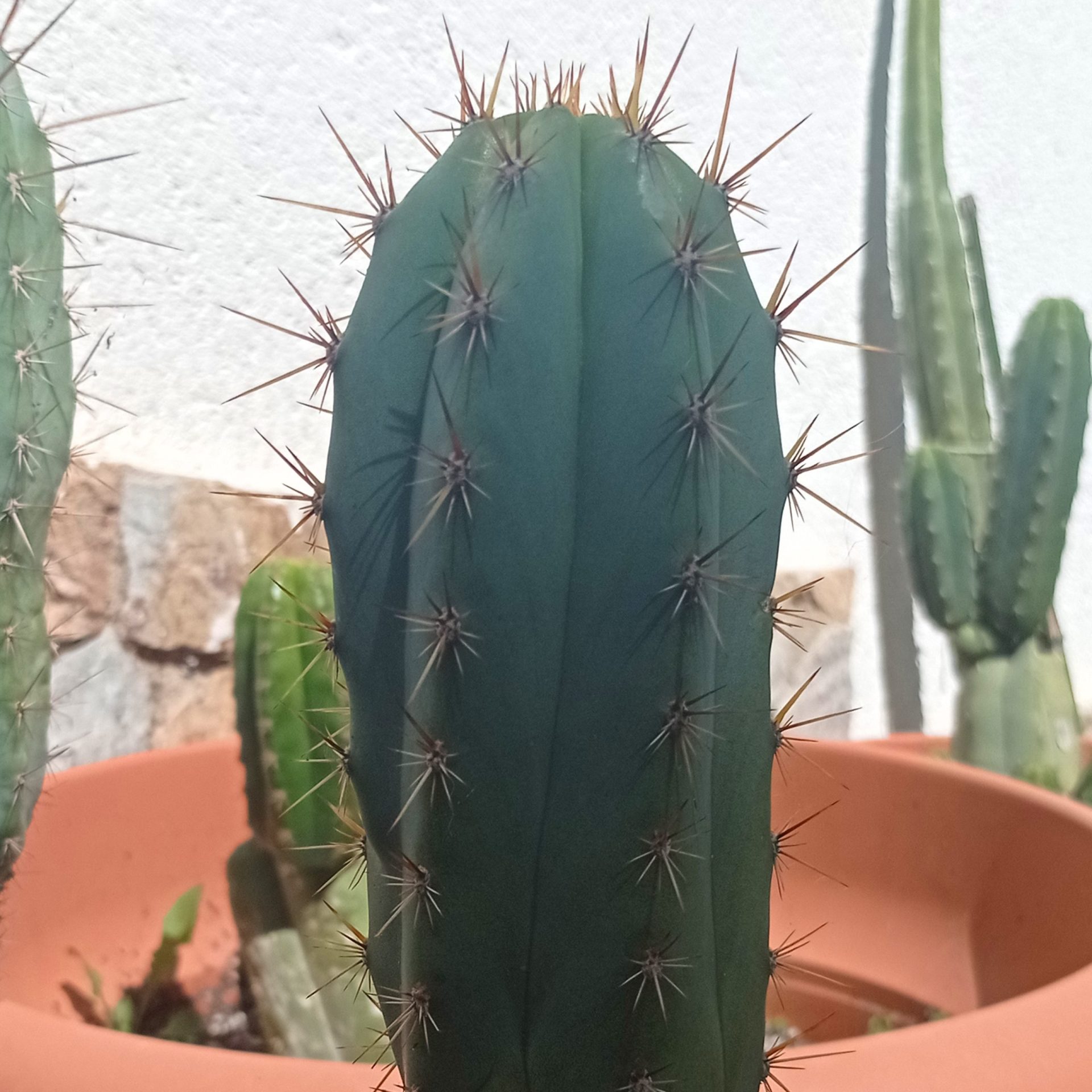
Trichocereus pachanoi ‘JL 2221’ | Lima, Peru | ‘San Pedro’ | Live plant
Trichocereus pachanoi ‘JL 2221’ is documented Peruvian material originating from seed collected by Joël Lodé, with older horticultural records associating JL 2221 with Lima, Peru. Our plants are clonal propagations of the original seed-grown mother plant, preserving this particular accession and genotype. Live plant.
Currently unavailable.
Product Features
Trichocereus pachanoi ‘JL 2221’ is a documented Peruvian accession originating from seed collected by noted cactus author, explorer and taxonomist Joël Lodé. Our original mother plant was raised from that seed, and the plants offered here are vegetative propagations from it, preserving the particular genotype we have maintained in our collection.
This is therefore quite different from an anonymous horticultural ‘San Pedro’. The JL 2221 collection number preserves a link back to Lodé’s South American collecting material, while older independent horticultural records identify MCA+JL2221 with Lima, Peru. We retain the simpler ‘JL 2221’ identity under which our original plant came to us rather than expanding or interpreting the additional MCA notation without firmer documentation of what it signifies.
That older Lima association is nevertheless valuable provenance. T. pachanoi is naturally distributed through Ecuador and Peru, and traceable Peruvian accessions allow genetically distinct material to remain identifiable rather than gradually being absorbed into the enormous pool of unnamed cultivated pachanoi.
Browse our JL 2221 archive for all material carrying this particular accession in our catalogue.
Our JL 2221 develops the classic pachanoid combination of substantial green columnar stems, broad rounded ribs and relatively restrained spination. Mature T. pachanoi branches readily from the base and can ultimately form large multi-stemmed specimens, although plants remain readily manageable through cutting and propagation in cultivation.
The species generally develops approximately six to eight ribs on established stems, with woolly areoles and comparatively short spines. Environmental conditions influence appearance considerably: strong light tends to produce stouter growth and stronger areole and spine development, while the epidermis can range from fresh green to distinctly blue-green or glaucous.
Mature plants produce the characteristic very large white to whitish flowers associated with the columnar Trichocereus. The blooms emerge from woolly floral tubes and typically open during the evening and night, often remaining open into the following day under suitable conditions.
Because our sale plants are clones of the original seed-grown JL 2221 mother, they preserve one specific individual from the original collection. Other plants genuinely raised from JL 2221 seed would be siblings from the same accession rather than genetically identical copies of ours.
Our Trichocereus pachanoi species archive brings together the much wider range of locality material, documented accessions, established clones, unusual forms and hybrids involving these genetics that we maintain.
As documented Peruvian botanical material, JL 2221 belongs within our Trichocereus Genetics from South America collection.
JL 2221 and Joël Lodé
JL 2221 is a collection/accession number, not a cultivar name. The JL designation connects the material with Joël Lodé, whose field work, cultivation, publishing and taxonomic research have contributed substantially to modern knowledge of the cactus family.
Lodé is also particularly relevant to Trichocereus taxonomy. His work has argued for recognising Trichocereus separately from an excessively broad Echinopsis, and his classification has influenced the way we organise much of our own collection.
The number should therefore remain attached to the plant rather than being replaced by a horticultural nickname. It communicates something much more useful: this plant belongs to a particular documented accession rather than merely being one of the innumerable unnamed pachanoi clones circulating in cultivation.
Historical horticultural photographs and cultivated specimens labelled “MCA+JL2221 (Lima, Peru)” provide additional corroboration that this numbered material has circulated independently for many years with Lima attached to its provenance. We have not found sufficiently reliable evidence to expand MCA into a collector or organisation name, so we deliberately leave that part uninterpreted.
That distinction matters. Collection labels are most valuable when the original information is preserved exactly and uncertainty is not converted into invented certainty.
Taxonomic note
Trichocereus pachanoi was described by Britton and Rose in 1920. Current Kew taxonomy accepts the species as Echinopsis pachanoi (Britton & Rose) H.Friedrich & G.D.Rowley, with a native range extending from southern Ecuador into Peru.
Kew currently treats Trichocereus pachanoi as a synonym of that accepted name. It also includes several historically separate taxa within the same species concept, including Trichocereus santaensis and T. schoenii.
Other modern classifications retain Trichocereus. Albesiano and Kiesling treated the species as Trichocereus macrogonus var. pachanoi, while Joël Lodé published the combination Trichocereus macrogonus subsp. pachanoi in 2024.
We retain T. pachanoi as the principal catalogue name because it remains exceptionally useful horticulturally and allows individual pachanoi accessions and clones such as JL 2221 to remain immediately intelligible.
The taxonomy and the provenance answer different questions. Modern botanical treatments tell us how the species is currently classified; JL 2221 tells us which particular collected genetic line this cultivated plant belongs to.
Cultivation
JL 2221 responds well to the general conditions we use for vigorous pachanoid Trichocereus: strong light, excellent drainage, good airflow and thorough watering during active growth followed by substantial drying of the substrate.
Strong light encourages thick stems, well-defined ribs and compact areole spacing. Plants moved from protected conditions should nevertheless be acclimatised gradually before exposure to intense direct sun.
Water thoroughly during active growth and allow the substrate to dry substantially before watering again. Established plants respond well to periodic feeding during the warmer growing season and sufficient root space to support their naturally vigorous columnar development.
T. pachanoi roots readily from healthy cuttings, which is how we preserve this particular JL 2221 genotype. A rooted or unrooted propagation from our mother plant remains genetically the same JL 2221 clone; seed produced from it would represent a new sexual generation and would not be genetically identical.
Reduce watering substantially as temperatures fall. Mature pachanoi tolerate comparatively cool conditions when healthy and acclimatised, but cold tolerance varies with plant size, duration of exposure and especially moisture around the roots. Cold, saturated substrate should always be avoided.
About Trichocereus
JL 2221 represents exactly the kind of plant we prefer to preserve within the collection: a recognisable species combined with a numbered accession, collector history and geographic provenance. That information gives the plant considerably more value as a genetic resource than an otherwise anonymous pachanoi clone.
The fact that our current plants descend vegetatively from the original seed-grown mother also means the genotype remains stable through successive propagations. This makes JL 2221 useful both as a collector plant in its own right and as traceable parental material should it be incorporated into breeding.
Explore our complete Trichocereus collection for the wider range of species, field-numbered accessions, locality material, established cultivars, clones and hybrids represented in the nursery.
Unless stated otherwise, plants ship bare-root to supported EU destinations. Outside our delivery area? Ask about seed-only orders or join our email list for shipping updates. Photos are representative unless an exact specimen is specified; ask for current specimen photos. Some plants are cut to order where noted. Save 10-35% automatically on qualifying live plants, with bonus seeds and at least one bonus cactus in every live plant order.
Product Details
| Product Type | |
|---|---|
| Amount | 1 unrooted cutting |
| Size | ~5 cm diameter, ~12 cm tall |
| Common Name | |
| Family | |
| Genus | |
| Species | |
| Clone/Variety/Cultivar | |
| Form | |
| Flower | |
| Breeder/Source | |
| Collection | Trichocereus Genetics from Lima, Peru, Trichocereus Genetics from Peru, Trichocereus Genetics from South America |
Only logged in customers who have purchased this product may leave a review.
You May Also Appreciate
-


Trichocereus smrzianus ‘Campo Quijano, El Puyil’ | Live plant
€20.00 Add to basket -

Trichocereus vatteri ‘R 122’ / ‘WR 122’ | Live plant
10% OFF until 30 Nov Original price was: €16.00.€14.39Current price is: €14.39. Add to basket -

Trichocereus atacamensis subsp. pasacana ‘JN 1128’ | ‘Cardón Grande’ | Live plant
€21.00 Add to basket -

Trichocereus rowleyi ‘P134’ (ex. var. pumila) | ‘Red Torch’ | Live plant
€18.00 Add to basket -

Lophophora williamsii ‘RS 378’ | ‘Peyote’ | Live plant
€32.00 Add to basket -

Trichocereus atacamensis subsp. pasacana ‘TB 1099.3’ | ‘Cardón Grande’ | Live plant
10% OFF until 30 Nov Original price was: €18.00.€16.20Current price is: €16.20. Add to basket -

Trichocereus atacamensis ‘TB 1320.2’ | ‘Cardón Grande’ | Live plant
€8.00 Add to basket -

Trichocereus peruvianus ‘Matucana’ f. variegata | ‘Variegated Peruvian Torch’ | Live plant
€72.00 Add to basket -

Trichocereus faundezii ‘GM 1849’ | Live plant
From €21.00 Browse options This product has multiple variants. The options may be chosen on the product page -

Trichocereus pachanoi cv. ‘Mujica’ | ‘San Pedro’ | Live plant
10% OFF until 30 Nov Original price was: €22.50.€20.25Current price is: €20.25. Add to basket -

Trichocereus pachanoi ‘Pumacayán’ (MT07) × Trichocereus ‘Lemmy’ (MT19) | Live plant
From €17.50 Browse options This product has multiple variants. The options may be chosen on the product page -

Trichocereus terscheckii ‘TB 0003.3’ | ‘Cardón Grande’ | Live plant
10% OFF until 30 Nov Original price was: €15.00.€13.50Current price is: €13.50. Add to basket
Reviews
There are no reviews yet