

Trichocereus bridgesii ‘JL’ | ‘Bolivian Torch’ | Live plant
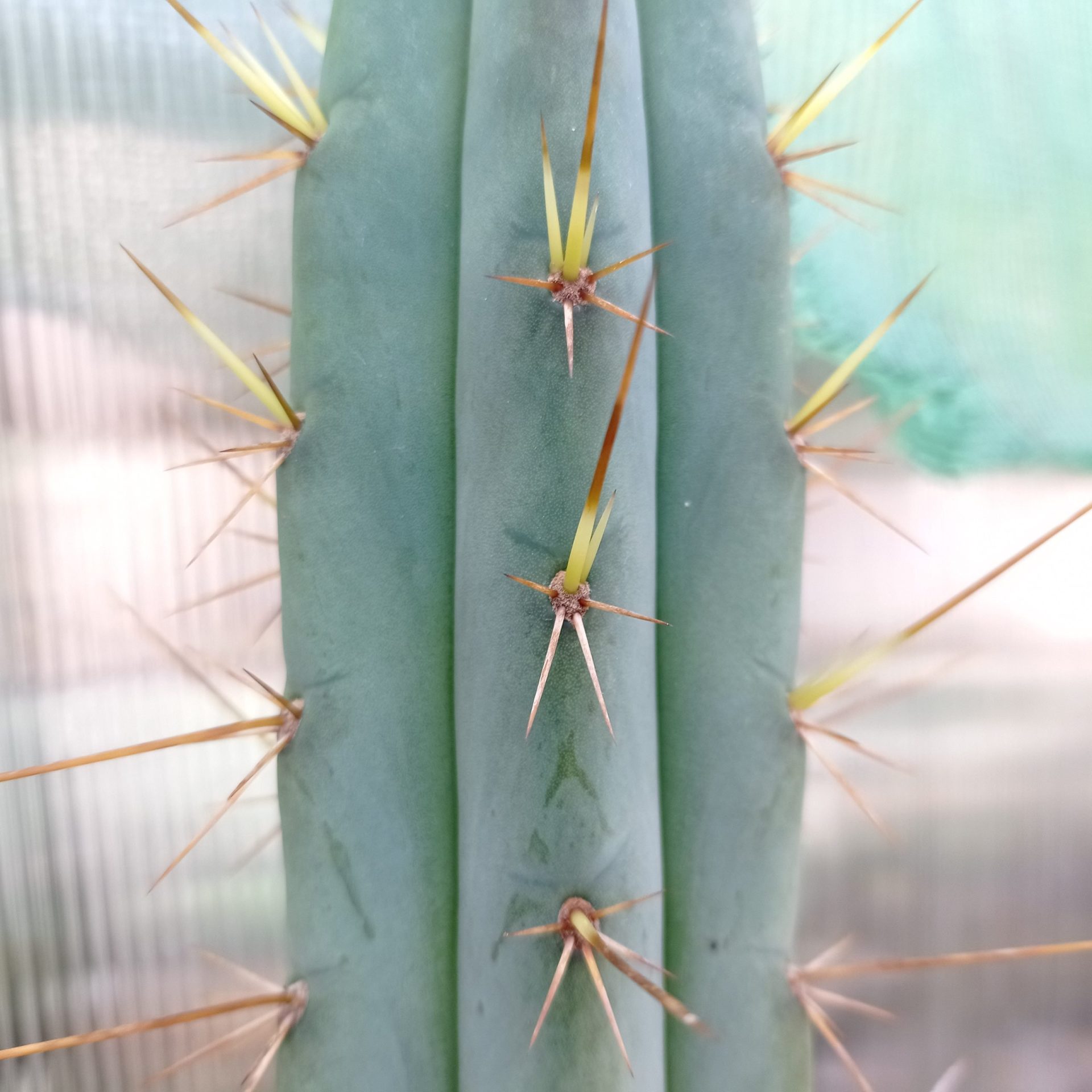
Trichocereus bridgesii ‘JL’ is a clonal Bolivian Torch accession we obtained directly from cactus expert and author Joël Lodé. Vigorous green to glaucous columnar growth, pronounced ribs, strong spination and large white to whitish flowers. ‘JL’ records our source rather than a formal cultivar. Live plant.
Currently unavailable.
Product Features
Trichocereus bridgesii ‘JL’ is a vigorous Bolivian Torch that we obtained directly from cactus expert and author Joël Lodé. Our plants are clonal propagations from the original mother plant we received from him, preserving this particular accession in our collection.
The ‘JL’ designation records its source. As with our other unnumbered JL plants, we do not treat it as evidence that Joël Lodé bred, selected or originally named the plant, and its history before reaching him is not documented by us. It is therefore better understood as a source/accession designation than as a formal cultivar name.
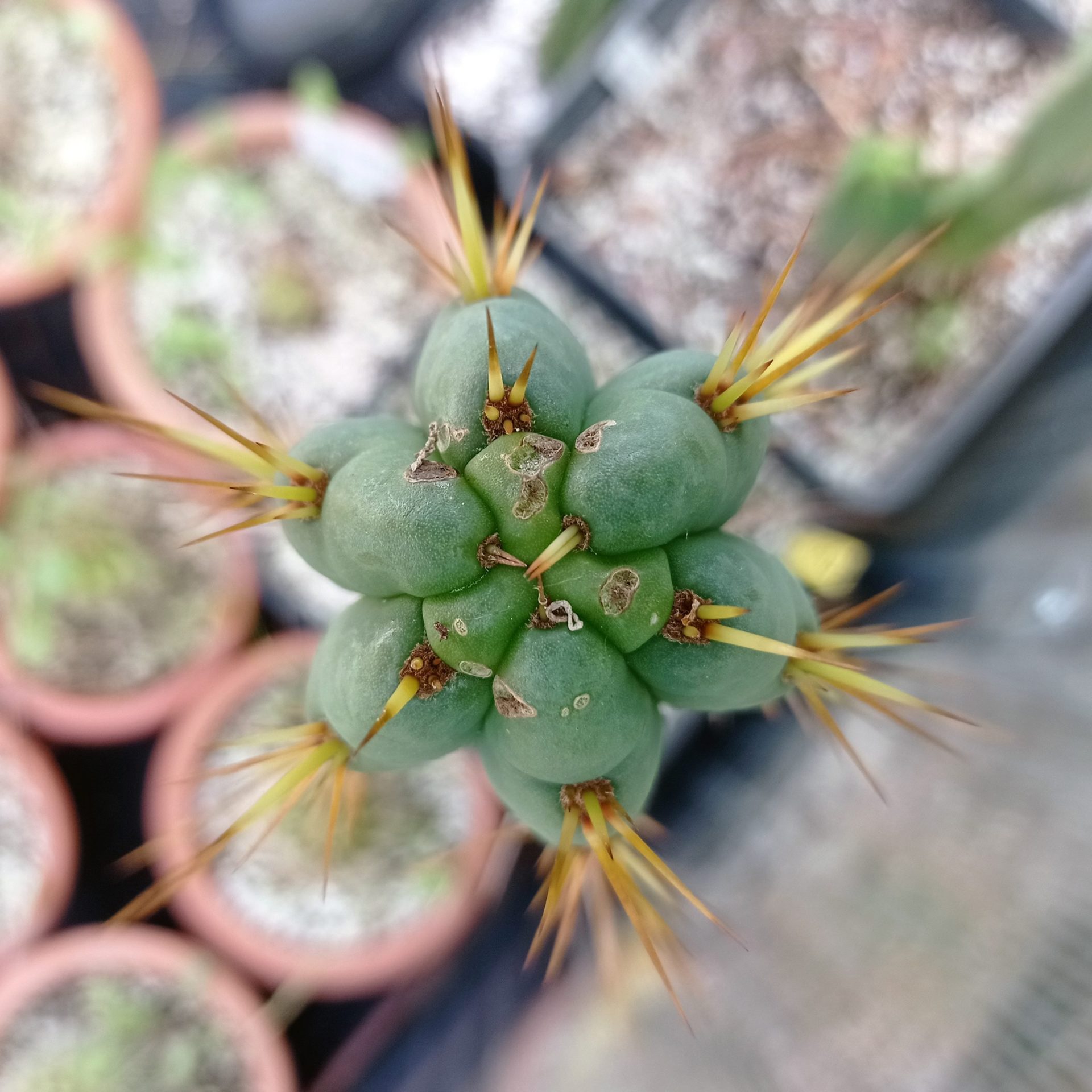
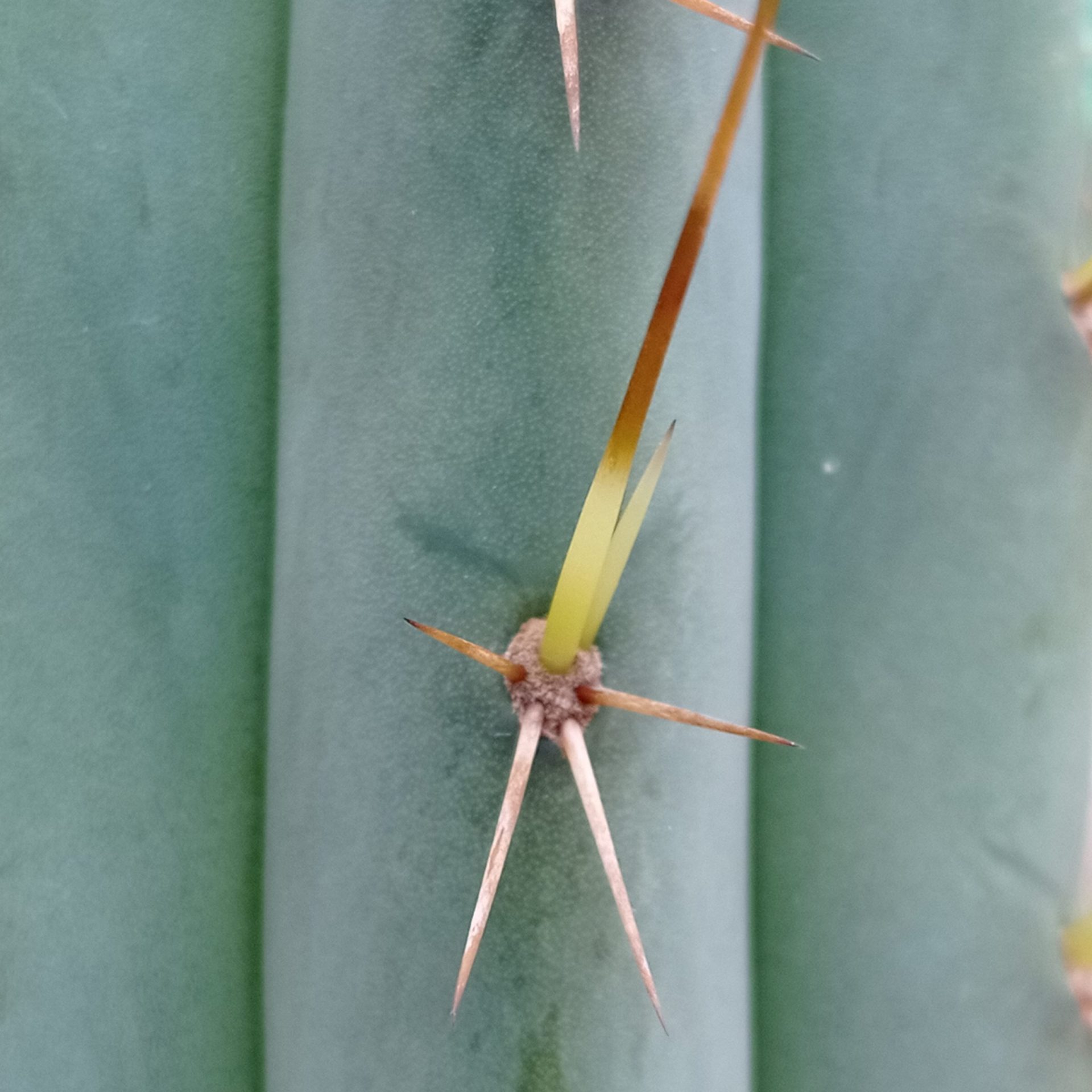
This plant displays the characteristic architecture of T. bridgesii: relatively slender upright columns, pronounced ribs and an attractive green to increasingly blue-green or glaucous epidermis under good conditions. Areoles can produce substantial honey-coloured, tan to brown spines, although spine length and density can vary considerably with age and growing conditions.
T. bridgesii is naturally a substantial columnar cactus. Mature plants can branch from the base and develop several metres of growth, while established specimens produce the species’ characteristic large white to whitish flowers. Compared with many of the heavier-bodied Trichocereus, its comparatively slender stems and strongly defined ribs give Bolivian Torch a particularly recognisable profile.
Our Trichocereus bridgesii species archive brings together the extensive range of botanical, accessioned, cultivated and breeding material we maintain under this species identity. It includes established named clones alongside locality and source-associated plants, making it possible to compare JL with the much broader diversity found within cultivated bridgesii.
The JL designation itself can be explored through our JL archive, where we maintain material obtained under the same source designation across several different Trichocereus species. These are separate plants rather than a single ‘JL clone’ occurring across species; the shared designation records their connection with Lodé as our source.
We also maintain other directly sourced JL material including T. pachanoi ‘JL’, T. peruvianus ‘JL’, T. thelegonoides ‘JL’ and T. werdermannianus ‘JL’. Keeping the source designation attached to each plant allows those acquisition relationships to remain visible without implying that the different plants constitute a common cultivar or genetic line.
As a botanical Bolivian species, this accession belongs within our Trichocereus Genetics from South America collection. Its immediate source was European, but the collection classification reflects the underlying South American genetics rather than simply the location of the nursery or collector from whom we obtained our plant.
Taxonomic note
Trichocereus bridgesii (Salm-Dyck) Britton & Rose was published in Trichocereus in 1920, based on the earlier Cereus bridgesii. It remains one of the most familiar names in horticultural Trichocereus, particularly under the common name ‘Bolivian Torch’.
Current Kew taxonomy treats Trichocereus bridgesii as a synonym of the accepted Echinopsis lageniformis (C.F.Först.) H.Friedrich & G.D.Rowley. The accepted species is native to Bolivia and grows primarily in desert or dry-shrubland environments. We retain T. bridgesii as the principal catalogue name because it remains the established horticultural identity and keeps this material intelligibly connected with the wider Trichocereus collection.
The names ‘Achuma’ and ‘Wachuma’ are also associated with this and related Andean columnar cacti, but ‘Bolivian Torch’ is the clearest common name for catalogue purposes. None of these common names should be confused with the JL accession designation.
Cultivation
T. bridgesii is a vigorous and generally straightforward cactus when provided with strong light, excellent drainage and adequate water during active growth. Use a freely draining cactus substrate, water thoroughly during warm growing conditions and allow the substrate to dry substantially before watering again.
Strong light encourages sturdy columns, pronounced ribs and good epidermal colour. Plants moved from protected conditions should be acclimatised gradually to intense direct sun. Moderate feeding during active growth supports the rapid development for which healthy bridgesii is known without forcing excessively soft tissue.
Compared with some heavier-bodied Trichocereus, T. bridgesii can be less forgiving of persistently wet roots during cool conditions. Reduce watering substantially as temperatures fall, maintain excellent air movement and avoid prolonged combinations of cold and saturated substrate.
About Trichocereus
Trichocereus is central to our collection, encompassing botanical species, documented accessions, locality material, old horticultural clones, mutants and an extensive range of hybrids. Source-documented plants such as this JL accession are particularly useful because they preserve a known part of the plant’s cultivation history even where its earlier provenance is unavailable. Explore our complete Trichocereus collection for the wider range.
Unless stated otherwise, plants ship bare-root to supported EU destinations. Outside our delivery area? Ask about seed-only orders or join our email list for shipping updates. Photos are representative unless an exact specimen is specified; ask for current specimen photos. Some plants are cut to order where noted. Save 10-35% automatically on qualifying live plants, with bonus seeds and at least one bonus cactus in every live plant order.
Product Details
| Product Type | |
|---|---|
| Amount | 1 rooted plant |
| Size | Size is added here when this item is in stock. |
| Common Name | |
| Family | |
| Genus | |
| Species | |
| Clone/Variety/Cultivar | |
| Form | |
| Flower | |
| Breeder/Source | |
| Collection |
Only logged in customers who have purchased this product may leave a review.
You May Also Appreciate
-


Trichocereus pachanoi cv. ‘Mujica’ | ‘San Pedro’ | Live plant
10% OFF until 30 Nov Original price was: €22.50.€20.25Current price is: €20.25. Add to basket -

Lophophora williamsii ‘RS 378’ | ‘Peyote’ | Live plant
€32.00 Add to basket -

Trichocereus faundezii ‘GM 1849’ | Live plant
From €21.00 Browse options This product has multiple variants. The options may be chosen on the product page -

Trichocereus rowleyi ‘P134’ (ex. var. pumila) | ‘Red Torch’ | Live plant
€18.00 Add to basket -

Trichocereus bridgesii f. semi-monstrosa cv. ‘RAP’ | ‘Monstrose Bolivian Torch’ | Live plant
10% OFF until 30 Nov Original price was: €81.00.€72.90Current price is: €72.90. Add to basket -

Trichocereus smrzianus ‘Campo Quijano, El Puyil’ | Live plant
€20.00 Add to basket -

Trichocereus atacamensis subsp. pasacana ‘TB 1099.3’ | ‘Cardón Grande’ | Live plant
10% OFF until 30 Nov Original price was: €18.00.€16.20Current price is: €16.20. Add to basket -
Trichocereus atacamensis ‘TB 1320.2’ | ‘Cardón Grande’ | Live plant
€8.00 Add to basket -

Trichocereus cordobensis cv. ‘Helon’ | Australian Clone | Live plant
€55.00 Add to basket -

Trichocereus knuthianus cv. ‘Fields’ | Live plant
€114.00 Add to basket -

Opuntia microdasys cv. ‘Rufida’ | ‘Mexican Bunny Ears Cactus’ | Live plant
€11.25 Add to basket -

Trichocereus atacamensis subsp. pasacana ‘JN 1128’ | ‘Cardón Grande’ | Live plant
€21.00 Add to basket
Reviews
There are no reviews yet