
Trichocereus atacamensis subsp. pasacana ‘JN 1128’ | ‘Cardón Grande’ | Live plant
€21.00
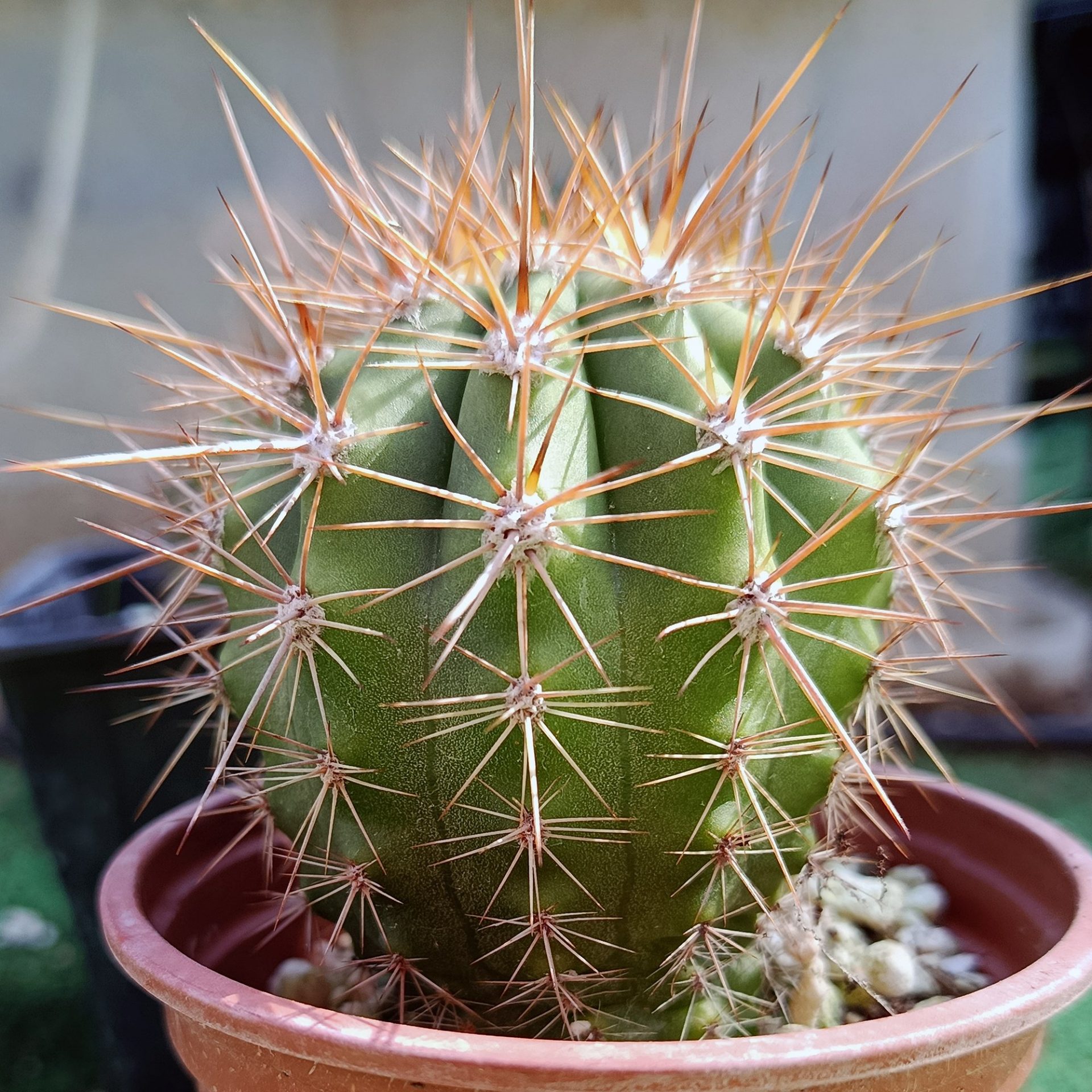
Seed-grown Trichocereus atacamensis subsp. pasacana ‘JN 1128’, preserving Jan Novák field-numbered genetics from Sañogasta, La Rioja, Argentina, at approximately 1,299 m elevation. Our young plants are already developing stout green stems and formidable copper-brown to straw-coloured spination. Each is a genetically distinct individual rather than a clone. Live plant.
Plant photos are representative unless an exact specimen is specified. Want to see a particular available plant? Ask for current specimen photos.
Product Features
Trichocereus atacamensis subsp. pasacana ‘JN 1128’ is documented field-numbered material tracing to a 2014 collection by Jan Novák at Sañogasta, La Rioja Province, Argentina, approximately 1,299 metres above sea level. Our plants are seed-grown, so each is a genetically distinct representative of the JN 1128 lineage rather than a clone.
‘JN 1128’ is a field number, not a cultivar. The JN prefix identifies Jan Novák’s collection series, while 1128 preserves the identity of this particular documented population. As elsewhere in our catalogue, the quotation marks follow our convention for named accessions, localities, field numbers and clones without implying that all such names are formal cultivars.
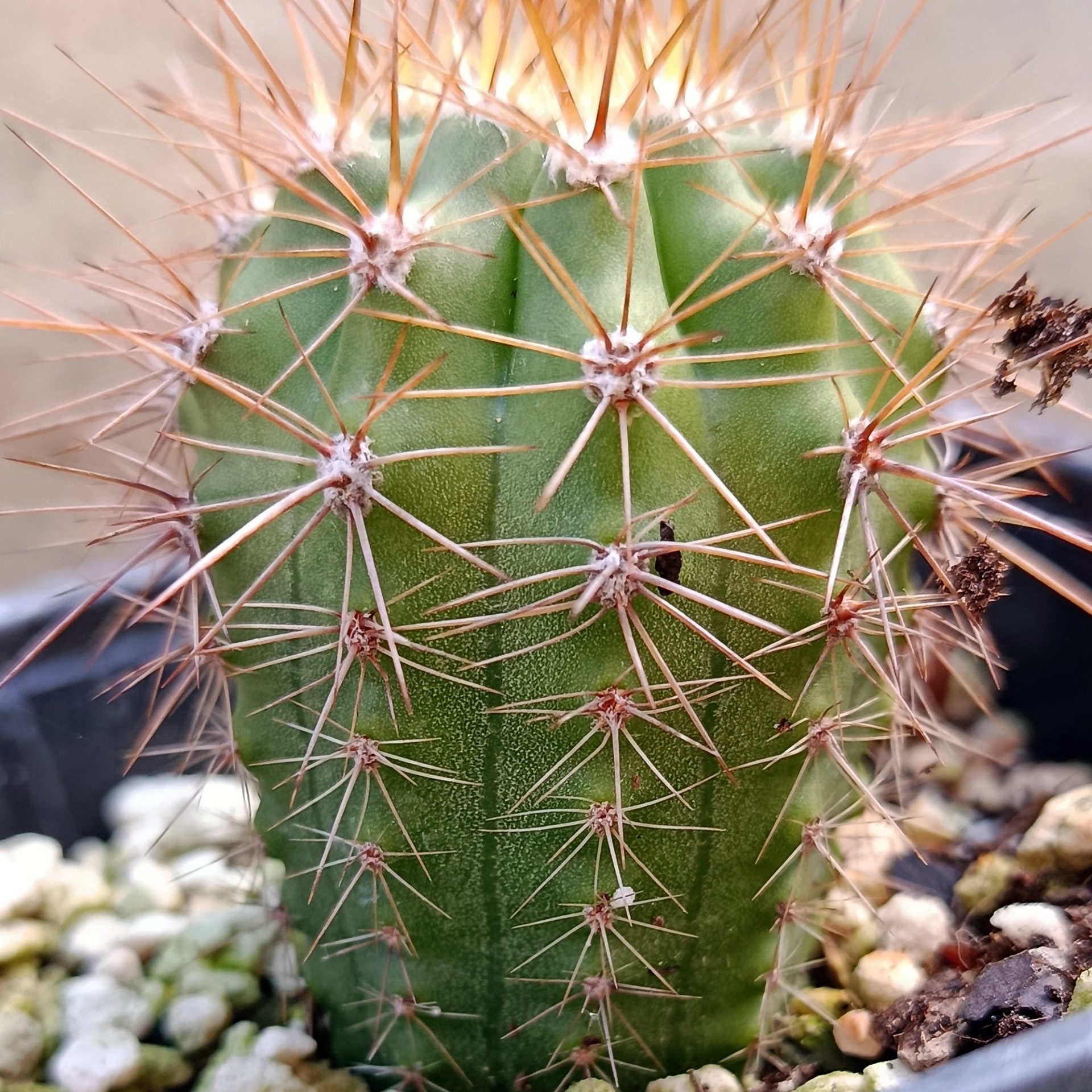
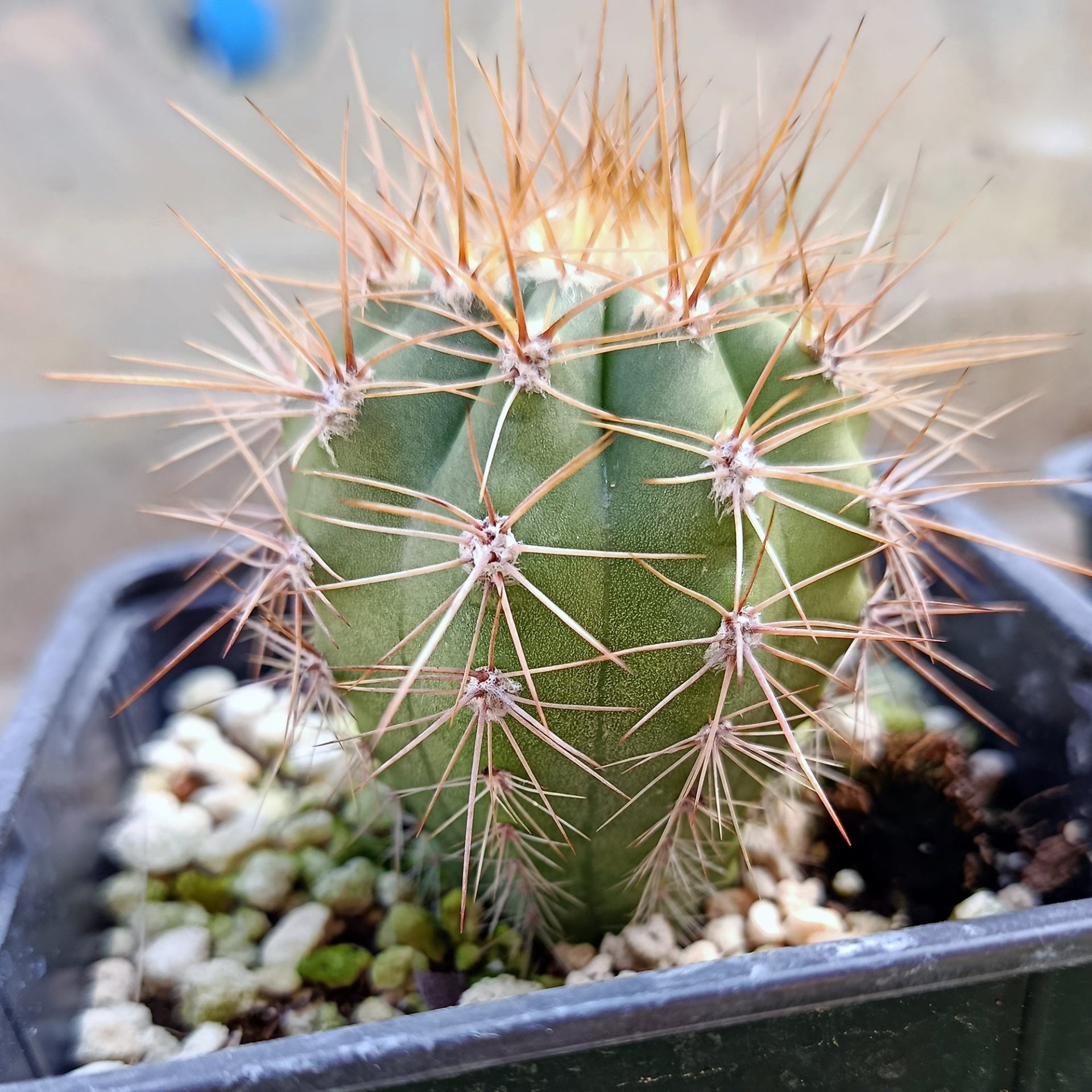
The plants photographed from this line are already developing an impressively heavy armature for their age. Their stout green stems carry numerous broad ribs with pale woolly areoles and dense clusters of long, slender spines. Fresh spines around the crown emerge in striking copper-orange, amber and reddish-brown tones before ageing through straw, cream and paler brown shades.
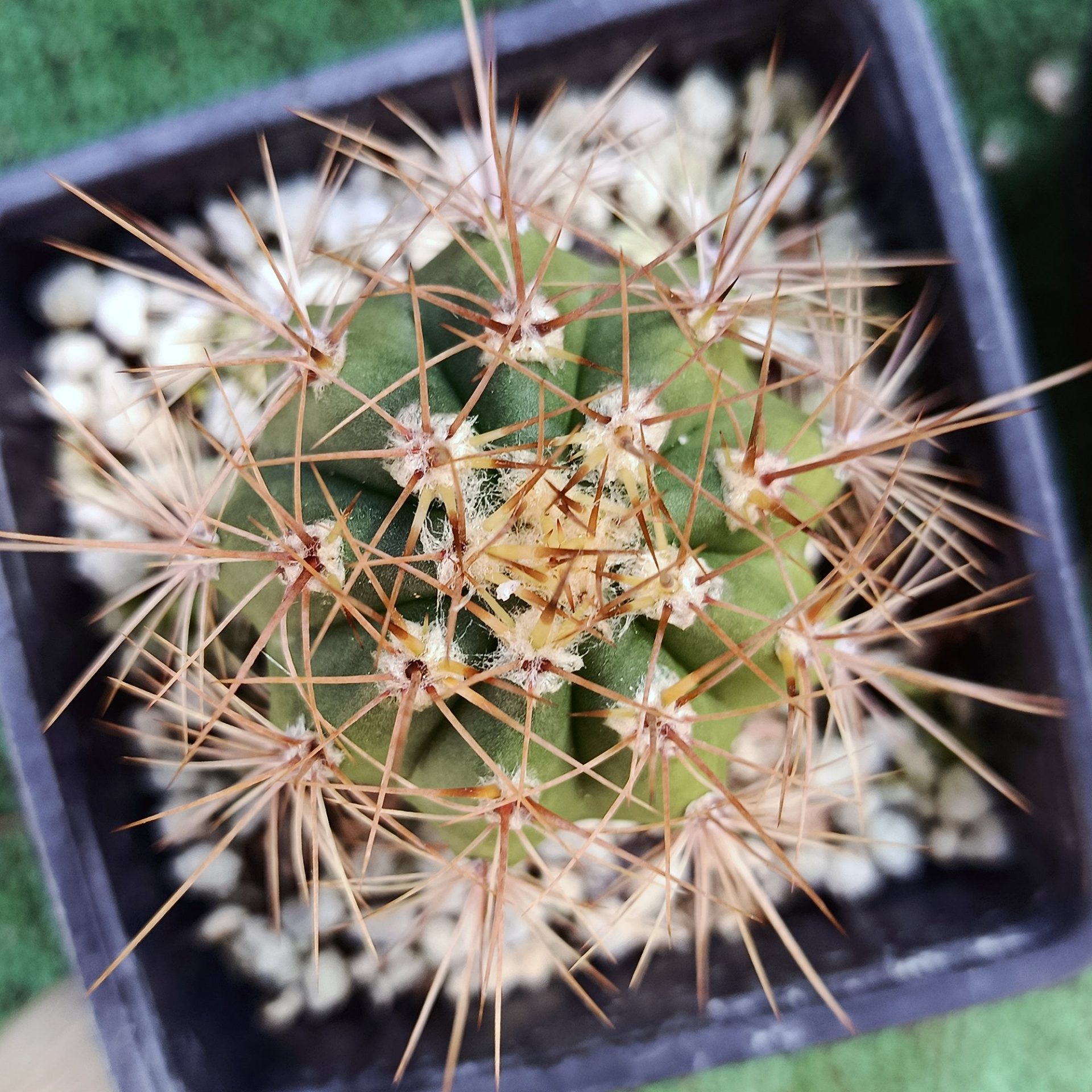
The juvenile apex can become particularly densely armed, with the newest spines crossing and overlapping above the growing point. Older growth lower on the stem remains visibly spiny but allows more of the green epidermis and rib architecture to show through. The result is already recognisably different from many of the more lightly armed columnar Trichocereus commonly encountered in cultivation.
JN 1128 provenance
Field number: JN 1128
Collector: Jan Novák
Recorded locality: Sañogasta, La Rioja, Argentina
Elevation: approximately 1,299 m / 4,262 ft
Collection year: 2014
This provenance is the principal reason for retaining the full ‘JN 1128’ identity. Rather than representing anonymous pasacana seed stock, these plants continue a documented La Rioja collection whose geographic origin, collector, field number and elevation have all remained attached to the lineage.
That does not mean every seed-grown JN 1128 plant will look identical. A field number identifies the collection lineage rather than one genotype, so differences in stem proportions, rib development, spine length and colour, vigour and eventual branching are entirely appropriate between seedlings.
About subsp. pasacana
Trichocereus atacamensis subsp. pasacana, widely known as ‘Cardón Grande’, is one of the genuinely massive South American columnar cacti. Mature plants can develop into imposing tree-like specimens several metres tall, with exceptionally thick trunks and substantial lateral branching.
Large plants develop numerous broad ribs and increasingly formidable areoles. Mature armature can become extraordinarily long and dense, with spines ranging through yellowish, amber, reddish-brown, brown and eventually greyer or bone-coloured shades. Some mature spines can approach approximately 30 cm in exceptional plants.
Young plants begin on a much smaller scale but progressively acquire the thick stems, heavier ribs and increasingly substantial armature associated with old Cardón Grande specimens. Our JN 1128 plants are already showing this trajectory particularly clearly: even at a relatively modest size, the newest growth carries a dense crown of conspicuously elongated spines.
‘JN 1128’ and the photographed plants
The current JN 1128 plants have stout rather than narrowly columnar juvenile growth. Their ribs are broad and clearly separated, while the relatively open rib faces contrast strongly with the dense spine clusters emerging from each areole.
Spine colour is especially attractive on fresh growth. The longest new spines are coppery, amber-orange to reddish-brown, accompanied by paler radial spines which eventually fade towards straw and greyish tones. White to cream wool around the youngest areoles further emphasises the darker new armature.
Individual seedlings may become more or less heavily armed than the plants photographed here. Spine number, length, thickness and colour can all change considerably with age and growing conditions, so the present photographs document the actual nursery material rather than defining a fixed JN 1128 phenotype.
Distribution & habitat
Subsp. pasacana is native principally to north-western Argentina and southern Bolivia, where it occupies dry Andean and inter-Andean landscapes exposed to strong sunlight, large daily temperature changes and seasonal moisture.
JN 1128 provides a particularly precise point within that broader distribution: Sañogasta in La Rioja Province at approximately 1,299 metres elevation. Retaining that information allows the accession to remain geographically meaningful alongside our other Argentine Trichocereus field material.
Field-numbered populations are particularly valuable in widespread and morphologically variable groups because locality information can remain useful even when different taxonomic treatments disagree about the precise boundaries between species or subspecies.
Subsp. pasacana and subsp. atacamensis
The broader Trichocereus atacamensis complex includes two traditionally recognised geographic subspecies. Subsp. pasacana is associated with southern Bolivia and north-western Argentina, while subsp. atacamensis is centred farther west in northern Chile.
Both become enormous, strongly armed columnar cacti and can overlap considerably in general appearance. Subsp. pasacana has traditionally been associated with a greater tendency towards substantial branching in mature plants, although individual morphology remains variable.
Related giant Andean species such as Trichocereus terscheckii can also approach this general appearance, which is another reason documented field provenance such as JN 1128 is worth preserving instead of relying on mature morphology alone.
Flowers & fruit
Mature subsp. pasacana produces large pale flowers ranging from white and whitish through pale pinkish or rose-tinted forms. Flowers can reach approximately 10–15 cm long and provide a striking contrast with the formidable armature of mature stems.
Successful pollination produces relatively small dark-green fruits covered with dense hairs. The fruits are edible and form part of the long relationship between these giant cacti and the people living within their native range.
Traditional uses
Old pasacana plants develop a substantial woody internal skeleton. This material has traditionally been used locally for construction, furniture, fuel and the manufacture of objects including rain sticks.
The cactus is encountered under several regional and horticultural names, including ‘Cardón’, ‘Cardón Grande’, ‘Cavul’, ‘Pasacana Tree Cactus’ and ‘Pasakana’. We retain ‘Cardón Grande’ as the principal common name in the catalogue.
Taxonomic note
This plant has moved through a substantial number of botanical combinations. Names applied to the same taxonomic lineage include Cereus pasacana, Echinopsis pasacana, Echinopsis atacamensis subsp. pasacana, Helianthocereus pasacanus, Pilocereus pasacanus, Trichocereus pasacana and Trichocereus atacamensis subsp. pasacanus.
Current Plants of the World Online treatment accepts Leucostele atacamensis subsp. pasacana as a distinct subspecies native from southern Bolivia to north-western Argentina. Under that treatment, Trichocereus pasacana and Echinopsis atacamensis subsp. pasacana are synonyms.
We retain Trichocereus atacamensis subsp. pasacana for ‘JN 1128’ because it preserves the horticultural and field identity under which this material has circulated, while the current Leucostele placement remains useful taxonomic context rather than a reason to discard the original accession history.
Cultivation
Grow ‘JN 1128’ in abundant light with excellent air movement and a very freely draining cactus substrate. Strong light encourages compact growth, strong ribs and the dense, well-coloured armature characteristic of this lineage, although plants moved from sheltered conditions should always be acclimatised gradually before exposure to intense direct sun.
During active growth, water thoroughly and then allow the substrate to dry substantially before watering again. Although mature Cardón Grande plants are adapted to dry environments, young container-grown specimens still benefit from regular water and moderate feeding while actively growing rather than being kept permanently starved and desiccated.
Growth is generally more deliberate than in fast columnar species such as T. pachanoi or many horticultural hybrids. Adequate root space and a long growing season help young plants build the broad stems required to support their increasingly substantial adult armature.
Reduce watering considerably during cool conditions. Established plants can tolerate substantial temperature variation when acclimatised, but prolonged cold combined with saturated roots remains a much greater risk than cool temperatures alone.
Our Trichocereus cultivation guide covers watering, substrates, feeding, light, acclimatisation and winter care in more detail.
La Rioja Trichocereus genetics
JN 1128 belongs within our Trichocereus Genetics from La Rioja, Argentina collection. Keeping the field number linked to that geographic archive allows it to be compared with the other documented La Rioja accessions represented in our collection.
It also belongs within the broader Trichocereus Genetics from South America collection, where we maintain species, field-numbered accessions and locality material originating across the native range of the group.
About Trichocereus
Trichocereus remains central to our collection, ranging from relatively slender, fast-growing columnar plants through compact flowering species to enormous Andean cacti such as subsp. pasacana.
Field-numbered plants such as ‘JN 1128’ are especially useful because they preserve information which a species name alone cannot carry. The accession records a particular collector, locality, elevation and collection lineage while still allowing natural variation to remain represented through genetically distinct seed-grown individuals.
Explore our pasacana archive, atacamensis species archive, La Rioja Trichocereus collection or our complete Trichocereus collection.
Unless stated otherwise, plants ship bare-root to supported EU destinations. Outside our delivery area? Ask about seed-only orders or join our email list for shipping updates. Photos are representative unless an exact specimen is specified; ask for current specimen photos. Some plants are cut to order where noted. Save 10-35% automatically on qualifying live plants, with bonus seeds and at least one bonus cactus in every live plant order.
Product Details
| Product Type | |
|---|---|
| Amount | 1 rooted plant |
| Size | ~4 cm diameter, ~6 cm tall |
| Common Name | |
| Family | |
| Genus | |
| Species | |
| Subspecies | |
| Clone/Variety/Cultivar | |
| Form | |
| Flower | |
| Breeder/Source | |
| Collection | Trichocereus Genetics from Argentina, Trichocereus Genetics from La Rioja, Argentina, Trichocereus Genetics from South America |
Only logged in customers who have purchased this product may leave a review.
You May Also Appreciate
-


Trichocereus cordobensis cv. ‘Helon’ | Australian Clone | Live plant
€55.00 Add to basket -

Trichocereus pachanoi cv. ‘Mujica’ | ‘San Pedro’ | Live plant
10% OFF until 30 Nov Original price was: €22.50.€20.25Current price is: €20.25. Add to basket -

Trichocereus rowleyi ‘P134’ (ex. var. pumila) | ‘Red Torch’ | Live plant
€18.00 Add to basket -

Lophophora williamsii ‘RS 378’ | ‘Peyote’ | Live plant
€32.00 Add to basket -

Trichocereus bridgesii f. semi-monstrosa cv. ‘RAP’ | ‘Monstrose Bolivian Torch’ | Live plant
10% OFF until 30 Nov Original price was: €81.00.€72.90Current price is: €72.90. Add to basket -

Trichocereus bridgesii f. monstrosa cv. ‘Rusty’ | ‘Monstrose Bolivian Torch’ | Live plant
10% OFF until 30 Nov Original price was: €77.00.€69.30Current price is: €69.30. Add to basket -

Trichocereus atacamensis subsp. pasacana ‘TB 1099.3’ | ‘Cardón Grande’ | Live plant
10% OFF until 30 Nov Original price was: €18.00.€16.20Current price is: €16.20. Add to basket -

Trichocereus faundezii ‘GM 1849’ | Live plant
From €21.00 Browse options This product has multiple variants. The options may be chosen on the product page -

Opuntia microdasys cv. ‘Rufida’ | ‘Mexican Bunny Ears Cactus’ | Live plant
€11.25 Add to basket -

Trichocereus smrzianus ‘Campo Quijano, El Puyil’ | Live plant
€20.00 Add to basket -

Trichocereus atacamensis ‘TB 1320.2’ | ‘Cardón Grande’ | Live plant
€8.00 Add to basket -

Trichocereus knuthianus cv. ‘Fields’ | Live plant
€114.00 Add to basket

Reviews
There are no reviews yet