
Dawson’s Cactus Garden was established at White Hills, Bendigo, in 1933 by Tom H. Dawson and Justin Gill. It grew into a major specialist nursery and advertised itself for decades as Australia’s largest cactus nursery. Some of the old columnar plants associated with the garden remain familiar to collectors through Australian Trichocereus clone names.
There are two overlapping records to consider. Victoria’s heritage documentation describes the original Dawson & Gill business and garden. The modern lists of named Trichocereus mother plants were assembled much later from growers’ records and surviving collections. Those lists preserve valuable horticultural identities, but cannot restore every lost label or establish the original wild locality of every plant.
Dawson & Gill at White Hills
The garden occupied a property at 571 Napier Street, White Hills, with a residence dating from 1868. The Victorian Heritage Database records that Myrtle Dawson, Tom’s wife, began the enterprise by purchasing two cacti. Tom, previously a milkman, subsequently established Dawson’s Cactus Garden with Justin Gill in 1933.
One of Dawson and Gill’s first substantial cactus projects was to sow half a paddock with Pilocereus seed imported from the United States. Within about a decade the nursery had become the main supplier of cacti in Victoria and was exporting some unusual material back to the United States.
An early Dawson & Gill catalogue held by the National Herbarium of Victoria listed more than 2,000 species in the nursery and garden. In 1948 the business advertised itself as the largest cactus nursery in Australia, and in 1962 it was still advertising that position as one it had held for more than twenty-five years. Customers extended throughout Australia and overseas, including New Zealand, Canada, India, Hong Kong, Malaysia, Great Britain and the United States.
The figures come from nursery catalogues, advertisements and the heritage assessment, rather than from an independently verified count of individual plants. They nevertheless show the scale of Dawson & Gill’s propagation and distribution business.
A Bendigo cactus garden
Justin Gill described Bendigo summers with shade temperatures frequently above 100°F (about 38°C), winter frosts severe enough to freeze the soil and rainfall concentrated in the cooler months. Writing about the garden, he observed:
“Here cactus growing is an outdoor game. We all try to grow cactus and other succulents to look like and act like what they are.”
The garden’s outdoor beds allowed many columnar cacti to develop into substantial specimens. Victoria’s heritage assessment singles out the massed planting of mature cacti, together with historic garden beds and nursery features, as important to the character of the site.
The outdoor collection was supported by glasshouses and other nursery structures. A cactus-society visitor in 1953 described a main glasshouse measuring approximately 30 by 12 feet (9.1 by 3.7 metres), with another smaller house displaying Adromischus and Haworthia. The site also had shade houses, a propagation house and a quarantine shed.
The garden also contained imported plants which had entered Australia before later quarantine restrictions made such introductions considerably more difficult. Heritage assessments specifically recognise the scientific value of these old specimens and the nursery’s role in propagating rare material for wider distribution.
Dawson’s place in Australian cactus culture
Dawson’s belonged to a wider network of Victorian cactus growers, nurseries and the Cactus and Succulent Society of Australia. The society organised regular excursions to the historic Fields collection north of Bendigo, commonly stopping at Dawson’s on the way. The heritage record refers to the Fields garden at Lockington; other horticultural references associate the Fields nursery with Tennyson. Neither place-name is needed to establish the connection between the collections.
Plants and propagation material passed between these growers. Some transfers were recorded in detail; others left little documentation beyond a plant label. That is one reason the histories of surviving Australian clones can be difficult to reconstruct.
Our Fields collection archive records material with a different horticultural source. A shared collecting network should not be taken as evidence that the two gardens’ individual accessions had the same origin.
Closure, sale and heritage protection
Dawson’s Cactus Garden remained open for public inspection into the early 1980s. Commercial selling stopped when Tom Dawson went into hospital in 1985, and the nursery closed following his death.
John and Suzanne Martin purchased the property in December 1992 and renamed it the Bendigo Cactus Garden. Some former nursery infrastructure was subsequently lost, including the quarantine shed and propagation house, but important parts of the garden, residence and cactus collection survived.
The former Dawson’s Cactus Garden was entered on the Victorian Heritage Register as H1406 in February 1998. The listing recognises its historical significance as a former cactus and succulent nursery, its scientific value as a collection containing important old specimens, and the unusual aesthetic effect of its massed cactus plantings.
Dawson’s Cactus Garden and Trichocereus
For collectors of Trichocereus, Dawson’s is also associated with old mother plants and cutting lines recorded under names inherited from the garden. These later horticultural records require a different kind of evidence from the nursery’s documented commercial history.
Liam Engel’s Australian San Pedro: A Classic Clone Catalogue, first published in the December 2022 Entheogenesis Australis Conference Journal, compiles Australian mother-plant records supplied by growers and groups them by garden or collection.
Engel’s list is not an original Dawson & Gill nursery catalogue. It is a later record of mother plants and the names under which collectors know them. Engel acknowledges uncertain identifications, potential duplicate entries and questions that cannot presently be resolved without genetic investigation.
We preserve such labels where they have a documented horticultural use, while separating them from botanical identity, original collection locality and demonstrated clonal descent.
Documented Dawson-associated Trichocereus mother plants
Engel lists the following Dawson-associated mother plants, using the names under which they were recorded in cultivation. The table reflects that list rather than a fresh identification of each specimen.
| Recorded group | Dawson-associated names |
|---|---|
| Trichocereus bridgesii | ‘Ben’; ‘Hulk’ |
| Trichocereus chiloensis | ‘Dawson’s No. 1’; ‘Dawson’s No. 2’ |
| Trichocereus knuthianus | ‘Dawson’s’ |
| Trichocereus pasacana | ‘Apache’; ‘Rango’; ‘Red’; ‘Twin Peaks’; ‘Tom’ |
| Trichocereus peruvianus | ‘John’; ‘Dawson’s No. 1’; ‘Dawson’s No. 2’ |
| Trichocereus skottsbergii | ‘Dawson’s’ |
| Trichocereus sp. | ‘Santa Fe’; ‘Sunset’ |
| Trichocereus terscheckii | ‘Banana’; ‘Big Blue’; ‘Dawson’s Long Spine’; ‘Dawson’s Short Spine’; ‘Gill’; ‘John’; ‘Mexican’; ‘Orange Spine’; ‘RJ’; ‘Snake’ |
Names and spelling: Engel’s published list spells the five T. pasacana entries as T. pascana. The Mescaline Garden’s later photographic catalogue uses pasacana, the established botanical spelling, which we follow here. Kew currently treats Trichocereus pasacana as a synonym of Leucostele atacamensis subsp. pasacana. Other names in the table also reflect historical horticultural usage rather than a claim about current accepted taxonomy: Kew treats T. knuthianus under Echinopsis cuzcoensis and T. skottsbergii as Leucostele skottsbergii. Identical short names or numbered labels appearing under different species do not, by themselves, indicate identical clones.
The terscheckii group
The largest part of the Dawson list is the material recorded as Trichocereus terscheckii. Ten names are recorded: ‘Banana’, ‘Big Blue’, ‘Dawson’s Long Spine’, ‘Dawson’s Short Spine’, ‘Gill’, ‘John’, ‘Mexican’, ‘Orange Spine’, ‘RJ’ and ‘Snake’.
The ten entries show how strongly giant Cardón-type plants are represented in the Dawson catalogue, alongside the better-known T. bridgesii and T. peruvianus material.
Kew currently accepts Leucostele terscheckii and Leucostele chiloensis for plants traditionally known as Trichocereus terscheckii and T. chiloensis. We retain the Trichocereus combinations when quoting historic garden labels. See our Trichocereus versus Echinopsis guide and giant Andean Cardón guide for further nomenclatural context.
The Mescaline Garden’s photographic catalogue has separate captions for ‘Dawson’s Short Spine Inside Garden’ and ‘Dawson’s Short Spine Outside Garden’. These identify photographed plants, not necessarily two different genotypes. We therefore retain Engel’s single ‘Dawson’s Short Spine’ entry rather than adding a second clone without evidence.
The blue peruvianus material
Dawson’s is perhaps best known among current Trichocereus collectors for blue Trichocereus peruvianus-type material. Engel’s Dawson group contains ‘John’, ‘Dawson’s No. 1’ and ‘Dawson’s No. 2’.
Plants of the World Online treats the botanical name Trichocereus peruvianus as a synonym of Echinopsis macrogona. That taxonomic decision does not settle the identity of every old plant circulating as T. peruvianus. We retain the recorded name when discussing Dawson clone labels and later hybrid pedigrees.
‘Sharxx Blue’ and ‘Dawson’s No. 2’
‘Sharxx Blue’ is one of the best-known blue Australian T. peruvianus clones. It is strongly associated in collector history with Dawson’s Cactus Garden and became widely distributed through the Australian Trichocereus community before spreading internationally.
‘Sharxx Blue’ does not appear under that name in Engel’s Dawson mother-plant list. In his separate San Pedronomics study of Australian Trichocereus auctions, Engel considers ‘Dawson’s No. 2’ and ‘Sharxx Blue’ highly likely to be the same clone.
This is an informed identification, not a demonstrated genetic match. We preserve both names and describe their proposed relationship without treating them as proven synonyms.
The clone’s precise selection and naming history is less firmly documented than its association with Dawson’s. Accounts of its early distribution differ, and its resemblance to Matucana-type Peruvian plants is not a substitute for a field collection record. We have not found independently verifiable wild-locality documentation for the cultivated clone.
‘John’ and the danger of short clone names
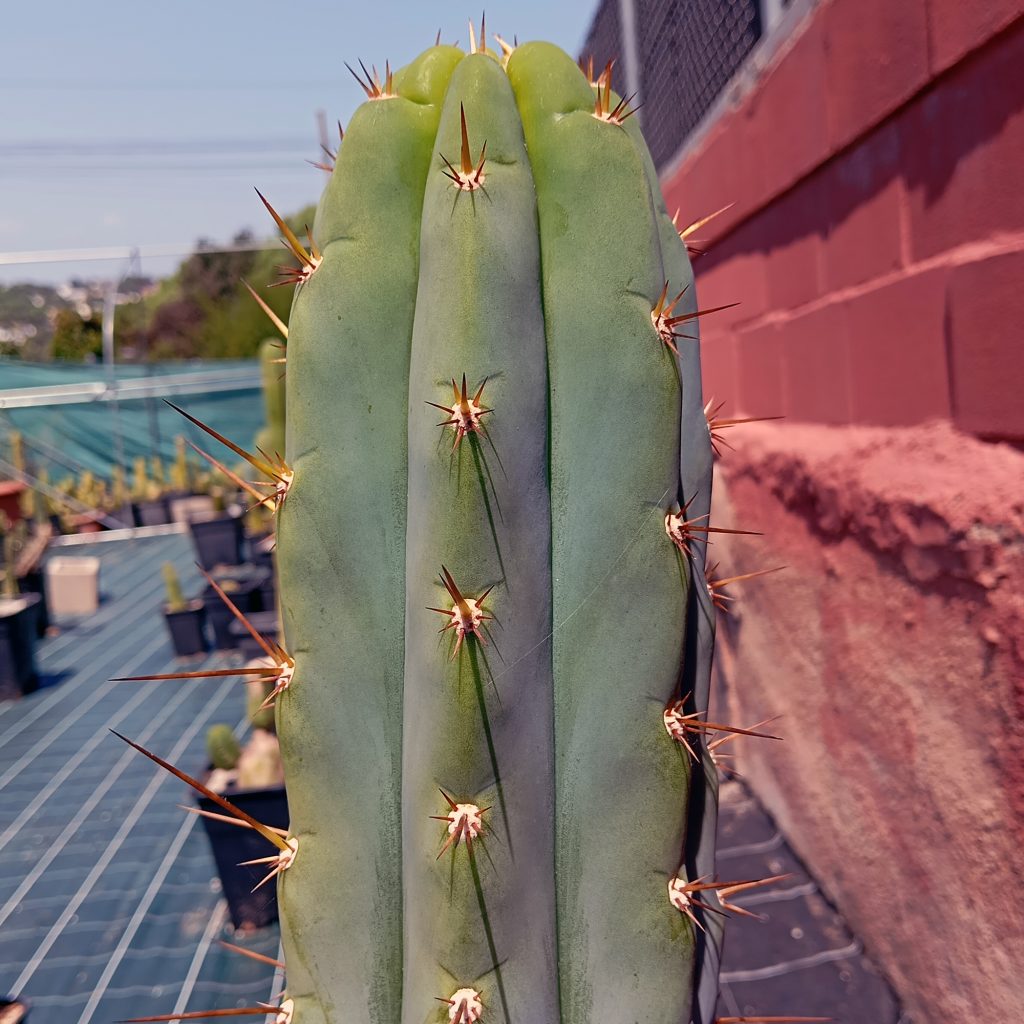
Trichocereus peruvianus ‘John’ is another useful example of why a clone name should not be separated from the rest of its label. Engel’s Dawson catalogue contains both T. peruvianus ‘John’ and T. terscheckii ‘John’. They are not interchangeable merely because both eventually acquired the same convenient human name.
Our existing product record attributes the name of the peruvianus ‘John’ to an owner of the garden, generally understood to be John Martin, who bought the property with Suzanne Martin in 1992. We have not verified the naming event from a contemporary source, so the explanation remains a later horticultural account rather than an established historical fact.
This distinction matters directly to our own collection. We grow a selected clone from Australian breeder Rodni Kisar’s Trichocereus peruvianus ‘John’ × ‘Roo’ cross. The Dawson connection comes through the peruvianus ‘John’ parent. The hybrid itself is a later seed-grown genetic individual, subsequently preserved by us clonally.

Dawson-sourced JAC material
Dawson’s influence extends beyond clones which retained an obvious Dawson name. Engel’s catalogue records several later JAC plants as having been sourced by the Australian grower Jactus from Dawson’s Cactus Garden:
- Trichocereus bridgesii ‘JAC007’;
- Trichocereus macrogonus ‘Blue JAC002’;
- Trichocereus peruvianus ‘Giant Blue JAC001’;
- Trichocereus peruvianus ‘JAC003’;
- Trichocereus peruvianus ‘JAC005’;
- Trichocereus peruvianus ‘JAC006’.
The same source explicitly notes that the parent details of the JAC plants are unknown. They should therefore be understood as Dawson-sourced horticultural material, not automatically as plants bred by Dawson & Gill, original named Dawson selections or accessions with documented South American locality data.
For these plants, the documented nursery connection is useful even where their original seed parents, collector and wild localities remain unknown.
What does Dawson provenance actually mean?
When cataloguing Dawson-associated plants, we distinguish the following records.
- Garden provenance: the plant or its clonal ancestor is documented as having grown at, or come from, Dawson’s Cactus Garden.
- Horticultural identity: a name such as ‘Big Blue’, ‘Dawson’s Short Spine’ or ‘Dawson’s No. 2’ distinguishes material in cultivation.
- Clonal identity: where material has genuinely been propagated vegetatively from one original individual, its descendants can preserve that genotype. A repeated name alone does not prove an unbroken clonal chain.
- Botanical identity: a historical label such as T. peruvianus or T. terscheckii records how a plant has been understood. Later taxonomy may place it elsewhere.
- Wild provenance: the South American locality, collector and collection event from which the ancestral material originated. Dawson provenance does not supply this information unless a separate historical record survives.
We therefore use ‘from Dawson’s’ only when the garden connection is supported, without turning it into a South American field locality, a registered cultivar name or proof that cuttings sold under a matching label share a genotype.
Dawson-associated genetics at Freaky Cacti
Dawson’s is represented in our own collection principally through later Australian Trichocereus genetics. These belong naturally within our Trichocereus Genetics from Australasia collection, which records the horticultural route by which the genetics reached cultivation rather than suggesting that the underlying South American species are native to Australia.
‘Sharxx Blue’ is one such connection. It appears as a recorded parent in several of our later hybrids and is known in cultivation for strongly glaucous stems and comparatively short spines.
Our selected ‘Sina’ × ‘Sharxx Blue’ hybrid was bred outside our nursery and brought into European propagation by Cactus Boy. It carries ‘Sharxx Blue’ ancestry, but the selected seed-grown individual did not originate at Dawson’s Cactus Garden.
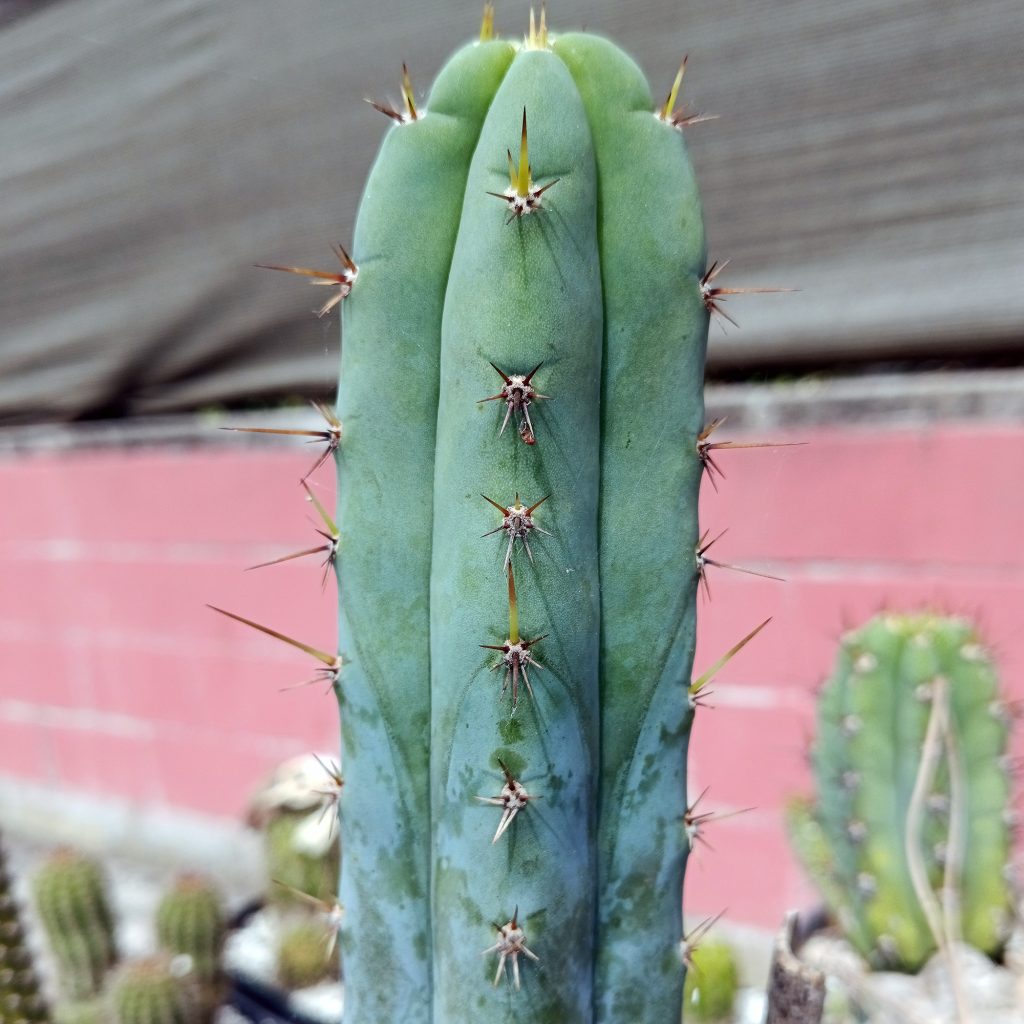
A seed-grown offspring of ‘Sharxx Blue’ is not the ‘Sharxx Blue’ clone, and ‘John’ × ‘Roo’ is not the ‘John’ clone. The parent names record ancestry; vegetative propagation of a selected seedling can then preserve that new individual. See our Trichocereus hybridisation and evidence guide for our approach to pedigrees.
The surviving Dawson record
The heritage record establishes the scale and influence of Dawson & Gill’s nursery independently of later claims about particular clones. The surviving plants and Australian collector records add a different kind of evidence, linking contemporary cultivated material with that nursery’s history.
Names such as ‘Big Blue’, ‘Dawson’s Short Spine’, ‘Dawson’s No. 2’, ‘John’ and the JAC lines remain worth recording, along with the limits of what is known about them.
Some names have been applied to more than one plant; others may refer to the same clone. Where the evidence permits only a probable identification, we record it as such.
For our own collection records, this means keeping original labels, acquisition sources, documented parentage and the distinction between seed-grown offspring and vegetative copies.
Related Freaky Cacti references
- Browse our complete Trichocereus catalogue.
- Explore Trichocereus Genetics from Australasia.
- Browse ‘Sharxx Blue’ and its descendants.
- Browse material associated with ‘John’.
- Browse Trichocereus terscheckii material.
- Browse Trichocereus peruvianus material.
- Read our giant Andean Cardón Trichocereus guide.
- Read our Trichocereus versus Echinopsis taxonomy guide.
Sources and further reading
- Victorian Heritage Database – Dawson’s Cactus Garden, Victorian Heritage Register H1406. Principal source for the establishment, commercial history, surviving garden and heritage significance of Dawson & Gill.
- Royal Botanic Gardens Victoria – HortFlora, Cactaceae. Australian cultivation context and historical reference to the White Hills nursery.
- Liam Engel – Australian San Pedro: A Classic Clone Catalogue. Principal modern published list of Dawson-associated Trichocereus mother plants and Dawson-sourced JAC material.
- Liam Engel – San Pedronomics: Auctioning Trichocereus Cacti. Source for the proposed identity of ‘Dawson’s No. 2’ and ‘Sharxx Blue’.
- The Mescaline Garden – Dawson’s Cactus Garden clone catalogue. Later photographic documentation of the named Dawson mother plants.
- Plants of the World Online (Kew) – Leucostele terscheckii, and Leucostele chiloensis. Accepted names corresponding to the historical Trichocereus labels.
- Plants of the World Online (Kew) – Leucostele atacamensis subsp. pasacana. Current treatment of the name Trichocereus pasacana.
- Plants of the World Online (Kew) – Trichocereus peruvianus; T. knuthianus; and Leucostele skottsbergii. Current name treatments, not independent identifications of the Dawson specimens.