
Quite a few names familiar to collectors of Trichocereus, Echinopsis and Lobivia owe their history to Nathaniel Lord Britton (1859-1934) and Joseph Nelson Rose (1862-1928). Their four-volume The Cactaceae drew together field collections, living plants, herbarium specimens, illustrations and earlier botanical literature on a scale rarely attempted before. It gave us the original descriptions of Trichocereus pachanoi and T. peruvianus in 1920, the combination Trichocereus bridgesii, and the genus Lobivia in 1922.
Rose was involved in both the pachanoi and peruvianus gatherings. The original accounts record who collected the plants, where and when, what they looked like and which photographs were published. They also tell us where the authors were uncertain. That matters when we compare a living cactus with its original description, or try to make sense of an old label or a claimed locality.
In this guide: The Cactaceae | Trichocereus and its original names | Pachanoi in Cuenca | Peruvianus at Matucana | Bridgesii and lageniformis | Macrogonus and typification | Lobivia | Chamaecereus | Soehrensia and Backeberg | Modern taxonomy | What collectors can establish | Original literature and sources.
Britton, Rose and the Work Behind the Names
Nathaniel Lord Britton and the New York Botanical Garden
Britton was well established in American systematic botany before he began work on the cacti. Following academic work at Columbia, he became the first Director-in-Chief of the New York Botanical Garden in 1896, a post he held until 1929. His botanical interests were considerably wider than cacti, including floristic work in North America and the Caribbean. The Garden supplied the collections, staff, library and institutional base that made a project of this size possible. His wife, the bryologist Elizabeth Gertrude Knight Britton, was also a co-founder of the Garden, a contribution easily overlooked when the story is told entirely through its first director.
Britton did far more than lend his name to the volumes. The eventual four volumes required comparing inherited European names, deciding which plants should be separated or united, forming genera and preparing descriptions that could be used by botanists beyond the authors’ own institutions. The result was an ambitious revision of a family whose living plants, preserved specimens and illustrations did not always tell quite the same story.
Joseph Nelson Rose in the Field
Rose, born in Indiana in 1862, trained at Wabash College and began working with the United States National Herbarium in 1888. His earlier botanical research included Mexican and Central American plants outside the cactus family. After service with the United States Department of Agriculture and the United States National Museum, he moved to a Carnegie Institution research appointment in 1912 to work with Britton on a worldwide cactus monograph. He resumed his Smithsonian curatorial post in 1917 while the manuscript and related research continued.
Surviving Smithsonian records cover his expeditions, specimen correspondence and work with Britton. Rose studied European garden and herbarium collections, then spent much of the following period examining cacti in the Americas. His journeys included Peru and Bolivia in 1914 and Ecuador in 1918, both crucial dates for the plants discussed below. He died in 1928, five years after the final volume appeared.
The division was never simply Britton at a desk and Rose in the field. Both studied living and preserved plants. But Rose’s numbered collections give several of the Trichocereus names discussed here a particularly direct connection to the original fieldwork.
How The Cactaceae Came Together
Britton had first envisaged a narrower regional survey. The project soon grew. Financial and institutional support from the Carnegie Institution helped make a study of the entire cactus family possible. Rose also needed to examine European collections. Many cactus names had been published from plants that reached European gardens with little or no reliable information about where they had been collected. Established specimens could be examined carefully, but their earlier history was frequently obscure.
The Carnegie Institution of Washington published The Cactaceae: Descriptions and Illustrations of Plants of the Cactus Family in four volumes: Volume I in 1919, Volume II on 9 September 1920, Volume III on 12 October 1922 and Volume IV on 24 December 1923. Volume IV’s imprint also states that its first 80 text pages were distributed separately on 9 October 1923, a distinction that can affect the dating of names published on those pages. Mary Emily Eaton was a principal botanical illustrator, alongside other contributing artists; photographs and drawings supplemented the taxonomic text. The volumes remained a major reference for subsequent taxonomists even as the classification itself underwent revision.
Two sections are especially relevant to our Trichocereus and Lobivia collections: the treatment of Trichocereus in Volume II, beginning on page 130, and the original account of Lobivia on page 49 of Volume III. The four volumes can be consulted through the Carnegie-hosted digital edition. Those dates and page numbers are worth keeping straight. The date a name was published is not the same question as how a later botanist classifies the plant.
Who Named Trichocereus?
One point is easily missed: Britton and Rose did not establish Trichocereus. Alwin Berger had published Trichocereus as a subgenus of Cereus in 1905, and Vincenzo Riccobono raised it to generic rank in 1909. Its generic authorship is therefore Trichocereus (A.Berger) Riccob.
In 1920, Britton and Rose accepted the genus and recognised 19 species. Their plants were generally ribbed, spiny South American columns, with large flowers, usually opening at night, and conspicuously hairy flower tubes. They selected Cereus macrogonus as the type species. The Greek-derived prefix tricho- refers to hair, particularly the hairs carried by the floral areoles; it does not refer to the spines on the stem. The treatment considerably enlarged Riccobono’s generic account, which had included only T. macrogonus and T. spachianus. The volume supplied a species key, descriptions and illustrations for later botanists to test, use or challenge.
Britton and Rose recognised the floral similarity to Echinopsis, but resisted Berger’s suggestion that the genera might be united. The argument over where Trichocereus ends and Echinopsis begins was already there in 1920. Their separation rested on the morphological evidence available in 1920 and remained open to reassessment.
What Defined Trichocereus in 1920?
The generic diagnosis in The Cactaceae combined stem habit with structures that could not be assessed on a cutting alone: predominantly nocturnal, funnel-shaped flowers; numerous scales on the ovary and floral tube, with hairs arising from their axils; and fruits without the bristles or spines of some other tall columnar genera. Their key also considered branching, mature habit, rib structure and the extent of spination. Ribs and a white flower, taken alone, are not enough to identify a plant as Trichocereus.
Cereus macrogonus shows how uneven that evidence could be. Britton and Rose recognised an old cultivated plant whose origin had been lost, described its appearance and noted that the New York Botanical Garden had a living example received from Kew. Other names could be linked to documented field gatherings. The contrast between an unlocalised European horticultural plant and the accurately numbered Cuenca and Matucana collections helps explain both the value of their fieldwork and the persistent argument over macrogonus.
Why Stems Are Not the Whole Story
Rib number, grooves above the areoles, spine counts and colours are all useful, but they can change as a plant matures or grows under different light levels. Modern analyses likewise recognise overlapping characters among the pachanoi, peruvianus and macrogonus groups. Their flower records supply characters that cannot be assessed from a stem cutting, including details that later botanists could revisit using preserved specimens and molecular data.
New Species and Renamed Species in 1920
| Name in The Cactaceae | Publication | What Britton and Rose contributed |
|---|---|---|
| Trichocereus pachanoi Britton & Rose | Volume II, pp. 134-135, fig. 196 | Original description of a new species, based on the Ecuadorian gathering Rose, Pachano & George Rose 22806 |
| Trichocereus peruvianus Britton & Rose | Volume II, p. 136, fig. 197 | Original description of a new species, based on the Peruvian gathering Rose & Mrs Rose 18658 |
| Trichocereus cuzcoensis Britton & Rose | Volume II, p. 136 | Original description of another Peruvian species, distinct from the new T. peruvianus on the same page |
| Trichocereus shaferi Britton & Rose | Volume II, p. 144 | Original description of an Argentine species; not to be confused with their later Lobivia shaferi |
| Trichocereus bridgesii (Salm-Dyck) Britton & Rose | Volume II, p. 134 | New combination for the previously published Cereus bridgesii Salm-Dyck |
| Trichocereus chiloensis (Colla) Britton & Rose | Volume II, p. 137 | Combination based on Colla’s earlier Cactus chiloensis (1826); now often treated in Leucostele |
| Trichocereus terscheckii (J.Parm. ex Pfeiff.) Britton & Rose | Volume II, p. 140 | Combination based on Cereus terscheckii (1837), one of the giant columnar Andean taxa |
| Trichocereus candicans (Gillies ex Salm-Dyck) Britton & Rose | Volume II, p. 142 | Combination based on an earlier Argentine cactus name |
| Trichocereus huascha (F.A.C.Weber) Britton & Rose | Volume II, p. 142 | Combination from Cereus huascha (1893), later treated under several allied genera |
| Trichocereus schickendantzii (F.A.C.Weber) Britton & Rose | Volume II, p. 144 | Combination from Echinopsis schickendantzii (1896), illustrating how the generic boundaries already overlapped |
The table records two different things botanists do with names. T. pachanoi, T. peruvianus, T. cuzcoensis and T. shaferi were described as new species. The other examples are combinations based on previously published names. The parentheses in an author citation preserve the earlier author; Britton and Rose’s names outside the parentheses record the transfer to Trichocereus. It tells us who described the species and who later moved it to another genus.
The Other Trichocereus Names in Volume II
The San Pedro, Peruvian Torch and Bolivian Torch names are only a small part of the 1920 account. A substantial proportion of the Trichocereus names still encountered in specialist collections were transferred from earlier Cereus, Cactus or Echinopsis names in the same volume. These combinations are historically important even when later authors have recognised their plants in different genera. The table gives selected examples. Britton and Rose did not discover or first describe all nineteen plants.
All Nineteen Species in the 1920 Treatment
For anyone checking an old label, it helps to have the complete 1920 roster in one place. In alphabetical order, the nineteen names recognised by Britton and Rose were T. bridgesii, T. candicans, T. chiloensis, T. coquimbanus, T. cuzcoensis, T. fascicularis, T. huascha, T. lamprochlorus, T. macrogonus, T. pachanoi, T. pasacana, T. peruvianus, T. schickendantzii, T. shaferi, T. spachianus, T. strigosus, T. terscheckii, T. thelegonoides and T. thelegonus. This is the 1920 list, not a list of nineteen species accepted today.
Alongside the now familiar San Pedro, Peruvian Torch and Bolivian Torch concepts were Chilean columns, large Argentine cardones, species with relatively compact stems and plants whose later classifications would lead well away from a narrowly defined Trichocereus. The historical placement of T. fascicularis, for example, illustrates why a name’s appearance in this 1920 roster must not be mistaken for proof of its present generic position. A collection label should preserve the original identification and the date or source of any subsequent redetermination.
Trichocereus cuzcoensis and T. shaferi: two further new species
Both Trichocereus cuzcoensis and T. shaferi were published as new species by Britton and Rose in 1920, on pages 136 and 144 respectively. The first was based on J. N. Rose 19022, collected below Cuzco on 1 September 1914, and remains a familiar name for Peruvian material in specialist cultivation; Kew currently places it under Echinopsis cuzcoensis. The second was based on Argentine material associated with John A. Shafer, including gathering Shafer 44 from a wooded ravine near San Lorenzo, Salta, on 11 January 1917. Britton and Rose described the inner flower segments of T. shaferi as probably white, again distinguishing an inference from a confirmed observation. Its history intersects with that of T. schickendantzii, illustrating that the original 19-species roster was subsequently reassessed at species and infraspecific rank.
It is worth watching the epithet shaferi, which appears in two different names: Trichocereus shaferi Britton & Rose (1920) and Lobivia shaferi Britton & Rose (1922). They refer to different plants. On an old nursery list mixing Trichocereus and Lobivia, the genus, year and collecting context may be needed to tell them apart.
Chilean columns: chiloensis and the later Leucostele question
The 1920 combination Trichocereus chiloensis (Colla) Britton & Rose was based on Cactus chiloensis Colla, published in 1826. Some figure captions and older reproductions render the epithet as ‘chilensis’, so both spellings may appear when searching historical scans; the nomenclatural records of Colla’s name and Britton and Rose’s combination use chiloensis. Under a narrower modern classification many of the Chilean columnar plants formerly placed in Trichocereus are treated in Leucostele, including Leucostele chiloensis. The old combination remains valuable for interpreting locality records and earlier treatments; stem height alone cannot determine a plant’s present generic placement.
The Giant Cardones: terscheckii and the Size of the Genus
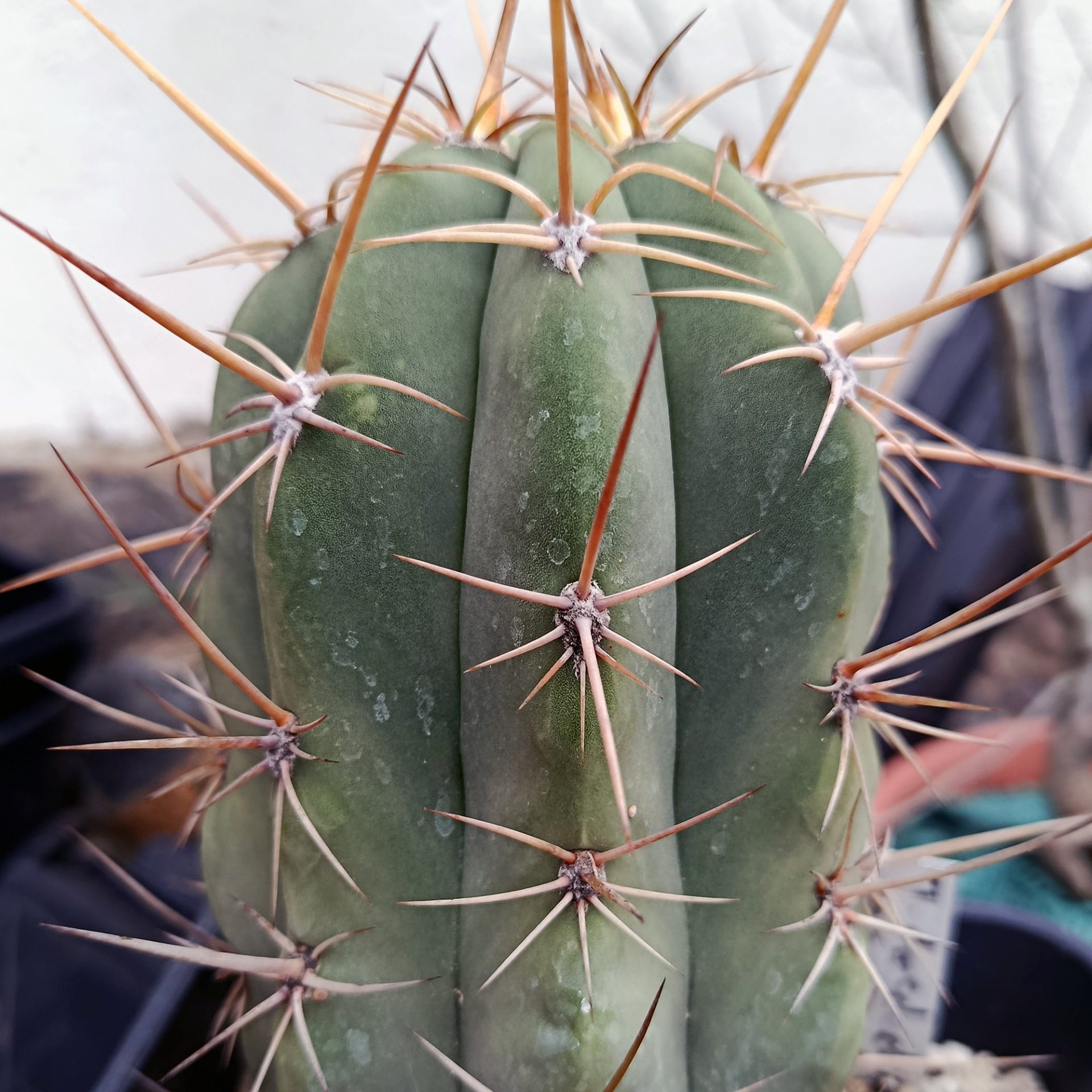
The combination Trichocereus terscheckii (J.Parm. ex Pfeiff.) Britton & Rose, on page 140, followed an 1837 publication under Cereus. This imposing Argentine cardón differs markedly in adult scale from the more familiar thin-stemmed ornamental torch cacti. Kew now places it under Leucostele terscheckii. It is a useful reminder of just how much variety Britton and Rose included in their columnar genus.
For a plant recorded as T. terscheckii, the historical authority and original name can be reported confidently; the identity of a particular seed batch, named locality or horticultural selection is a separate question. This is particularly worth remembering when nursery records also use informal labels such as ‘Cardón Grande’.
Argentine flowering columns: candicans, huascha and schickendantzii
The combinations T. candicans, T. huascha and T. schickendantzii illustrate another side of their treatment. Some are relatively low and clustering, or carry striking floral colours, rather than resembling tree-sized San Pedro cacti. Huascha has later been placed in Lobivia, Helianthocereus and Soehrensia in different classifications; schickendantzii was originally published as an Echinopsis before Britton and Rose transferred it. Their changing classifications also help explain the names found in flowering-cactus collections and older hybrid records.
Transferring a species to Trichocereus did not make Britton and Rose its original authors. For the species to which the combinations refer, the earlier author remains inside the parentheses. The author citation thus distinguishes an earlier species from a genuinely new description by Britton and Rose.
Trichocereus pachanoi: The 1918 Cuenca Collection
Trichocereus pachanoi Britton & Rose was described from a collection made at Cuenca, Ecuador, from 17 to 24 September 1918. The collector line records J. N. Rose, A. Pachano and George Rose 22806. That number belongs to a botanical gathering. It is not a nursery clone, a seed batch or a locality label to be attached to a similar-looking plant a century later.
The species was named in honour of Abelardo Pachano, a professor at the Quinta Normal in Ambato, who accompanied Rose during his work in the Ecuadorian Andes. Pachano was one of the collectors, not simply the person honoured in the name. George Rose took the photograph reproduced as figure 196, showing the upper part of a substantial plant growing on a cliffside near Cuenca. The photograph tells us about that plant in its field setting. It does not identify every San Pedro cactus subsequently grown in cultivation.
Britton and Rose described a tall, branching plant around 3-6 m high, with six to eight broad ribs, transverse depressions above the areoles and relatively few spines, sometimes none. Where spines were present, the longer ones were recorded at about 1-2 cm. They also described large, fragrant flowers opening at night, white on their inner parts, with the ovary and flower tube bearing conspicuous dark hairs. Those floral details belong alongside the better-known description of its relatively short spines. Both are part of the original species account.

Cultivated in Ecuador, but where was it originally wild?
Their remarks on habitat are notably cautious. The authors observed widespread cultivation in Ecuador, including hedges and ornamental planting, and recorded the local names agua-colla and giganton. They thought plants in certain western Andean valleys, including around Alausí, might be native. But its long history in cultivation made it difficult to say with confidence where the cactus had originally grown wild. They gave a broad high-Andean context of approximately 2,000-3,000 m, rather than establishing that every cultivated Ecuadorian population represented a natural wild occurrence.
Plants may move between settlements, fields and gardens for generations, and a locality where a cactus grows does not by itself establish that it evolved there or that a later cutting shares the original collection’s genetic history. The 1918 record fixes where Rose and his companions encountered and collected their material. It cannot, by itself, tell us how San Pedro cacti spread through the Andes in prehistoric times.
Why the name “San Pedro” needs a provenance record
The published Ecuadorian gathering should not be confused with the much larger and older cultural history of the plants commonly called San Pedro or huachuma. Indigenous and local uses, the movement of plants between Andean settlements, and the origin of particular modern clones are different historical questions from the date at which a European-language botanical name became validly published. Britton and Rose themselves recognised that the plant was cultivated and that its original wild habitat was difficult to establish. Their work provides an important taxonomic starting point, not a definitive account of pre-colonial dispersal or present-day horticultural genealogy. A later ethnobotanical chapter by Paniagua-Zambrana and Bussmann (2020) documents names such as San Pedro and huachuma and discusses traditional Andean uses under Echinopsis pachanoi. Its broad synonym list also includes T. peruvianus and T. macrogonus. That list belongs to the chapter’s treatment and should not be presented as though it were the same taxonomic decision as Kew’s present separation of E. pachanoi and E. macrogona. For the related horticultural terminology and species distinctions, see our San Pedro cactus FAQ.
When a plant is circulated as ‘Ecuadorian pachanoi’, ‘PC’, a numbered collection or a named cutting, that label must be interpreted on its own evidence. It is inappropriate to treat Rose 22806 as the source of every cultivated short-spined plant. Conversely, a modern accession differing in spine length from their figure does not automatically represent a different species, especially where environment and growth stage are unknown.
The type specimen and the 2012 lectotype
The type specimen has its own complicated history. In 2012, Sofía Albesiano and Roberto Kiesling reported that the original specimen held at the United States National Herbarium was missing. Their account records that it had reportedly not been found since at least 1941. They designated a preserved duplicate from the same Rose, Pachano and George Rose 22806 gathering, held in New York as NY 386191, as the lectotype. The particular gathering remains the original one even though the surviving name-bearing sheet is housed in a different herbarium.
A lectotype anchors a name to surviving original material when such a selection is needed. It is not a newly collected plant, and it does not turn any present-day nursery cutting into original Rose material. The lectotypification establishes which surviving sheet fixes the name, without implying that the original US specimen has been recovered.
Trichocereus peruvianus: The 1914 Matucana Collection
The original description of Trichocereus peruvianus Britton & Rose is on page 136 of Volume II. The authors explicitly identified the original collection as Rose and Mrs Rose 18658, gathered near Matucana, Peru, on 9 July 1914, at approximately 2,100 m elevation. The peruvianus gathering therefore predates the pachanoi collection by four years, even though the two names appeared together in 1920.
Mrs Rose, identified in Rose’s later biography as his wife Lou B. Sims Rose, is also credited with the photograph used for figure 197, taken at Matucana in 1914. Her photograph and the field number remain part of the original evidence. They are also reminders that the work commonly credited simply to ‘Britton and Rose’ involved other people.
The diagnosis presents a robust plant approximately 2-4 m tall, bearing erect or ascending branches around 15-20 cm thick. Young growth was glaucous; the stems had six to eight broad, rounded ribs, with roughly ten stout brown spines at some areoles and the longest reaching about 4 cm. Britton and Rose compared it particularly with T. bridgesii, finding the Matucana cactus more heavily and darkly spined and growing at a lower elevation than the Bolivian plant they knew by that name.

The flowers the authors had not seen
The original account states that the authors had not seen mature flowers of T. peruvianus. They inferred that the blooms were large and probably white from the available material and related plants. It would be wrong to present those inferred flower characters as something they had directly observed. Later botanical work and cultivation can supply further information, but that belongs to a different body of evidence.
The name itself presents another problem, and spine lengths in nursery photographs will not resolve it. In their 2012 interpretation of the older Cereus macrogonus, Albesiano and Kiesling treated the Matucana plants within T. macrogonus and cited the Rose 18658 gathering, including material catalogued as US 761324 and NY 386193. That original 1914 gathering must not be confused with the independently designated Cereus macrogonus neotype: D. Smith 2456, collected in Peru in 1982. Rose 18658 is the original peruvianus gathering, not the 1982 neotype selected for the older name Cereus macrogonus. Neither collection can authenticate the ancestry of an unconnected modern plant sold as ‘Peruvian Torch’.
A modern plant labelled ‘Matucana’ still needs a provenance record of its own. The locality in the 1920 description does not authenticate an unrelated accession, even one with very similar stems.
What the Matucana description actually establishes
For the Matucana plant, we have a collection date, approximate altitude, gathering number, photograph and measured stem characters. The stated differences from T. bridgesii refer to the specimens the authors compared, not to every later plant assigned to either name. The large differences in spine length visible among current seed-grown peruvianus material should therefore be read as a reason to examine provenance, flowers and additional characters, not as an invitation to identify plants by one supposedly fixed “Peruvian Torch” spine formula.
Why Cereus peruvianus is not the original name of the Peruvian Torch
The epithet peruvianus can be particularly treacherous in old cactus catalogues. Britton and Rose’s Trichocereus peruvianus was a newly published species name in 1920; it was not a transfer of the much older name Cereus peruvianus. Those names have separate histories, and similar epithets should not be treated as evidence that they denote the same species.
The nomenclatural distinction was significant in 1931. When the Matucana plant was placed under Cereus in 1931, the name Cereus rosei Werderm. was published to avoid using an already occupied Cereus peruvianus combination. The IPNI record for Cereus rosei explicitly connects it with Britton and Rose’s 1920 Trichocereus peruvianus. A label saying simply “Cereus peruvianus” is therefore not a reliable historic synonym of Rose’s Matucana cactus.
Trichocereus bridgesii: An Older Species, a New Combination
Trichocereus bridgesii (Salm-Dyck) Britton & Rose has a different history from the two newly described species. Salm-Dyck first published the plant as Cereus bridgesii in 1850. Britton and Rose transferred that previously named species to Trichocereus, so their contribution was a new combination, not the discovery or original description of the species. You can see the difference in the author citation.
The earlier literature had also used names involving lageniformis. Britton and Rose cited Förster’s name in the spelling Cereus lagenaeformis in their discussion of T. bridgesii; the spelling lageniformis is used in modern nomenclatural treatments. Kew currently accepts Echinopsis lageniformis (C.F.Först.) H.Friedrich & G.D.Rowley for this group, based on the earlier Cereus lageniformis of 1861. Its author citation is different because its nomenclatural starting point is different. The older name T. bridgesii remains important in horticulture and historical breeding records; it should not be reinterpreted as though Britton and Rose introduced the name Echinopsis lageniformis in 1920.
Their account describes a pale green, sometimes glaucous columnar cactus generally 2-5 m tall, with four to eight ribs and comparatively few but potentially very long spines. It discusses material cultivated around La Paz, Bolivia, where cacti could be planted as hedges or associated with boundary walls. The original place from which Salm-Dyck’s nineteenth-century horticultural material was obtained was not securely documented. Rose collected Bolivian material that the authors compared with the European concept of the species, but comparison is not a proven vegetative link to the original plant.

A named bridgesii clone, an old European plant labelled lageniformis and a recent seed-raised Bolivian cactus may be related taxonomically without sharing a documented clonal pedigree. The names help us understand what sort of plant we are looking at, but not where a particular clone came from. Our gallery of Trichocereus bridgesii mutants illustrates some of the forms circulating in specialist cultivation, although appearance alone does not establish shared ancestry.
Two different plants called Echinopsis bridgesii and Trichocereus bridgesii
Echinopsis bridgesii Salm-Dyck is a separately published name, not the Echinopsis combination for Britton and Rose’s Bolivian Torch. Salm-Dyck published Echinopsis bridgesii separately in 1850, and Kew currently accepts it as a different Bolivian cactus. By contrast, Kew treats Trichocereus bridgesii (Salm-Dyck) Britton & Rose as a synonym of Echinopsis lageniformis. These are different taxonomic identities, not merely two fashionable ways of writing a genus name.
Consequently, removing the word Trichocereus and replacing it with Echinopsis in an old bridgesii label is potentially misleading. The source and author citation are needed to know which published name is intended. Readers encountering these names can compare Kew’s separate treatments of Trichocereus bridgesii, Echinopsis lageniformis and Echinopsis bridgesii. The author citations distinguish two names that share an epithet but refer to different plants.
Cereus macrogonus: The Older Name at the Centre of the Debate
The name macrogonus is older than either of the 1920 descriptions. Salm-Dyck published Cereus macrogonus in 1850, but the plant’s original geographic origin was not known from that account. Like many nineteenth-century cacti, it had been studied in European cultivation. Berger and Riccobono subsequently placed it in the history of Trichocereus, and Britton and Rose treated it as the type of that genus.
In 2012, Albesiano and Kiesling re-examined the original description and later records and argued that the plants known as T. peruvianus were conspecific with T. macrogonus. To stabilise the older name, they designated D. Smith 2456, collected on 1 October 1982 between Acobamba and Palca in Junín, Peru, as the neotype of Cereus macrogonus (SI, with an isoneotype at MO). Their treatment separately cites Rose and Mrs Rose 18658 as the historic Matucana material associated with T. peruvianus. They also treated pachanoi as a distinguishable variety, publishing Trichocereus macrogonus var. pachanoi (Britton & Rose) S.Albesiano & R.Kiesling. Their evidence included variation in ribs, areoles, spines, epidermis and cultivation history. They acknowledged that spine characters alone could be affected by growing conditions and that intermediate plants existed.
This helps explain why an old nursery catalogue and a modern botanical reference may handle macrogonus, peruvianus and pachanoi differently. They are not proof that all three names are simply interchangeable labels for every plant circulating under them. Original species concepts, later synonymy, the identity of a type specimen and the provenance of an individual cutting are four questions that require different evidence.
Echinopsis and Early Generic Boundaries
Britton and Rose were working among closely allied genera with overlapping characters. Traditional Echinopsis included many comparatively compact, often globular cacti with large funnel-shaped flowers. Trichocereus emphasised columnar habit and a particular combination of floral structures; the plants later grouped under Lobivia tended to be smaller, highland forms with flowers opening by day and shorter floral tubes. These distinctions were practical for studying a specimen or a living collection, but the boundaries were never absolute. Our illustrated Echinopsis species guide examines that group separately from the columnar Trichocereus discussed here.
Two years after their expanded Trichocereus treatment, Britton and Rose established Lobivia for Andean species they considered distinct from existing genera. The resulting names helped growers describe breeding parents and flower types, even after subsequent classifications reassembled many of the same species within Echinopsis. The chronological distinction matters: Britton and Rose did not create the genus Echinopsis, and neither their 1920 nor their 1922 genus concepts matches every taxonomic treatment in use today.
Lobivia: A New Andean Genus in 1922
Britton and Rose established Lobivia Britton & Rose in Volume III, page 49, published on 12 October 1922. Its name is an anagram of Bolivia, though their treatment included cacti of Peru and Argentina as well as Bolivia. They chose Echinocactus pentlandii Hook. as the type species, presented in their genus as Lobivia pentlandii (Hook.) Britton & Rose.
The initial treatment comprised 20 species, mainly taken from plants formerly placed under Echinopsis and Echinocactus. The authors described generally globular to short-cylindrical plants, solitary or forming clusters, with conspicuous ribs and spines. They emphasised their daytime flowers, comparatively short, broad tubes and relatively small rounded fruits. Their species came from highland environments in the central and southern Andes.
Britton and Rose were quite open about the limitations. Some of these plants might not belong together; others were known only from descriptions or photographs. Better material could change the arrangement. Lobivia reflected the evidence available in 1922.
They also noted a possible division within the genus: two plants transferred from Echinocactus, named E. thionanthus and E. chionanthus, were described as possessing a dense internal ring of hairs in the flower tube. They suggested that this and other floral differences might eventually prove important at generic rank. They were plainly not presenting the 1922 boundaries of Lobivia as the final word.

Original Lobivia names that still matter
The type species L. pentlandii ties the genus to Hooker’s earlier Echinocactus pentlandii. Two species described by Britton and Rose themselves, L. ferox and L. bruchii, reveal how differently the members of their original assemblage would subsequently be interpreted. These are original 1922 names, unlike their new Lobivia combinations based on older species.
For later cactus breeders, Lobivia was a useful label for many small-bodied Andean parents with conspicuous flowers. Their actual parent plants and recorded cross histories still matter more than the genus under which a modern database files the names. Our Lobivia flower gallery shows why the name has remained so useful to growers.
Two early Lobivia names illustrate different subsequent histories
Lobivia ferox Britton & Rose appeared on page 50 in 1922, with figure 63. The original material was collected by J. N. Rose 18918 on dry hills east of Oruro, Bolivia, on 18 August 1914. Rose sent living plants to the New York Botanical Garden, but the account explicitly says that the authors had seen neither flowers nor fruit; one cultivated plant had still not flowered. Kew presently recognises its name under Echinopsis ferox; historical labels may also use Pseudolobivia. These names reflect different generic treatments. They do not, by themselves, tell us which seed line an old nursery parent came from. Our Lobivia ferox ‘MUS14/L43’ nursery material is an independently recorded, later locality line and should not be confused with Rose’s 1914 gathering.
Lobivia bruchii Britton & Rose was also described on page 50. Here the original description was drawn from a photograph taken in March 1907 of a plant at Tafí del Valle, Tucumán, Argentina, sent by Dr C. Bruch. Figure 62 reproduces that photograph. The authors reported red flowers but did not know the fruit or seeds. This is not the same sort of evidence as Rose’s numbered L. ferox gathering. The authors had a photograph of bruchii, not a living plant they had personally studied. Its eventual role as the type of Soehrensia connected what started as a genus of comparatively compact Andean plants with groups often discussed alongside Trichocereus. Ferox and bruchii show why a 1922 Lobivia label need not imply that every species placed there forms a narrowly defined modern clade. The authors had already acknowledged precisely this difficulty.
Chamaecereus: Another Britton and Rose Genus from 1922
Immediately before their Lobivia chapter, on page 48 of Volume III, Britton and Rose established Chamaecereus Britton & Rose, published on 12 October 1922. They based its type species, Chamaecereus silvestrii (Speg.) Britton & Rose, on the earlier Cereus silvestrii Speg., described in 1905. They established the genus, but the species itself had already been described. Kew now treats the familiar peanut cactus as Echinopsis chamaecereus. Alongside Lobivia, the name became important in the history of small-stemmed and intergeneric ornamental breeding.
The plant’s low, freely branching stems and conspicuous flowers made it horticulturally unlike the tree-like subjects of Volume II. It also became important in the terminology of crosses between small-bodied flowering cacti and related ornamental lines. Hybrid labels using Chamaecereus should be read historically when following an old breeder’s own record, even where a modern taxonomy would change the genus of one parent. Of course, an old cross label does not independently prove the parentage of the surviving plant.
The Lobivia bruchii to Soehrensia Connection
Their 1922 description of Lobivia bruchii Britton & Rose from Argentina (Volume III, p. 50) was subsequently reinterpreted at generic rank. The name was later combined as Trichocereus bruchii (Britton & Rose) F.Ritter and Echinopsis bruchii (Britton & Rose) Friedrich & Glaetzle. It also became the taxonomic anchor of another well-known generic name: Soehrensia.
Soehrensia was established by Curt Backeberg in 1938, not by Britton and Rose. The combination Soehrensia bruchii (Britton & Rose) Backeb. followed in 1940, with the 1922 Lobivia bruchii as its basionym. The two dates refer to different acts: establishing the genus in 1938 and publishing the combination for its type species in 1940. The sequence links the nomenclature of Lobivia, Trichocereus and Soehrensia, although it does not place every species assigned to those genera in a single lineage.
The changing placement of bruchii reflects the difficulty of delimiting these genera by morphology alone. Later authors could examine its morphology and place it among tall-stemmed Trichocereus, in Soehrensia, or within a broader Echinopsis. Those alternative placements are taxonomic opinions, whereas the place and authorship of the 1922 name are nomenclatural facts. When reading an old seed packet, pedigree or field record, it is worth keeping both the original name and the later interpretation. Botanical authors have not all used the same classification.
From Lobivia to Echinopsis, Soehrensia and Back Again
Changes to generic boundaries became particularly conspicuous in the twentieth century. In 1974, Heimo Friedrich’s treatment of the Echinopsis alliance and Gordon Rowley’s associated nomenclatural work provided the framework for placing many traditional Trichocereus species under a broader Echinopsis. Different authors later disagreed over whether such a wide genus best represented the group’s morphology and evolutionary relationships. Older names including Lobivia and Soehrensia continued to circulate in horticulture and in narrower taxonomic treatments.
The current Kew Plants of the World Online treatment places Lobivia and Chamaecereus in the synonymy of Echinopsis. Kew also treats Soehrensia as part of a broad Echinopsis concept. They accept Echinopsis pachanoi for the plant originally described as T. pachanoi; place T. peruvianus under Echinopsis macrogona; and treat T. bridgesii within Echinopsis lageniformis. That is Kew’s current treatment, not a change to what was published in 1920 or 1922.
The 2012 Albesiano and Kiesling interpretation differs in its rank for pachanoi, placing it within T. macrogonus. The treatments can agree on the historical type material while differing over the rank at which a plant group should be recognised. An ‘accepted name’ is the name accepted by that particular botanical checklist. It does not erase the original publication or authenticate labels attached to individual plants.
What more recent molecular research does, and does not, resolve
DNA-based work has since added evidence that Britton and Rose could not have examined. A 2012 study by Schlumpberger and Renner highlighted repeated evolutionary changes in growth form and pollination-related floral characters, making it difficult to defend some traditional generic boundaries by appearance alone. In 2025, de Vos and colleagues published a phylogenomic classification built from hundreds of nuclear genetic markers and a sampling of 170 cactus species. Their classification treats the traditional Chamaecereus, Soehrensia and Trichocereus sensu stricto groups within Echinopsis in the broad sense, and lists Lobivia in that generic synonymy. However, the authors explicitly mark Lobivia as not sampled in their own molecular dataset. They also did not sample Leucostele; reviewing partly conflicting earlier analyses, they placed it tentatively among early-diverging lineages of their Trichocereinae, rather than claiming that its position was fully resolved. A classification of sampled species and genera should not be mistaken for direct genetic evidence about every species or nursery accession assigned to them.
The authors themselves call for denser sampling of rapidly diversified cactus groups. Even a detailed phylogenomic classification cannot identify a particular nursery accession or establish its parentage.
Why Leucostele appears beside Trichocereus
Some familiar old Trichocereus names, especially large Chilean and Argentine columns such as chiloensis and terscheckii, appear in modern Kew treatments under Leucostele. They should not simply be folded into every statement about the modern accepted circumscription of Echinopsis. The historic genus used by Britton and Rose was broad, and its former contents are not necessarily assigned as a single block in every recent classification. For historical records, it makes sense to keep the original combination and add a modern accepted name where it helps. For a species-by-species comparison of these modern combinations with their traditional labels, see our illustrated Leucostele guide.
What This Means for Collectors and Breeders
Historical names are evidence, but not pedigrees
A cutting labelled T. pachanoi can be compared with the 1920 diagnosis, but that alone will not tell us whether it came from Ecuador, Peru, a twentieth-century European nursery or a recently selected seedling. The same principle applies to a T. peruvianus ‘Matucana’ label and to a T. bridgesii clone. A useful accession record keeps species identification, locality evidence, clonal identity and breeding history separate.
A good accession record preserves the original label, the person or nursery from which material was received, the date acquired, any field number and any confirmed parentage. Where a plant was seed-raised from a named clone, the offspring is genetically distinct from the parent. If the source of a name is uncertain, it is better to record that than invent a history for it. For examples of modern provenance and parentage recorded separately from species names, see our 2025 cactus breeding records.
Flowers, photographs and field numbers
The gathering numbers 22806 and 18658 refer to historical specimens and collections. Neither number implies that living original clones have survived, nor should a number attached to a different collector’s material be assumed to refer to the same plant simply because its appearance is similar. A field number is useful when it can still be traced to the actual collecting record. Our cactus field-number reference explains how collection codes, locality identifiers and accession records should be read.
How the names entered cactus breeding
Britton and Rose were primarily taxonomists and botanical investigators, not the originators of the named flowering hybrid lines familiar from later American nurseries. They organised and described plants whose names would later appear on nursery labels and in breeding records. In twentieth-century breeding, the familiar Echinopsis and Lobivia groupings became particularly important for large-flowered hybrids, including Harry Johnson’s Paramount hybrids and the later Robert Schick material.
Why an old hybrid pedigree may contain more than one correct genus name
An early horticultural cross might be recorded using Trichocereus, Lobivia or Chamaecereus for its parent plants. A later breeder may record descendants of the same lineage under Echinopsis. These names can be taxonomic alternatives for the relevant parent concept, but a changed genus assignment does not change the genetic identity of a documented parent or prove that two independently circulated plants are the same clone. The recorded source of the parent still matters. The practical relationships between these historically separate groups are covered in our Trichocereus hybridisation and compatibility reference.
That is why we retain the original names when recording an established cross. We can add a synonym or current taxonomic interpretation separately. Replacing every historical genus mechanically with Echinopsis would erase useful information about the original breeder’s identification and the period in which a cross was recorded. Our Robert Schick hybrid reference and Harry Johnson history demonstrate how important dated nursery and introduction records are to making sense of these names.
Using the Original Accounts as Evidence
What a number, specimen and photograph can establish
A collection number is a link to a collecting event, and ideally to preserved material and a catalogue entry. For these particular species, 22806 links to the September 1918 Cuenca gathering and 18658 to the July 1914 Matucana gathering. A photograph published in a protologue shows a plant documented at that time and place. A type specimen anchors the application of a scientific name under the nomenclatural Code. None of these, on its own, proves that a plant sold a century later is the same clone, comes from the same locality or has an unbroken chain of provenance.
Type specimens fix names, but not the complete variation of a species
Typification and taxonomic circumscription answer different questions. The type of a name establishes the specimen to which that name is permanently attached under botanical nomenclature. A taxonomist must still decide which other specimens and populations belong to the same species or, where appropriate, to a subspecies or variety. The type does not itself describe the entire range of variation in spine length, rib count or flower colour.
This explains how Albesiano and Kiesling could publish a lectotype for pachanoi in 2012 and still propose placing that plant at varietal rank within macrogonus. It also explains how Kew can retain the older types while recognising Echinopsis pachanoi separately and treating Trichocereus peruvianus within Echinopsis macrogona. A later taxonomic opinion does not retrospectively change the date, collectors or wording of Britton and Rose’s original publication.
How to compare a living cactus with the original description
When comparing a living cactus with an old description, start with its age and growing conditions. Record the number and shape of ribs on mature growth, the form and spacing of areoles, grooves above them, spine number and length on different-aged sections, and whether the epidermis is green or glaucous. If the plant flowers, add photographs and measurements of buds, open flowers, the floral tube, pericarpel, fruit and seeds. Where collection history exists, keep the locality, collector, original label, accession number and dates with the photographs. Note which characters agree with Britton and Rose, which differ and which you have not yet been able to check.
For practical comparisons and an explanation of the variation that prevents one-character identification, see our Trichocereus identification keys and discussion of Trichocereus and Echinopsis. The historical names are also worth retaining exactly as received in original breeding records, with modern interpretations added separately rather than substituted for an earlier parentage.
Original Literature and Further Reading
- Britton, N. L. & Rose, J. N. (1919-1923). The Cactaceae: Descriptions and Illustrations of Plants of the Cactus Family. Carnegie Institution of Washington, four volumes. Consult Volume II, pp. 130-145, for the original Trichocereus treatment; see Volume III, p. 48, for Chamaecereus and pp. 49-59 for Lobivia. Carnegie-hosted digital edition.
- International Plant Names Index. Bibliographic record for the four volumes of The Cactaceae, with the issue dates of the four volumes.
- International Plant Names Index. Original publication records for T. pachanoi, T. peruvianus, T. bridgesii and Lobivia. These document authorship and publication, not a single settled taxonomic treatment of all cultivated plants.
- Albesiano, S. & Kiesling, R. (2012). ‘Identity and Neotypification of Cereus macrogonus, the Type Species of the Genus Trichocereus (Cactaceae)’. Haseltonia 17: 24-34. Discusses the macrogonus complex, the 1914 Matucana material and the lectotype of T. pachanoi. Read the journal article.
- Smithsonian Institution Archives. United States National Museum, Division of Plants, Record Unit 221. Institutional biographical notes and research correspondence concerning Rose and the Cactaceae project.
- New York Botanical Garden Archives. Nathaniel Lord Britton records, including biographical and professional documentation.
- New York Botanical Garden (2026). ‘How the Garden Took Root: An Interview with Nathaniel Lord Britton’. The Garden’s presentation of a 1933 interview documents Elizabeth Gertrude Knight Britton’s role in its foundation. Read the institutional history.
- Mitich, L. W. (1981). ‘A Salute to Joseph Nelson Rose’. Cactus and Succulent Journal (US) 53: 299-303. Includes biographical material, Berger family recollections and a bibliography of Rose’s work. Read the CSSA republication.
- International Plant Names Index. Publication records for Trichocereus, Chamaecereus, and Lobivia, distinguishing original generic authorship from later combinations. The recorded basionyms include Cactus chiloensis (1826), Cereus terscheckii (1837), Cereus huascha (1893), Echinopsis schickendantzii (1896), and Cereus silvestrii (1905).
- International Plant Names Index. Records for Lobivia bruchii Britton & Rose, Soehrensia Backeb. and Soehrensia bruchii (Britton & Rose) Backeb.. These document the 1922, 1938 and 1940 publications and the type relationship.
- Paniagua-Zambrana, N. Y. & Bussmann, R. W. (2020). ‘Echinopsis pachanoi (Britton & Rose) Friedrich & G. D. Rowley’, in Ethnobotany of the Andes, pp. 773-778. Discusses local names, uses and a broader synonym list. The taxonomic grouping used in this ethnobotanical chapter should be distinguished from current Kew checklist decisions. Publisher’s reference work.
- Schlumpberger, B. O. & Renner, S. S. (2012). ‘Molecular phylogenetics of Echinopsis (Cactaceae): Polyphyly at all levels and convergent evolution of pollination modes and growth forms’. American Journal of Botany 99(8): 1335-1349. The analysis examines convergent floral and growth-form characters in the Echinopsis alliance. Publication record and abstract.
- de Vos, J. M. and colleagues (2025). ‘Phylogenomics and classification of Cactaceae based on hundreds of nuclear genes’. Plant Systematics and Evolution 311, article 28. Read the open-access study. Its classification is relevant to the treatment of Echinopsis and its traditional segregate genera.
- Royal Botanic Gardens, Kew. Plants of the World Online records for T. pachanoi, T. peruvianus, T. bridgesii and Lobivia, for the present checklist relationships.
For a wider view of the plants themselves, see our illustrated Trichocereus guide and recommended books on Trichocereus.
Our Trichocereus catalogue and Lobivia catalogue bring together plants, seeds and relevant hybrids recorded under those horticultural headings. These browse categories do not imply descent from Rose’s early collections. To browse more broadly by species epithet, recorded provenance, product type or availability, use the Catalogue Explorer. Species archives can also include hybrids carrying the epithet in their ancestry, and occasionally unrelated plants in other genera which share that epithet. Check the complete product name.