
A cactus producing fewer or shorter spines than expected is not necessarily unhealthy. Spination varies between species, between genetically distinct individuals of the same species, with age, and to some extent with growing conditions. Some cacti are naturally almost spineless; some named forms have been maintained specifically for reduced armature; others produce weaker spination only after their conditions change.
There are also two quite different problems commonly described as a cactus “losing its spines”. An old spine may actually have been broken or detached, or the plant may have begun producing new areoles with fewer, shorter or weaker spines. Those situations have different causes and should be diagnosed separately.
Start by Looking at Where the Change Occurred
A cactus stem is a useful record of its own recent history. The spines farther down an established column were formed when those sections were close to the growing point, sometimes years earlier. The newest areoles immediately below the apex record much more recent development.
If old growth has a few empty areoles or broken spines but the growing tip remains compact and normally armed, physical damage is more likely than a cultivation problem. If the newest growth is consistently producing shorter or fewer spines than the older stem, something has changed in either the plant’s development or its growing conditions. If the entire plant has always been lightly armed and otherwise looks healthy, reduced spination may simply be part of its genetics.
The accompanying growth matters. Fewer spines combined with a narrowing, elongated apex points towards inadequate light far more strongly than short spines by themselves. Reduced spination accompanied by scars, distorted tissue, discolouration, softness or declining vigour calls for a different investigation.
How Cactus Spines Develop
Cactus spines arise from areoles, the specialised structures which are one of the defining features of the cactus family. Young areoles contain meristematic tissue and can give rise, depending on the cactus and the developmental state of the areole, to spines, hairs, branches or flowers.
Spines begin as developing primordia in young areolar tissue and subsequently harden. Their development is largely concentrated around actively growing parts of the plant, although areole behaviour differs considerably across the Cactaceae. This becomes important when asking whether a lost spine can grow back.
Cactus spines are often described simply as “modified leaves”. That remains a convenient traditional shorthand, but their precise developmental homology is less straightforward than the phrase suggests. Recent anatomical work on cactus seedlings has questioned whether spine development can be equated neatly with ordinary leaf development. For cultivation purposes, the important point is simpler: spines are produced by the areolar system as the cactus develops, and their eventual form reflects both the genetics of the plant and the circumstances under which that tissue formed.
Some Cacti Are Naturally Spineless
The cactus family contains everything from plants armed with enormous rigid spines to species which become effectively spineless. Mature Lophophora, for example, normally lack conventional persistent spines, while some columnar cacti produce only very modest armature compared with closely related species.
There can also be considerable variation within a species. Seed-grown siblings are genetically distinct individuals, so differences in spine number, length, thickness, colour and orientation are perfectly possible even when all of the plants carry the same species name.
This is particularly relevant when comparing a seed-grown plant with photographs of one selected clone. A heavily spined representative circulating online does not establish how every member of the species should look.
Inermis: spineless and nearly spineless forms
The Latin inermis means “unarmed”. In botanical and horticultural names it is used for plants lacking, or markedly reducing, structures such as spines or thorns.
Our inermis archive brings together cactus material maintained under that sort of identity. One useful example is Echinocereus triglochidiatus f. inermis, the spineless to very lightly spined form of the claret-cup cactus.
The word itself should not be mistaken for a genetic diagnosis. Different plants have acquired inermis names independently, and the underlying biology need not be identical. Nor does an inermis designation necessarily mean that every individual remains absolutely devoid of spines throughout its life. Some seed-grown forms can occasionally produce short or isolated spines while remaining conspicuously less armed than typical plants.
Most importantly, a healthy inermis plant is not suffering from “spine loss”. There is nothing to correct by increasing fertiliser, changing the watering regime or applying pesticides simply because it lacks the armature of the ordinary form.
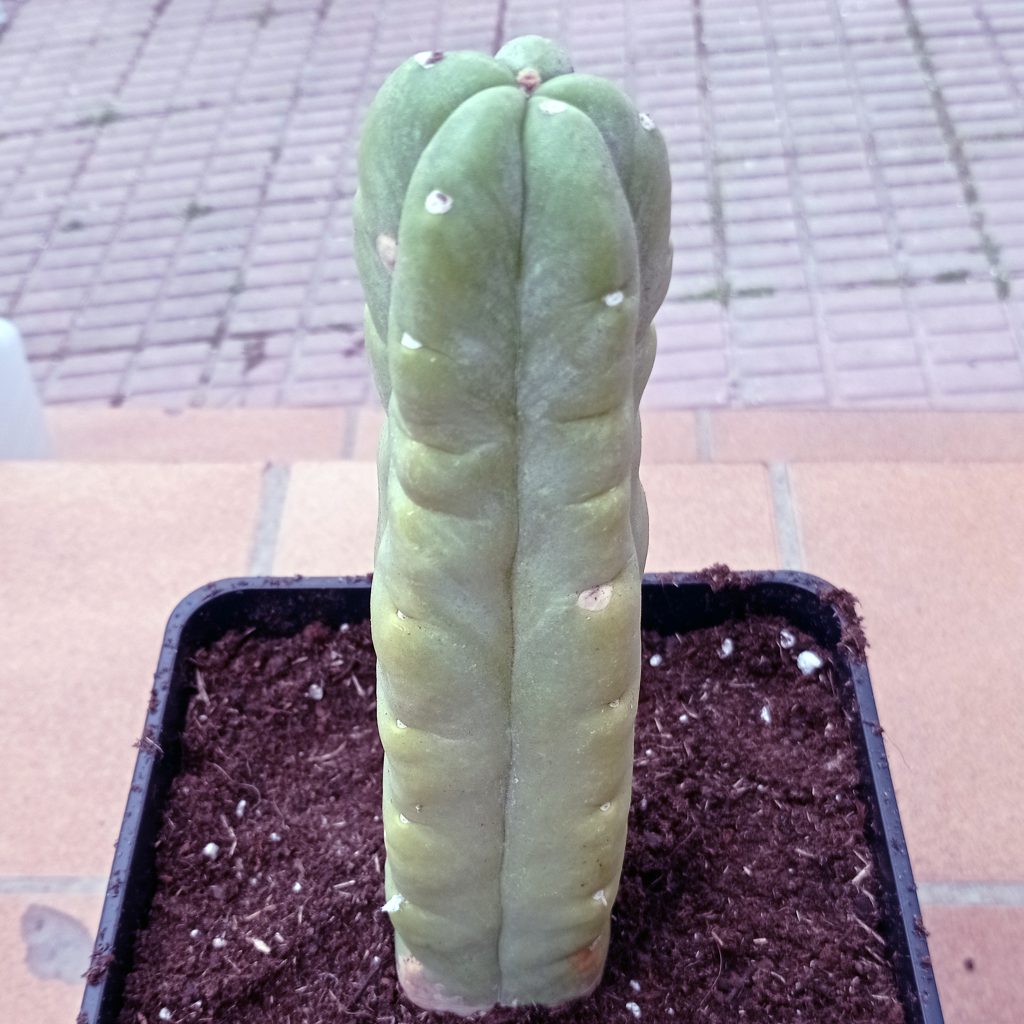
Brevispina and brevispinus: short-spined forms
Brevispina, brevispinus and related names refer to unusually short spination rather than complete absence of spines. These names also occur in different botanical and horticultural contexts, so they should not be interpreted as one formal rank or one shared genetic condition.
We use our brevispina archive as a practical horticultural grouping for short-spined forms, selections and crosses involving relevant parents. It is deliberately broader than a register of formally described botanical forms.
The contrast with ordinary plants can be considerable. Our clonally maintained Trichocereus atacamensis subsp. pasacana f. brevispina produces much shorter armature than typical pasacana, which can develop an exceptionally dense covering of long spines. The short-spined habit is the defining feature of that cultivated material, not evidence that the plant needs stronger light or different feeding.

Another example is Trichocereus candicans f. brevispinus. We maintain this plant vegetatively, preserving the genetics of our established mother material. Individual propagations can still vary somewhat with age and conditions, but conspicuously restrained spination remains characteristic of the plant.
Seeds involving a short-spined parent are another matter. Sexual reproduction produces genetically different offspring, so a brevispina or brevispinus parent does not guarantee identically short-spined seedlings. Some may strongly resemble the parent, others less so.
Spination Changes as a Cactus Matures
Cactus seedlings are not miniature versions of mature specimens. Rib structure, stem proportions, areoles and spination can all change considerably as juvenile growth gives way to adult growth.
Some species begin with fine or relatively inconspicuous juvenile spines and become much more heavily armed later. Other cacti can become less conspicuously spined with maturity, and some show considerable variation between individuals. Freshly produced spines can also differ markedly in colour and texture from older ones, becoming greyer, paler or more brittle as they age.
When judging a young plant, compare it with material of a similar age if possible. A large habitat specimen carrying decades of mature growth is not necessarily a useful standard for a seedling which germinated last year.
Light Can Change Spine Development
Light is one of the first growing conditions worth checking when a normally well-spined cactus begins producing noticeably weaker armature at the apex.
With Trichocereus, insufficient light commonly produces narrower, elongated and softer growth, often accompanied by increased spacing between areoles and reduced spine development. The whole pattern matters. A short spine on an otherwise compact, normally proportioned stem tells us considerably less than a rapidly narrowing apex covered in weak new growth.
Environmental effects on cactus spination are real, but they are not uniform. Research on cactus spine morphology has found relationships with factors including solar radiation and water availability, while different spine characteristics can respond differently. Genetics remain fundamental.
For the plants we grow, good light generally encourages compact, characteristic development. Our Trichocereus cultivation guide discusses this in more detail, including the interaction between light, temperature, watering and active growth.
Do not move a pale, etiolated cactus directly from poor light into fierce sun. Tissue which developed under shade can scorch badly before the plant has acclimatised. Increase exposure progressively.
The narrow portion of an already etiolated stem will not later expand into normal compact growth. What can improve is the growth produced afterwards.
Watering Affects the Plant, Not the Old Spines Directly
The original version of this article listed both overwatering and underwatering as direct causes of spine loss. That description is misleading.
Persistently saturated, poorly aerated substrate can damage roots and encourage rot. Once the root system is badly compromised, the plant may stop growing normally, lose vigour or produce abnormal tissue. That can affect the development of new areoles and their spines, but the important problem is the unhealthy plant and root system. Excess water does not ordinarily make established mature spines simply fall out.
Drought is similarly indirect. A dry cactus commonly slows or stops growth and uses water stored within its tissues. If the plant is dormant or barely growing, it may simply produce no new areoles and therefore no new spines. Severe or prolonged stress can influence subsequent development, but a cactus which has paused for winter does not have a spine deficiency.
If unusual new growth is accompanied by a soft or discoloured base, collapsing tissue, progressive yellowing or unhealthy roots, investigate the root system and the possibility of rot. If the plant is firm, somewhat dehydrated and inactive during an appropriate dormant period, the explanation may be far less exciting.
Nutrient Problems Are Possible, but Short Spines Do Not Diagnose Potassium Deficiency
The old article also identified potassium deficiency specifically as a cause of spine loss. We would not diagnose a mineral deficiency from reduced spination alone.
Cacti require adequate mineral nutrition to produce healthy tissue. A badly starved plant can certainly become weak, discoloured or stunted, and anything which interferes seriously with normal growth may also alter the new areoles being produced. The appearance of the spines by itself does not identify which nutrient, if any, is deficient.
Excess feeding can create problems of its own. Vigorous growth driven by plentiful water and fertiliser needs sufficient light and suitable temperatures. Pushing a cactus into rapid growth under inadequate light tends to produce poor-quality tissue rather than an improved specimen.
Look at the complete cultivation history before changing fertiliser: substrate, root condition, recent feeding, water, light, temperature, season and general vigour all matter.
Pests Can Interfere with Developing Growth
Mealybugs are frequently blamed when cacti lose spines, but their effect is again more complicated than the old explanation suggested. They do not normally cause healthy old spines to detach simply by feeding on the plant.
Mealybugs, scale insects, mites and thrips can all damage cacti. Feeding around tender new tissue may distort growth, while a substantial infestation can reduce vigour sufficiently to affect normal development. Root mealybugs can cause deterioration without any obvious colony being visible above the substrate.
Look for evidence beyond the spines: recurring white waxy material, actual insects, sticky deposits, stippling, bronzing, roughened epidermis, fine webbing, fresh scarring, distorted new growth or unexplained loss of vigour. A small hand lens often settles questions which several rounds of speculative treatment do not.
Our guide to common cactus pests covers mealybugs, root mealybugs, scale, mites, thrips and the other usual suspects in much greater detail.
Damage to the Growing Point Can Leave a Short-Spined Section
The youngest developing tissue around a cactus apex is much more vulnerable than an old hardened section of stem. Mechanical injury, pest feeding, severe scorching, cold damage or rot can interfere with normal development while ribs and areoles are still forming.
A cactus which suffers a temporary injury may therefore retain a band of irregular growth long after the original problem has disappeared. Areoles can be displaced or malformed, ribs may change shape, and spination can be reduced or irregular through the affected section before later growth returns to normal.
Severe destruction of the apical growing point can stop that apex altogether. Surviving meristematic tissue elsewhere on the plant may then produce one or more branches or offsets.
Local damage should not automatically be described as a mutation. A permanent clonally maintained monstrose or other abnormal growth form is a different proposition from one battered growing point. Our mutant cactus collection contains plenty of examples of genetically or developmentally unusual growth for comparison.
Old Spines Can Simply Be Broken Off
Not every missing spine requires a physiological explanation. Mature cactus spines can be snapped, rubbed or detached during transport, repotting and handling, through contact with neighbouring plants or greenhouse structures, or by animals. Long old spines may also become brittle and weathered.
The decorative artificial flowers occasionally glued or pinned onto supermarket cacti can damage spines, areoles and epidermis as well. Removing the ornament carelessly can cause considerably more damage than the cactus had before somebody decided it needed improving.
If a few older areoles are bare while the cactus is otherwise firm, vigorous and producing normal new growth, there is usually no cultivation problem to correct.
Do Lost Cactus Spines Grow Back?
Do not expect a broken mature spine to repair itself. Once the spine has matured and hardened, a snapped end does not heal and resume elongation in the way an actively growing shoot can.
The more interesting question is whether the same areole can later produce additional spines. There is no single answer for the whole cactus family.
In Echinocereus, anatomical research has shown that the mature areole becomes sealed by periderm. Once this happens, it does not continue producing new spines. The meristem associated with the areole can instead become enclosed within the stem and later develop into a vegetative or floral bud.
Other cacti behave differently. Some lineages can continue producing additional spines from older areoles, and certain tree-like opuntioid cacti can remain capable of adding armature to areoles well below the current growing point. It is therefore inaccurate to claim either that cactus spines always grow back or that they never can.
What almost every healthy actively growing cactus can do is produce new areoles on new growth. Those areoles then develop whatever spination is appropriate to that plant’s genetics, age and conditions.
Reduced Spination: A Practical Diagnosis
| What the cactus is doing | What it suggests | What to check |
|---|---|---|
| Healthy plant which has always had very few or no spines | Normal species character, an inermis form or ordinary genetic variation | Identity, provenance and photographs of comparable plants |
| Consistently short-spined but otherwise normal growth | Genetic variation or a short-spined form such as brevispina or brevispinus | Plant identity and whether it is seed-grown or clonally propagated |
| New spines become shorter while the stem also narrows and elongates | Insufficient light is likely | Recent light levels, seasonal conditions and acclimatisation |
| A single band of growth has poor or irregular spination | A temporary period of stress or damage while that tissue was developing | Past sunburn, cold, pests, physical injury or root trouble |
| Older areoles have lost individual spines but new growth remains normal | Mechanical damage or weathering | Handling, transport, neighbouring plants and animals |
| Reduced or distorted growth occurs with white deposits, bronzing, scarring or visible pests | Pest damage | Growing point, areoles, crevices, pot and roots |
| Growth deteriorates with softness, discolouration or damaged roots | Root dysfunction or rot | Substrate, drainage, watering and root condition |
| The cactus is firm but dormant and producing no new areoles | Seasonal or drought-induced growth cessation | Temperature, season, hydration and whether active growth should be expected |
| Seed-grown siblings have noticeably different spines | Normal genetic segregation | No correction is required if the plants are otherwise healthy |
Spineless Does Not Necessarily Mean Safe to Handle
Reduced ordinary spination can also disguise other defensive structures. Opuntia and its relatives produce glochids, minute barbed structures which detach readily from the areole and lodge very efficiently in skin. A nearly spineless prickly pear can therefore still make its point.
The same general caution applies to unfamiliar forms. “Spineless” usually describes the conspicuous armature, not a promise that every part of the plant can be handled bare-handed without consequence.
Read the New Growth Before Treating the Plant
The newest areoles usually provide the most useful evidence. If they are forming normally on a compact, healthy plant, a few missing old spines rarely justify intervention. If each successive areole is becoming more weakly armed while the stem also changes shape, colour or vigour, investigate the conditions under which that tissue is developing.
Above all, establish what the plant is before trying to correct it. An inermis cactus does not need to be made spiny, a brevispina form is not nutritionally deficient because its spines are short, and a snapped old spine is not evidence that the roots need fertiliser.
Related Freaky Cacti pages: browse inermis forms · browse brevispina and other short-spined material · Echinocereus triglochidiatus f. inermis · Trichocereus atacamensis subsp. pasacana f. brevispina · Trichocereus candicans f. brevispinus · Trichocereus cultivation · common cactus pests.